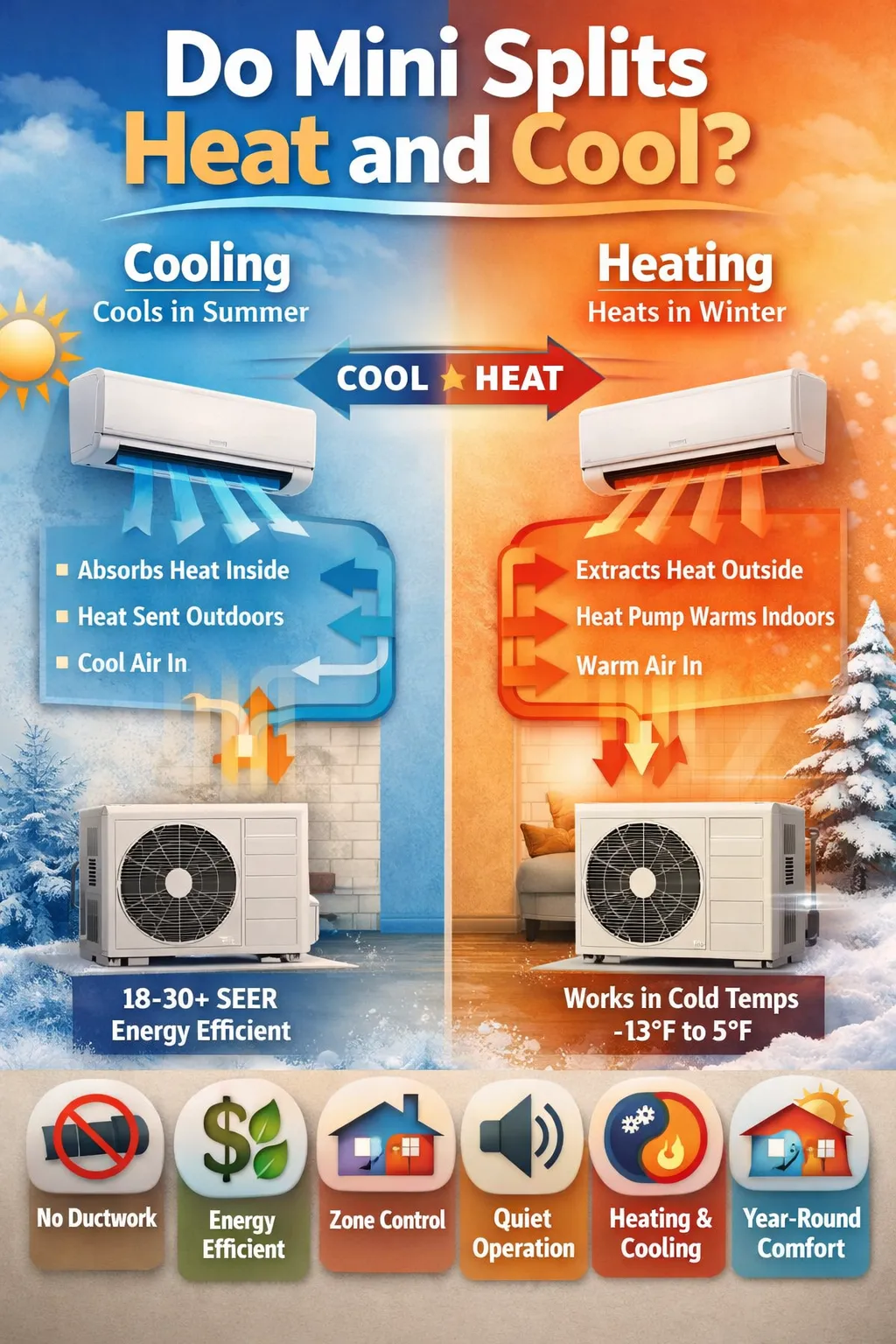

Short answer: yes — almost every residential mini split sold in North America heats and cools. The longer answer is that "mini split" is a form factor, not a function. Some mini splits are cooling-only air conditioners, and some are heat pumps that reverse the refrigerant cycle to do both. The label on the box, not the shape of the indoor head, tells you which one you've got.
If you're shopping in the U.S. or Canada, the unit you're looking at is almost certainly a heat pump. Cooling-only mini splits exist, but they're rare on the consumer market because the engineering cost of adding heating mode is small, and most homeowners want one piece of equipment instead of two. The single sentence to remember: a mini split heat pump uses the same refrigerant loop to move heat in either direction, and that's why one box can replace both your furnace and your AC.
What You're Actually Getting
A mini split system has two pieces of hardware and a small bundle of copper, drain line, and signal wire connecting them. The outdoor unit (the "condenser") houses the compressor, the outdoor coil, the reversing valve, and the inverter board. The indoor unit ("air handler" or "head") houses a smaller coil and a quiet variable-speed fan. Refrigerant moves between the two through a pair of insulated copper lines — typically 1/4" liquid and 3/8" or 1/2" suction — that can run 25 to 50 feet without any noticeable performance loss.
In cooling mode, refrigerant arrives at the indoor coil cold and low-pressure. The fan blows your room air over the coil, the refrigerant absorbs heat (and condenses moisture out of the air, which drains away), and the now-warm refrigerant goes back outside, gets compressed, and dumps that heat to the outdoor air. In heating mode the reversing valve flips the flow direction, so the outdoor coil becomes the absorber and the indoor coil becomes the radiator. Same machine, same refrigerant, opposite direction.
Because there's no ductwork, you skip two of the biggest losses in a traditional HVAC system: the 20–30% of conditioned air that leaks out of duct joints and the heat that conducts through duct walls in unconditioned attics and crawlspaces. That's the structural reason mini splits are roughly 30% more efficient than central systems with comparable nameplate ratings.
This makes mini splits a strong fit for older homes without existing ductwork, garage conversions, room additions, attic conversions, and ADUs. Running ductwork in a finished home can run $5,000–$15,000 by itself before you even get to equipment. A ductless wall-mounted mini split sidesteps that entirely. They also shine in homes with one room that's always too hot or too cold despite the central system running — adding a single zone to that problem space is usually the cheapest fix. Not sure what size you need? Run the mini split sizing calculator before you shop.
How the Refrigerant Cycle Actually Heats Your House
People understand cooling intuitively — refrigerant blows cold air, hot air goes outside, easy. Heating with the same machine is where the skepticism creeps in. How can a unit pull heat out of 20°F air and use it to warm a 70°F room?
The trick is that refrigerant boils at a much lower temperature than water. R-410A, the refrigerant in most current mini splits, boils at roughly -55°F at atmospheric pressure. R-32, which is replacing R-410A in newer systems, is similar. That means even when it's freezing outside, outdoor air is "hot" relative to liquid refrigerant — heat naturally flows from the warmer air into the colder refrigerant, vaporizing it.
The compressor then squeezes that vapor up to a much higher pressure, which raises its temperature to 150–200°F. The hot, high-pressure refrigerant gas flows to the indoor coil, your room air blows over it, and the refrigerant condenses back to liquid as it dumps heat into the room. The liquid passes through an expansion valve that drops its pressure and temperature back down, and the cycle starts over.
The pressure-temperature relationship is the part that confuses people. A useful analogy: water boils at 212°F at sea level but only 202°F at 5,000 feet (Denver, Salt Lake City) because air pressure is lower. Refrigerant works the same way — change the pressure and you change the boiling point. The compressor and expansion valve are just two ends of a pressure cycle that repositions the boiling point of refrigerant relative to the air on each side of the coil.
When you set the thermostat to "heat," the reversing valve flips and the cycle runs the other direction: the indoor coil now holds high-pressure hot refrigerant, the outdoor coil holds low-pressure cold refrigerant, and heat flows from outside to inside. No combustion, no resistance heating, just a pressure cycle moving thermal energy uphill.
Cold Climate Performance: Where the Limits Really Are
Heat pumps don't fail in cold weather — they lose capacity. As outdoor air gets colder, it holds less recoverable heat per cubic foot, and the compressor has to work harder to lift refrigerant temperature high enough to be useful indoors. Capacity falls along a curve.
A typical 12,000 BTU standard mini split rated at 47°F outdoor temperature will deliver roughly:
- 12,000 BTU at 47°F (full nameplate)
- 9,500 BTU at 17°F
- 7,000 BTU at 5°F
- Cuts off entirely between -5°F and 5°F
Cold-climate models — sometimes branded "hyper-heat," "Heat 2.0," or "low-ambient" — use enhanced vapor injection, larger compressors, and higher refrigerant charge to push the capacity curve out. A modern cold-climate mini split typically delivers:
- 100% capacity at 5°F (instead of 60–70% for a standard model)
- 75–80% capacity at -13°F
- Operation continues to -22°F on premium models
The practical implication: in Minneapolis, Burlington, or Denver, a standard mini split alone is undersized for January. Either oversize a cold-climate model so it covers your design temperature, or run the heat pump as primary and keep an existing gas furnace as backup for the 5–15 coldest days a year (a setup called dual fuel). For deeper detail on this, see our cold-climate heat pump guide. Cold-climate units typically cost 20–30% more than standard units up front, but in northern climates the runtime savings recover that premium in 2–4 winters.
For most of North America — anywhere south of roughly the Great Lakes line — a standard mini split heat pump handles 100% of the heating load on its own. No backup, no resistance heat, no furnace.
Efficiency Numbers That Actually Matter
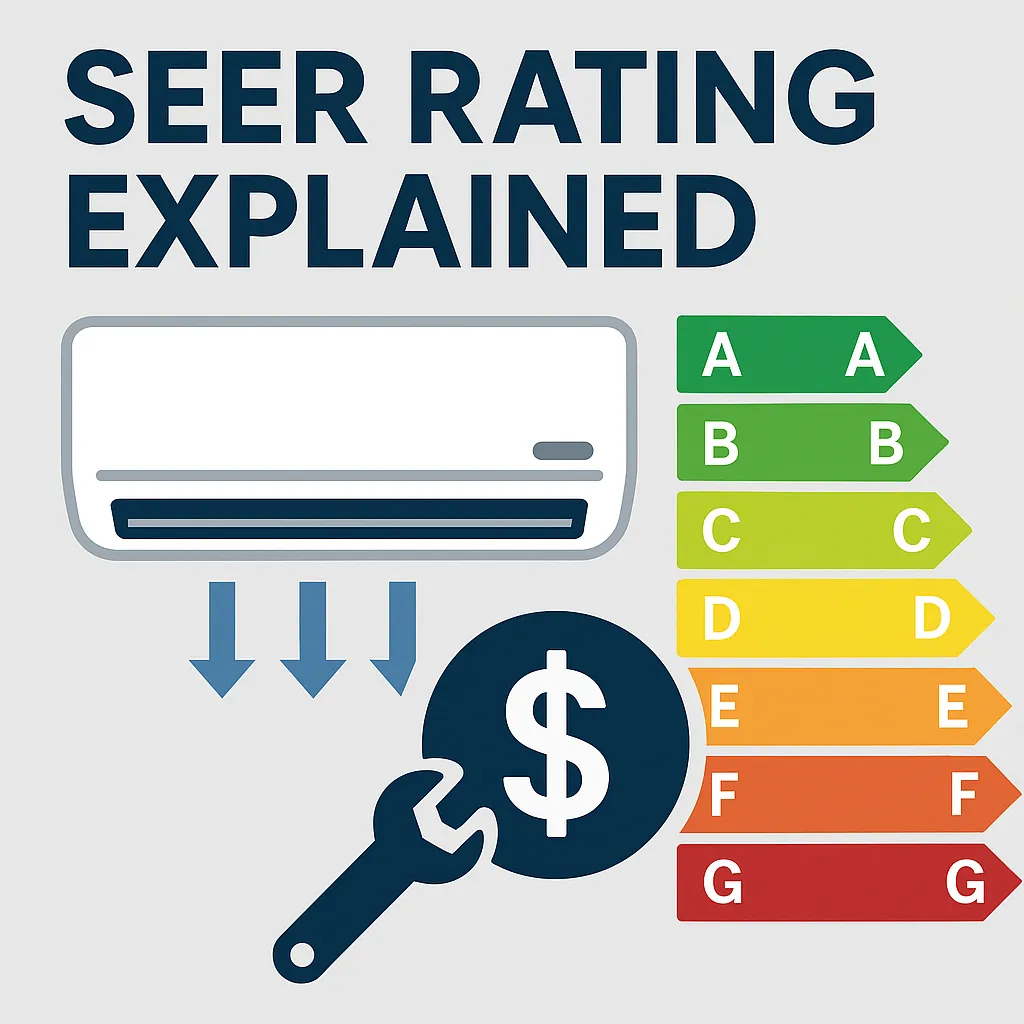
Two ratings tell you what a mini split will cost to run: SEER2 (cooling) and HSPF2 (heating). Both are seasonal averages, both replaced the older SEER and HSPF standards in 2023, and both are roughly 4–5% lower than the old numbers for the same equipment because the new test methodology assumes more realistic duct losses and thermostat behavior.
A typical decent mini split today rates around 20 SEER2 / 10 HSPF2. Premium and Zone Air systems hit 24+ SEER2 / 11+ HSPF2. For comparison, a 10-year-old central AC sits around 13 SEER2-equivalent, and a typical gas furnace runs at 80–95% AFUE. The HSPF2 number is especially important if you're considering replacing a furnace — 10 HSPF2 means the heat pump produces about 2.93 BTU of heat for every BTU of electricity it consumes, or roughly 293% efficiency. Resistance heating (electric baseboards, electric furnaces) tops out at 100%. Combustion heating tops out at 95–98%. The heat pump wins by 3x.
The other efficiency advantage isn't on the spec sheet: ducts. Most homes have central system ducts running through attics, crawlspaces, or unconditioned chases, where they leak conditioned air and conduct heat through their walls. Energy Star estimates 20–30% of the energy a central system produces is lost in the duct network before it reaches the room. A mini split's refrigerant lines are insulated copper inside a sealed jacket — the loss between outdoor unit and indoor head is under 3%. That's why a 20 SEER2 mini split typically beats a 20 SEER2 central system in real-world utility bills, even though the lab numbers are identical.
What About the Downsides?
Three honest tradeoffs:
Upfront cost. A mini split installed by a contractor will usually cost more than a comparably sized central AC tied to an existing furnace. The gap closes (and often reverses) once you factor in ductwork, but if you already have ducts, central will look cheaper at the quote stage. The DIY route changes the math considerably — a pre-charged DIY single-zone system costs $1,500–$2,500 installed by the homeowner, vs. $4,500–$6,500 for a contractor-installed equivalent. Saving $1,500–$3,500 takes a weekend; here's how the DIY install actually goes.
Aesthetic. The indoor head is visible. Wall-mounted heads have come a long way (modern units are slim, white, and quiet), but they're still appliances on the wall. If that bothers you, ceiling cassettes or concealed ducted air handlers tuck into the ceiling and look much cleaner — at higher cost.
Multiple zones means multiple heads. A 2,400 sq ft house typically needs 3–5 zones for even comfort, which means 3–5 indoor heads. A multi-zone system shares one outdoor unit but runs separate refrigerant lines to each head. If one indoor head matters more than the others (master bedroom, living room), confirm the system supports independent setpoints — not all do.
For a deeper comparison vs. the alternatives, see mini split vs central air or mini split vs window AC.
Bottom Line
If you're asking "do mini splits heat and cool?" — almost every model sold in North America does both, and the same hardware that cools your living room in July reverses direction to heat it in January. They're significantly more efficient than central systems for the same comfort, especially in homes that don't already have well-sealed ductwork. The cold-climate limits are real but well-defined: standard models work down to about 5°F, cold-climate models down to -13°F, and premium units down to -22°F. Match the model to your design temperature and you're done.
Next steps: Calculate the BTU you need → browse single-zone heat pump systems or multi-zone bundles → read the install guide if you're going DIY, or find a vetted installer if you're not.
Related guides: