
Mini Split Sizing Calculator: HVAC BTU Load Calculator
A mini split sizing calculator for calculating BTU load for a room or whole home. A free and easy way to size a ductless mini split system.
Last updated · ACCA Manual J 8th Edition methodology
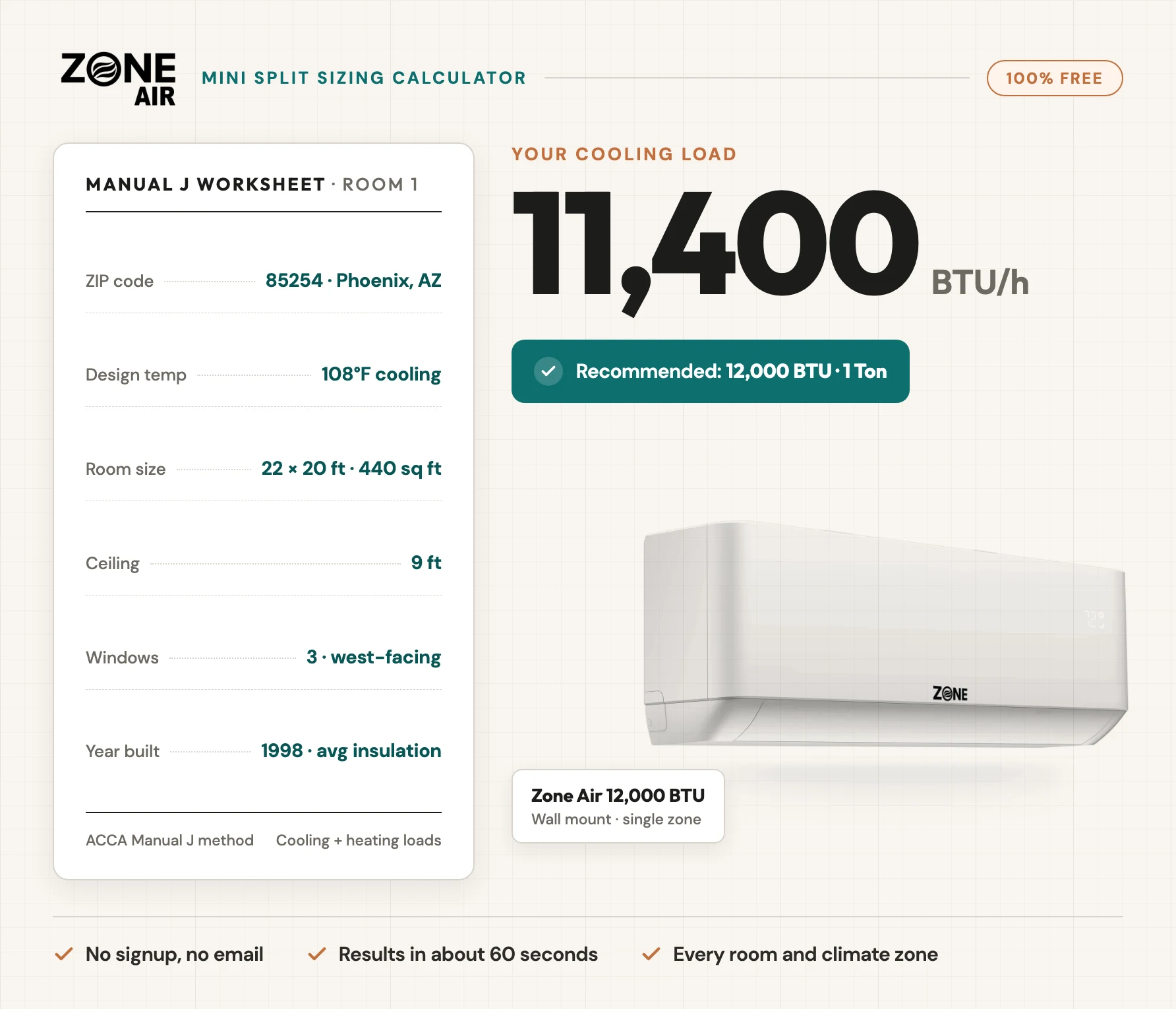
How the Mini Split Sizing Calculator Works
This is a BTU load calculator for ductless mini splits. It starts from your room's square footage, then adjusts that baseline with the same factors an ACCA Manual J 8th Edition load calculation applies — outdoor design temperature for your ZIP, ceiling height and volume, glass and doors, air leakage, ventilation, and internal gains. Everything runs in your browser: no account, no email, nothing to download.
- Pick Basic or Pro. Basic asks for the essentials and fills in Manual J defaults for the rest. Pro exposes year built, window type, shading, duct location, wind shielding, exact dimensions, and per-window detail.
- Choose your scope. Room(s) for one space or a few; Whole Home to size a multi-zone system floor by floor.
- Enter your ZIP and the room. The ZIP resolves your outdoor design temperature and climate, which is why the same 400 sq ft bedroom returns different answers in Phoenix and Portland.
- Read the result. You get a BTU/h load per room, the load breakdown behind it, and the Zone Air systems that match — single zone for one room, multi zone for several.
For multi-room projects the calculator keeps each room separate and totals them, so you can size the outdoor condenser. Size that condenser to the simultaneous peak rather than the raw sum — bedrooms and living rooms rarely peak in the same hour, which is why a 36,000 BTU three-zone system can comfortably serve rooms that add up to more than 36,000 BTU on paper.
Read it as a planning number, not a stamped design. Rooms with wall-to-wall glass, cathedral ceilings, or unusual internal loads need a common-sense check on top of the calculator, or a professional Manual J.
Mini Split Sizing FAQ
What size mini split do I need for my room?
Most rooms land between 20 and 25 BTU per square foot, so a 400 sq ft room usually needs 9,000–12,000 BTU and a 600 sq ft room around 18,000 BTU. Ceiling height, insulation, sun exposure, climate zone, and window count all move that number, which is why the calculator asks for them instead of using a flat multiplier. Run it above for a figure based on your actual room, then shop 9,000 BTU, 12,000 BTU, or 18,000 BTU systems in the matching size class.
How accurate is this BTU calculator?
It uses the same ACCA Manual J 8th Edition methodology professional load software uses, and for most residential rooms it lands within 10–15% of a paid in-home assessment — accurate enough for DIY installs, room additions, and single-room jobs. For a whole-home replacement, a heavily glazed great room, or mixed construction, a stamped professional Manual J is still worth the $150–$300.
Can I size a mini split from square footage alone?
Square footage gets you a starting point, but it can be off by 30–50% in either direction. A 500 sq ft room with poor insulation and west-facing glass might need 18,000 BTU, while a well-insulated 500 sq ft room with one north window needs 9,000. Insulation, climate zone, ceiling height, and sun exposure all bend the answer, which is what the calculator accounts for.
Should I round up or down between sizes?
For an inverter-driven mini split — every Zone Air system — pick the size closest to your calculated load. Inverter heads modulate from roughly 40–115% of rated capacity, so a 12,000 BTU unit really covers about 4,800–13,800 BTU as conditions change through the day. With a single-speed air conditioner you would stay within 15% and lean under rather than over.
What happens if a mini split is oversized?
It short-cycles. An oversized head drives the room to setpoint, shuts off, and restarts a few minutes later, never running long enough to pull humidity out of the air — so the room reads the right temperature but feels clammy. Short cycling also wears the compressor out years before its rated life. Oversizing is the most common mistake in DIY sizing.
Should I size for the whole home or each room?
Start at the room level. Each indoor head serves one room or one connected open area, so the load calculation is per zone rather than whole-house. For a multi-zone project, run each room, then size the outdoor unit to the simultaneous peak rather than the raw sum — bedrooms and living rooms rarely peak in the same hour. Use the Whole Home scope above to do that in one pass.
What if I don't know my insulation or window details?
Basic mode fills in Manual J defaults for everything it does not ask about, so you still get a usable number from a ZIP code and a room size. Switch to Pro when you can supply real values — year built, window type, shading, duct location — and the estimate tightens. If you only verify one thing, verify ceiling height: it is the easiest input to misjudge from the floor and one of the most impactful on the result.
Do I need a professional load calculation for a DIY install?
For a single room or a straightforward addition, this calculator gives you what you need without paying $150–$300 for an in-home Manual J. For whole-home replacements, complex multi-zone layouts, or homes with vaulted ceilings, large banks of glass, or mixed construction, pay for the professional calculation. Paired with the DIY installation guide, the calculator covers most homeowner jobs.
Related Mini Split Sizing Resources
Best DIY Mini Splits, Compared
Once you know your BTU load, see how the top DIY mini split systems stack up
Browse Mini Splits by Size
Shop 9,000, 12,000, and 18,000 BTU Zone Air heat pumps
Mini-Split Installation Cost Guide
Complete pricing breakdown for DIY vs professional installation
DIY Installation Guide
Step-by-step instructions for installing your mini-split
DIY Mini Splits Explained
What pre-charged, no-vacuum-pump systems are and what they cost to install
What Size Mini Split Do I Need?
What goes into a BTU number, and how the multipliers stack
Free Manual J Load Calculator
The ACCA methodology this calculator runs on, explained
Mini Split Sizing Calculator
The standalone version of this tool — bookmark it or share it without the rest of the shop
Sizing a Garage Mini Split
Uninsulated slabs and roll-up doors change the load — here's how
2026 Rebates by State
HOMES, HEAR, and utility incentives that stack on a heat pump install