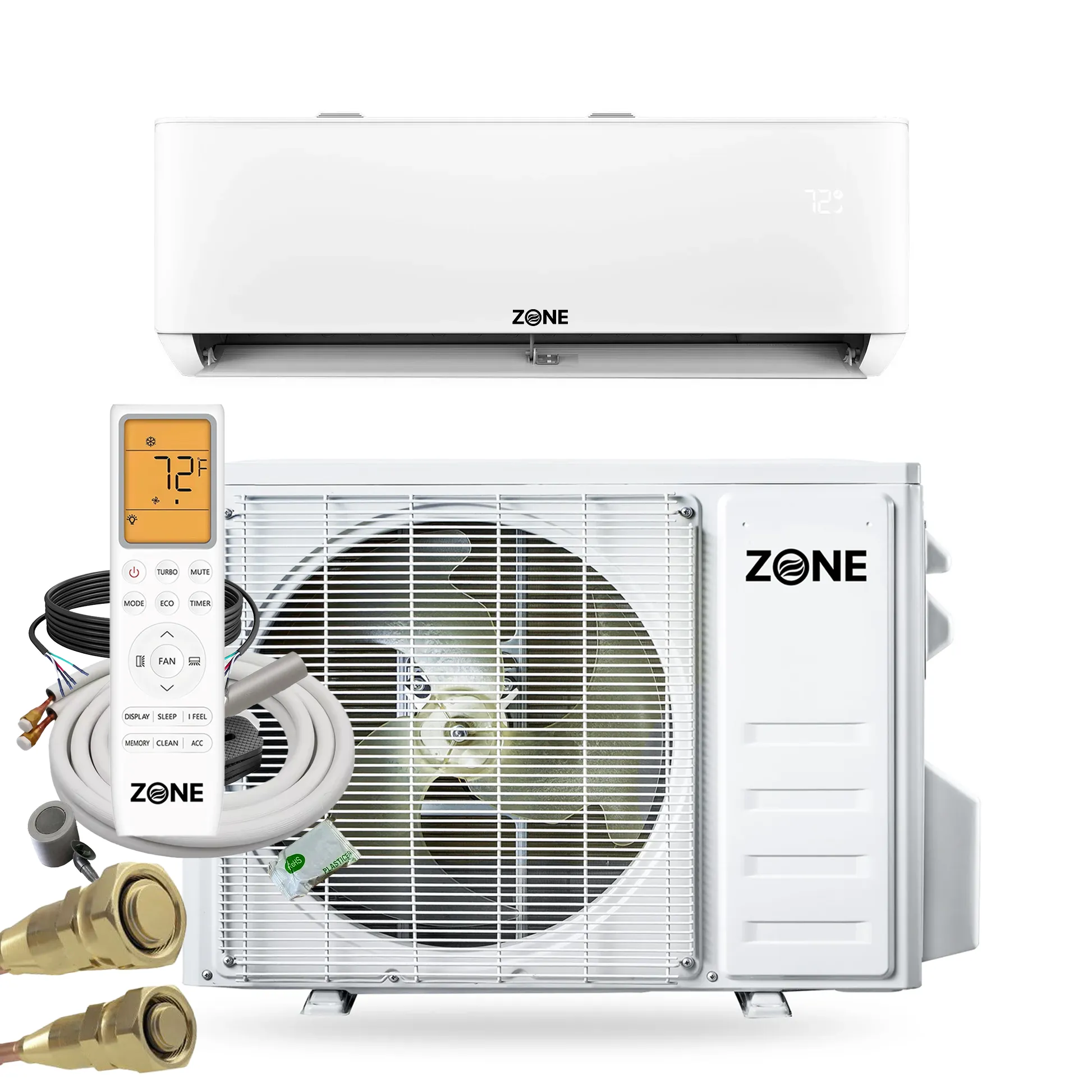

"They predicted disaster" Robert told us after his Vermont neighbors found out he replaced oil heat with a Zone Air heat pump. The question behind their fears: "Do heat pumps work in freezing temperatures?"
New cold-climate heat pumps can reliably heat down to -13°F. Robert told us his Zone Air 18k BTU unit heated 1,800 sq ft to 68°F, and cost $285 vs. $520 for oil. Savings: $235/month ($2,820/year). Payback: Under 2 years on $5,400 system.
Key: Standard heat pumps can fail below 15-20°F. True cold-climate models (like Zone Air) work to -13°F with EVI tech.
Cold Climate Heat Pumps: How the Technology Works
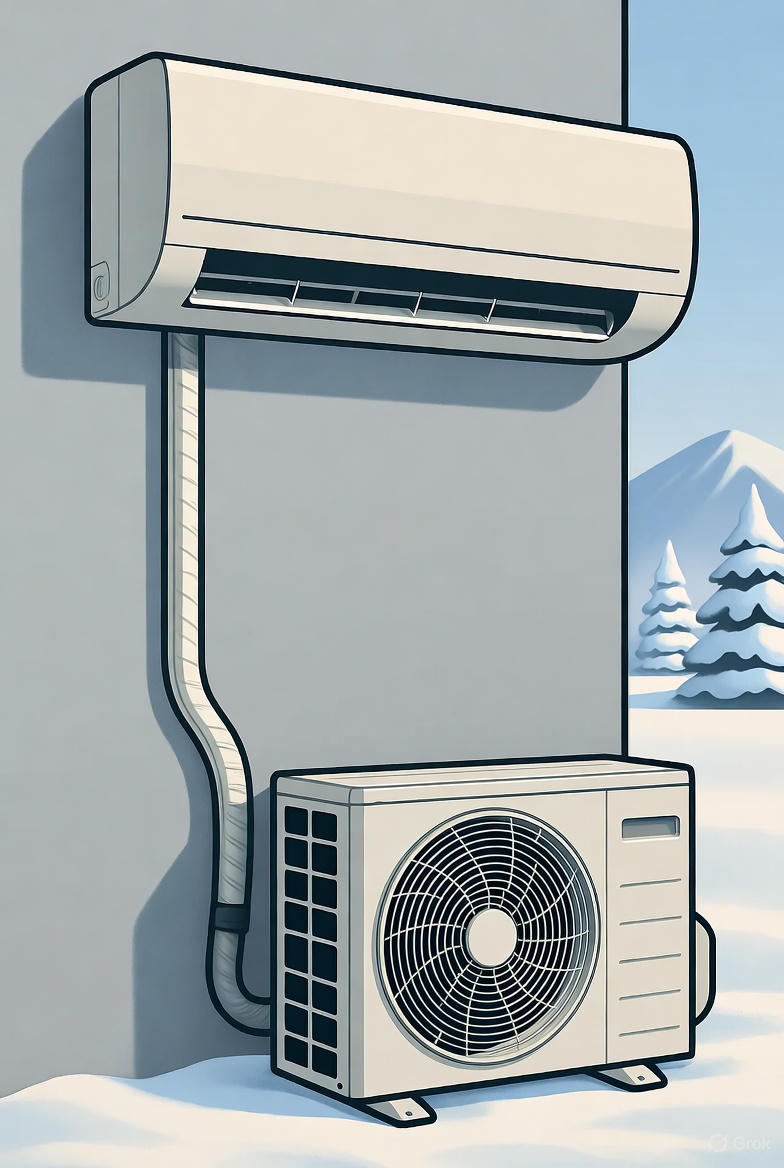
Heat pumps and mini splits move air across copper coils. Both indoor and outdoor units have these coils. Inside the copper coil is refrigerant. When your unit is in operation, that refrigerant is constantly flowing through copper lines. The refrigerant is the medium through which the energy (heat or lack of heat) can travel.
When you cool your home, you are heating the outdoors, and when you heat your home, you are cooling the outdoors. When your air conditioner is in heating mode, air from inside your house blows over the indoor coils. Heat is transferred to the air, but in turn, the refrigerant loses that heat. In other words, energy is traded between the air in the room, and the refrigerant.
You might wonder, how can we heat up air in the freezing cold outside to then heat our homes? Well, air contains heat until -460°F absolute zero. So theoretically, you could even get heat out of air that is -460°F!
Although your unit can get heat out of cold air, there are some tradeoffs. As temperatures get increasingly more extreme, both hot and cold outside, air conditioners will become less efficient.
12K BTU capacity at different temps:
- 47°F: 12,000-13,000 BTU (100%)
- 17°F: 10,000-11,000 BTU (85%)
- 5°F: 8,500-10,000 BTU (75%)
- -13°F: 5,500-7,500 BTU (55%)
Critical: Size (capacity) should be based at YOUR design temperature, not rated BTU. Rated BTU always gives you the best case scenario, and not real world numbers.
Operating Ranges & Efficiency
Heat Pump Types:
- Standard: Operates to 15°F — Best for Southern US, mild winters
- Cold Climate: Operates to -13°F — Best for Mid-Atlantic, Midwest (Zone Air systems)
- Hyper-Heat: Operates to -22°F — Best for Northeast, Mountains (premium)
COP (Coefficient of Performance): Higher = more efficient. Electric resistance = 1.0 COP.
Cold Climate Heat Pump COP by Temperature:
- 47°F: 3.8-4.5 COP
- 17°F: 2.8-3.5 COP
- 5°F: 2.2-2.8 COP
- -13°F: 1.5-2.0 COP (standard units shut down)
Even at -13°F, cold climate heat pumps are 50-100% more efficient than electric baseboard heat.
Best Heat Pump for Cold Weather: 2025 Models
Best Warranty: Mitsubishi Hyper-Heat | -13°F | $2,500-4,000
Best Value: Zone Air DIY | -13°F | $1,800-2,400
Best Budget: Pioneer WYS | 5°F | $1,200-1,600
Warning: Budget models (<$1,600) often fail below 20°F. Not true cold climate systems.
Sizing for Cold Climates
Critical: Size based on heating capacity at YOUR design temperature, not rated BTU, and not cooling capacity.
Example: 12K BTU unit delivers 12,000 BTU at 47°F but only 8,500-10,000 BTU at 5°F.
3-Step Sizing:
- Find design temperature (coldest 1% of winter): Boston 9°F, Minneapolis -12°F, Denver 0°F
- Calculate heat loss at design temp using load calculator
- Check capacity at YOUR design temp (not rated BTU)
Example: 1,000 sq ft needs 18,000 BTU at 0°F
- Zone Air 18K at 0°F: 14,500 BTU ❌ Too small
- Zone Air 24K at 0°F: 19,500 BTU ✅ Sufficient
Backup Heat: Needed if design temp below -13°F or poor insulation. Options: electric baseboard, existing furnace (set 3-5°F lower), or dual-fuel auto-switchover.
Winter Tips
Do:
- Keep temp 68-70°F consistently (avoid setbacks >3°F)
- Use AUTO fan mode
- Set backup heat 3-5°F lower than heat pump
- Clear snow 6" from outdoor unit
- Mount unit 6-12" above snow line
Don't:
- Constantly adjust temperature (wastes energy)
- Turn off at night (recovery wastes more)
- Block units (reduces capacity)
- Cover outdoor unit (causes failure)
- Interfere with defrost cycles (2-10 min every 30-90 min is normal)
Some ice on the outdoor unit is normal. It shouldn't be a problem if outdoor temperature is within the listed operating temperature.
Heating Cost Comparison
2,000 sq ft home, Boston MA (40M BTU/year):
- Cold Climate Heat Pump: $670/year
- Natural Gas: $610/year (-$60 vs heat pump)
- Propane: $1,390/year (+$720 vs heat pump)
- Heating Oil: $1,360/year (+$690 vs heat pump)
- Electric Baseboard: $1,875/year (+$1,205 vs heat pump)
Payback Example:
- Equipment + install: $4,500
- vs propane savings: $720/year
- Payback: 6.2 years (3.5 years with $2,000 tax credit)
Tax Credits & Rebates 2025
Federal: 30% of equipment + install, max $2,000/year (2023-2032)
- Requires: SEER2 ≥16, HSPF2 ≥8.5
State Rebates:
- MA: $10,000 | NY: $12,000 | VT: $5,000 | ME: $8,000 | CO: $5,000
Example (MA): $4,500 system → $1,350 federal → $3,000 state = $150 out-of-pocket
Check dsireusa.org for your state.
Why Zone Air
Performance: -13°F operation, 80% capacity at 5°F, COP 2.2-2.5
Value: $1,800-2,400 (saves $800-1,200 vs Mitsubishi/Fujitsu)
Support: 7-year compressor and 5-year parts warranty, 24/7 tech support, DIY-friendly
Real Results (Minneapolis): Zone Air 18K heated 1,200 sq ft down to -18°F
- Cost: $84/month vs $310 propane
- Savings: $226/month ($1,356/season)
- Backup heat used only 3% of hours (below -10°F)
View Zone Air Cold Climate Systems
Frequently Asked Questions
Will a heat pump really work when it's -10°F outside?
Yes. Zone Air cold climate systems maintain 60-70% capacity at -10°F. A 36K BTU system delivers 21,600-25,200 BTU at -10°F. Key: size for YOUR design temp, not rated BTU. Standard heat pumps fail below 15-20°F, but cold climate models (EVI tech) work to -13°F (Zone Air) or -22°F (premium).
How much does it cost to heat with a cold climate heat pump vs. oil or propane?
50-70% less. Vermont home: 800 gal oil at $3.50 = $2,800/year. Same home with heat pump at $0.18/kWh = $900-1,400. Saves $1,400-1,900/year.
Do I need backup heat with a cold climate heat pump?
Only if design temp below -10°F or poor insulation. Backup runs 5-15 nights/winter (10% of heating). Size heat pump for 90-95% of needs.
What's the difference between standard and cold climate heat pumps?
Cold climate models have Enhanced Vapor Injection (EVI), larger coils, variable-speed compressors. Operate to -13°F vs 15-20°F for standard. At 5°F: cold climate maintains 70-85% vs 40-55% for standard.
Can heat pumps provide emergency heat during power outages?
No—require electricity. Use generator, wood stove, or battery backup. (Gas/oil furnaces also need electricity for blowers.)
Which cold climate heat pump brand is best value?
Zone Air: $1,800-2,400, -13°F operation, 7-year compressor warranty. Mitsubishi Hyper-Heat: $2,500-4,000, premium performance. Zone Air saves $800-1,200 upfront with same core tech.
The Bottom Line
Yes, heat pumps absolutely work in freezing temperatures—the technology has come a long way. Cold climate heat pumps save 50-75% vs propane/oil/electric, work efficiently to -13°F (Zone Air) or -22°F (premium), and deliver heating + cooling in one system.
Success factors: Choose true cold climate model, size for YOUR design temp, add backup if needed, maintain properly, keep temp consistent.
Ready to save?
- Calculate your heat load with our calculator
- Review Zone Air's cold climate systems
- Call (801) 882-2324 for sizing assistance
- Check available rebates and tax credits
Related Articles: