Install Your Own Mini Split & Save $3,000+
A DIY mini split installation puts professional-grade heating and cooling in your hands for a fraction of the cost. With a pre-charged Zone Air kit, you skip the contractor markup, avoid HVAC licensing requirements, and finish the project in a single weekend using basic tools you likely already own.

A DIY Kit for Homeowners Without HVAC Experience
If you have priced out a professional mini split installation recently, you already know the frustration. Traditional HVAC installs can run $4,500 to $8,000 or more per zone once you add equipment, labor, permits, refrigerant handling, and EPA-certified technicians — before the contractor markup.
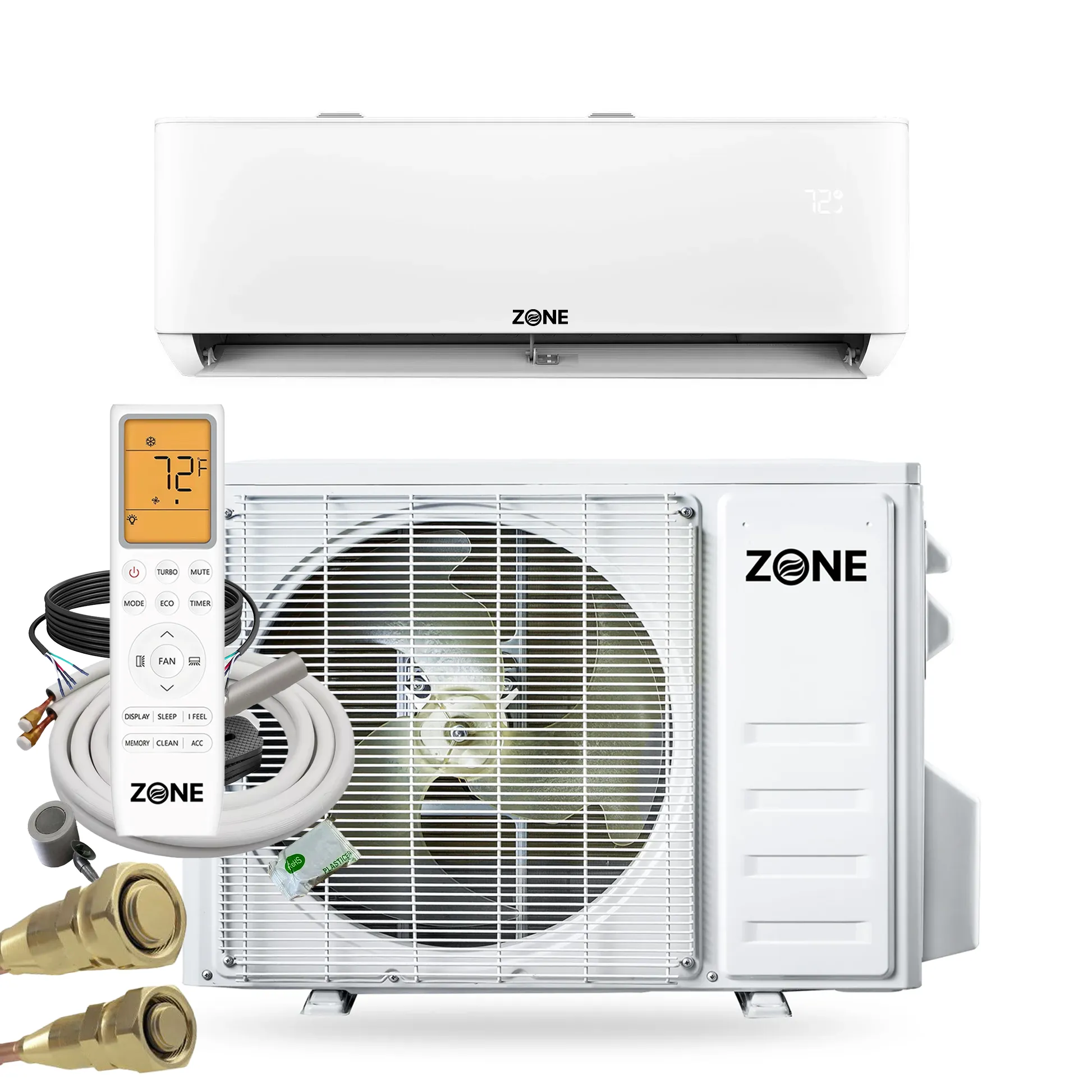
Zone Air DIY kits were built to remove that cost barrier. Everything needed comes in the box: the indoor unit, outdoor condenser, pre-charged refrigerant lines, mounting hardware, electrical components, and detailed step-by-step instructions. No specialized training, no vacuum pump, no flaring copper, no HVAC license.
The Cost Difference, Visualized
Same equipment, same comfort — the gap is almost entirely contractor labor you can skip.
DIY figure reflects a single-zone kit plus an electrician for the dedicated circuit; professional range includes equipment, labor, and permits.
Efficiency That Shows Up on Your Bill
SEER2 measures cooling efficiency — higher is better. Zone Air units reach up to 24 SEER2.
What Makes a Zone Air DIY Kit Different
Five design choices turn a job that used to require a licensed contractor into a weekend project.
Pre-charged refrigerant lines
The sealed line set arrives factory-filled with R-454B. You connect, you do not charge — no vacuum pump, no gauges, no EPA license. That alone saves the $400–$1,800 a vacuum pump and gauge set would cost.
Everything in one box
Indoor unit, outdoor condenser, pre-charged line set, mounting brackets, control wiring, condensate drain hose, hardware, and step-by-step instructions. No surprise trips to the hardware store.
Up to 24 SEER2 efficiency
Higher SEER2 means lower monthly bills. A unit at 24 SEER2 is far more efficient than a typical 13-SEER system, and Zone Air units hold that efficiency in real-world conditions.
Quick-connect fittings
Instead of brazing or flaring copper, you hand-tighten and torque pre-fitted connections to spec — a secure, leak-proof seal without professional-level skills.
45-day satisfaction guarantee
If the system does not meet your expectations during setup or early use, you are covered — which takes the risk out of tackling the install yourself.
How DIY Mini Split Installation Works
The whole job breaks into three clear steps. Most first-timers complete a single-zone system in 6–8 hours — a manageable weekend project that saves $3,000–$5,000 versus hiring out.
Plan and mount the units
Choose locations for both units. The indoor head mounts high on an interior wall (about 7–8 ft up) on the included brackets for good airflow; the outdoor condenser sits on a level pad or wall bracket with clearance for airflow — and, in northern regions, above the snow line. Mounting on the east or north side keeps the condenser out of harsh afternoon sun. Verify your BTU sizing for the room and climate first, then drill the 2–3" wall pass-through (3.5" on some larger line sets). Safety glasses and gloves recommended.
Connect the refrigerant and electrical lines
Route the pre-charged line set through the wall to the condenser, keeping a slight downward slope and gentle bends (12" minimum radius — never kink the copper). Torque the quick-connect fittings to spec on both units; hand-tight is not enough and over-tightening damages the fitting. For power, 9K–12K units may run on a 115V circuit, while units above 12,000 BTU usually need a dedicated 208/240V circuit. Check your panel capacity and local codes — some jurisdictions require a licensed electrician for the circuit, but the HVAC work stays fully DIY.
Test and commission the system
Open the service valves on the outdoor unit to release the pre-charged refrigerant, then power up and run both heating and cooling. Check every connection with a soap-and-water solution — bubbles mean re-torque. Confirm the indoor unit drains condensate (slight tilt toward the drain) and that airflow is unobstructed. Install the filters, set up the WiFi controls, and add line-set covers for a clean, weather-protected exterior.
Want the full walkthrough with torque specs and drill angles? See the step-by-step install guide, or the line-by-line installation cost breakdown.
What You Get with Zone Air
A complete system and a support structure built around a successful homeowner install — everything in one box, nothing to source separately.
Complete kits, standard household tools
Every bracket, fitting, and component ships together. You need a drill, wrench, level, and screwdrivers — standard tools, not specialized HVAC equipment.
Pre-charged linesets, extendable to 25 ft
A 16 ft pre-charged R-454B line set is standard, and a pre-charged extension takes your total reach to 25 ft — flexible placement without ever flaring copper or handling refrigerant.
Energy Star + cold-climate rated
Energy Star models meet strict performance requirements, including verified heating output in the cold. Zone Air cold-climate units keep heating efficiently down to −13°F.
US-based support through your project
Installation videos, detailed written instructions, and US-based technical support (9–5 MST) are there from planning your layout through powering it on.
See how Zone Air lines up against other DIY brands in the full Zone Air vs MrCool comparison.
What a DIY Install Typically Looks Like
Representative examples of the cost, speed, and efficiency homeowners see — your results depend on your space, climate, and electrical setup.
Roughly half the cost of going pro
Where a contractor quote lands around $6,800 for a single zone, a DIY build with a Zone Air single-zone kit typically comes in near $2,100–$2,400 total — including hiring an electrician for the dedicated circuit. DIY installs commonly save $3,000–$5,000 versus a contractor.
A weekend garage-workshop upgrade
Adding year-round climate control to an unheated ~400 sq ft workshop is a realistic Saturday-afternoon project — no prior HVAC experience needed, just the included instructions and basic tools.
Lower bills than baseboard or window units
Replacing electric resistance heat or window ACs with an efficient mini split heat pump meaningfully cuts seasonal energy use, especially for the specific rooms you actually live in.
Who DIY Mini Split Installation Is For
Homeowners with basic DIY skills
If you can drill a hole in a wall and follow instructions, you can upgrade heating and cooling without the $4,500+ contractor price tag.
Adding comfort to specific spaces
Garages, workshops, additions, finished basements, or ADUs — anywhere extending ductwork is impractical. A ductless mini split gives you zoned control exactly where you need it.
Budget-conscious, professional-grade results
Equipment runs roughly $1,899–$3,999, versus $4,500–$8,000+ for a traditional contractor install. The cost advantage is clear.
Cold-climate residents
Northern homeowners get cold-climate heat-pump performance rated down to −13°F, replacing inefficient baseboard heat in the rooms that matter most.
Zone Air DIY System Options
The right size and configuration depends on your space, climate, and how many rooms you want to control. Single-zone systems start at $1,899 with free shipping.
Single-zone systems — for individual rooms
Each ships with the indoor unit (wall-mount or ceiling-cassette options), outdoor condenser, pre-charged line set, and a complete install kit. Need more capacity? 24,000 BTU and up is available as a multi-zone bundle.
Multi-zone systems — for whole-home coverage
Two-zone
Two air handlers, one condenser — independent control in two rooms.
Three-zone
Ideal for open-concept areas or homes with distinct living spaces.
Multi-zone
Up to five separate areas — whole-home coverage without ductwork.
DIY Mini Split Installation FAQ
The questions homeowners ask most before their first install.
How long does DIY mini split installation take for a first-time installer?
Most first-time installers complete a single-zone setup in 6–8 hours: mount the units, connect the pre-charged lines, wire the electrical, and commission the system. Plan for a full Saturday and you will likely finish with time to spare. Repeat installs go faster.
Do I need special tools or HVAC experience to install a Zone Air system?
No HVAC experience required. You will need standard tools — a drill, level, wrench set, and screwdrivers — plus a torque wrench for the line-set fittings, and wire strippers and a multimeter for the electrical. You do not need a vacuum pump, refrigerant gauges, or flaring tools. Everything else comes in the box.
What if I make a mistake or need technical support?
Zone Air provides installation videos, detailed written instructions, and US-based technical support (9–5 MST). Check every connection with a soap-and-water solution as you go; if something needs adjustment, support can walk you through it. The 45-day satisfaction guarantee protects your purchase if the system does not meet expectations.
How does the warranty work on a DIY installation?
Zone Air offers a 7-year compressor warranty and 5-year parts warranty on DIY installs — no certified dealer required. Register your system within 90 days of purchase and follow the included instructions. Keeping documentation (photos of your install help) makes any future claim straightforward.
Can I add more zones later if my needs change?
Yes. Multi-zone outdoor condensers are designed to support expansion, so you can plan ahead, or simply add a separate single-zone system for another space later. Each zone operates independently with its own control.
What are the electrical requirements?
Smaller 9K and 12K BTU units may run on a standard 115V circuit. Units above 12,000 BTU typically need a dedicated 208/240V circuit. Check your panel capacity and local codes before starting; if you need a new dedicated circuit, budget roughly $200–$500 for an electrician — still far less than a full contractor install.
Start Your DIY Mini Split Installation
Every kit arrives complete: indoor unit, outdoor condenser, pre-charged line set, brackets, electrical components, drainage, and clear instructions. Save $3,000–$5,000 versus a contractor, get up to 24 SEER2 efficiency, and back it with a 45-day satisfaction guarantee and 5-year warranty. Free shipping on every order.