
DIY Ductless Air Conditioners: Assembled, Tested, and Inspected in the USA by Zone Air
A ductless air conditioner — also called a mini split AC system — cools your home by moving heat from inside to outside through refrigerant lines instead of ducts. Up to 25 SEER2 efficiency, indoor sound levels as low as 22 dB, and dehumidification that beats most central AC. This guide covers how mini split ACs cool, how to size one, what they cost, and how they compare to window and central AC.
Jump to the systems, or start with how mini split AC actually cools:
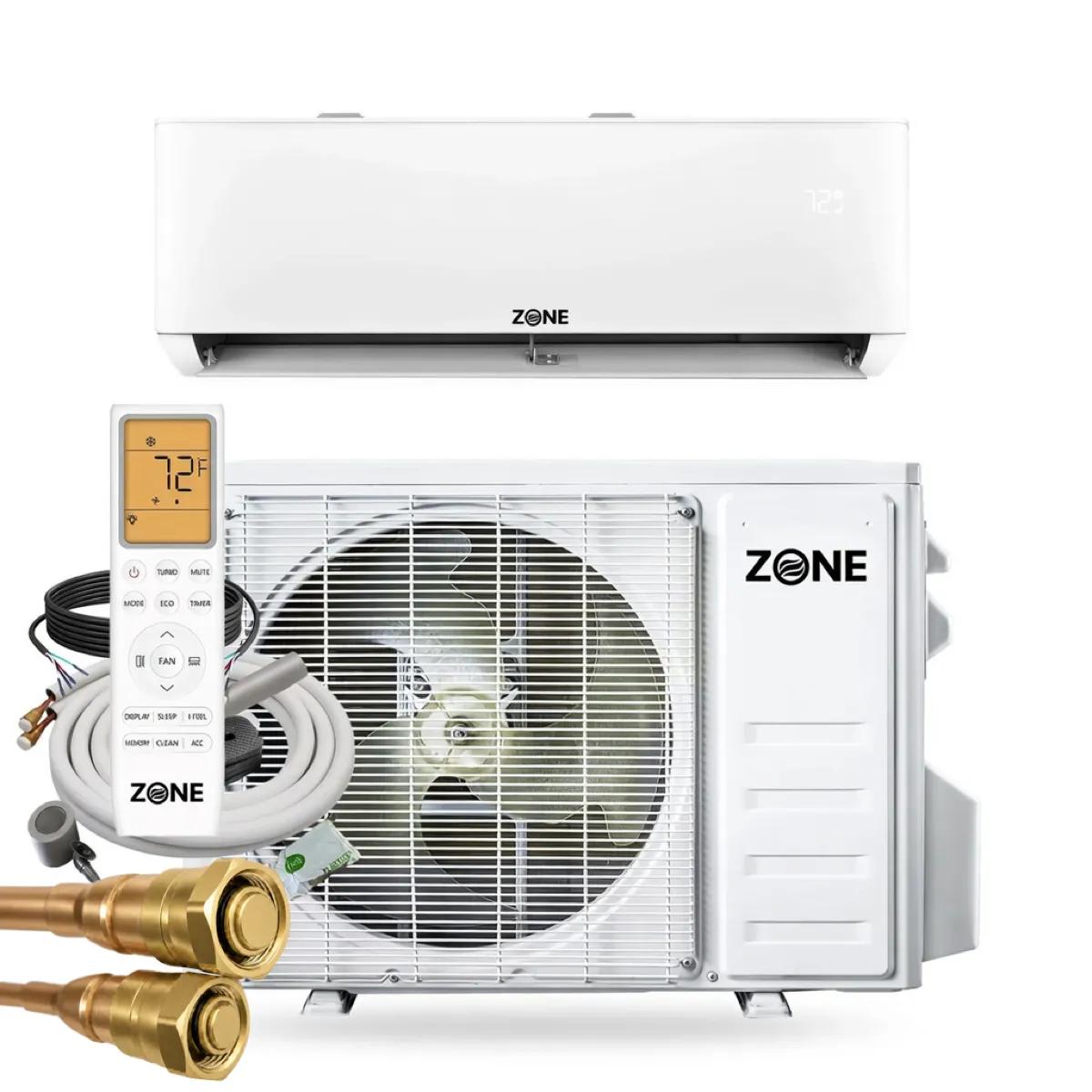
How a Ductless Mini Split AC System Cools
A ductless air conditioner uses the vapor-compression refrigeration cycle — the same physics as your fridge, scaled up for a room. A variable-speed inverter compressor in the outdoor unit pressurizes refrigerant (Zone Air uses R454B, the low-GWP replacement for R410A) and pushes it through copper lines into the indoor air handler. Inside the room, the refrigerant evaporates in the indoor coil, absorbing heat from the air being blown across it by the indoor blower. The cooled air is delivered into the room; the heat-laden refrigerant returns to the outdoor unit, condenses, and rejects that heat to the outside air. The cycle repeats continuously, modulating up and down to match the cooling load.
The reason mini split ACs reach 22–25 SEER2 while central AC tops out around 17 SEER2 comes down to two things. First, the inverter compressor modulates from roughly 25% to 100% capacity — running at partial load most of the day instead of cycling on and off. Continuous modulation eliminates the start-up energy spike that fixed-speed AC systems pay every cycle, and it keeps the indoor coil cold enough to dehumidify effectively. Second, there are no ducts. The U.S. Department of Energy estimates that duct losses account for 25–40% of cooling energy in a typical central-AC system — leakage at joints, conduction through hot attics, and pressure imbalances. Ductless ACs pay none of that penalty.
The four physical components
- Outdoor unit (condenser) — houses the inverter compressor, outdoor coil, condenser fan, and electrical controls. Sits on a ground pad or wall bracket within 50 ft of the indoor head.
- Indoor unit (air handler) — houses the indoor coil, blower fan, washable filter, and adjustable louvers. Mounts high on the wall, in a ceiling cassette, or hidden above a soffit.
- Refrigerant lineset — two insulated copper lines (suction and liquid) connecting the two units, plus a condensate drain that carries dehumidified water outside. Zone Air ships pre-charged R454B linesets in 16 ft and 25 ft lengths.
- Communication and power wiring — a 4-wire control cable lets the indoor and outdoor units coordinate compressor speed, fan speed, and thermostat input.
Ductless AC vs Window AC vs Central AC vs Portable AC
For cooling, four options dominate the residential market. The table below compares ductless mini split AC against the three most common alternatives. Numbers are typical ranges — exact values depend on capacity, climate, and installation quality.
| System | Cooling efficiency | Indoor noise | Installed cost (typical) | Best fit |
|---|---|---|---|---|
| Ductless mini split AC | 22–25 SEER2 | 22–32 dB | $1,900–$10,000 | Permanent install; quiet, efficient room or whole-home cooling |
| Window AC unit | 10–12 CEER | 50–60 dB | $200–$700 | Renters; single-room temporary cooling under $400 |
| Central AC (with ducts) | 14–17 SEER2 | 40–50 dB (registers) | $5,000–$10,000 | Whole-home cooling when ductwork already exists |
| Portable AC | 8–10 CEER | 50–65 dB | $300–$700 | Temporary use only — least efficient option |
The headline takeaway: against a window unit, a ductless AC cuts cooling-season energy use by 40–60% and runs 10–15 dB quieter indoors — but costs 4–5× more up-front. Against central AC, ductless wins on efficiency and on installed cost if you don't already have ducts; central AC wins on per-cubic-foot cost if you do. Against a portable AC, ductless wins on every metric — portables only make sense for temporary cooling where no permanent install is possible.
SEER2 and EER2 — What the Cooling Numbers Mean
SEER2 (Seasonal Energy Efficiency Ratio, 2023 revision) measures cooling efficiency averaged across a typical cooling season. Higher is better. The federal minimum for split-system AC is 14.3 SEER2 in the South and 13.4 SEER2 in the North; ENERGY STAR requires ≥16 SEER2; the best ductless mini split ACs hit 25 SEER2. Each SEER2 point above the federal minimum cuts seasonal cooling energy use by roughly 4–5%.
EER2 is the peak-condition cooling number — efficiency at 95°F outdoor temperature. SEER2 averages across the season; EER2 captures the worst case. In a hot, humid climate (Houston, Phoenix, South Florida), prioritize EER2 alongside SEER2 — a unit can have a great SEER2 number but lose efficiency on the actual hot days that matter. Zone Air systems publish both ratings on every product page.
Dehumidification: The Underrated Feature of Ductless AC
A ductless mini split AC removes humidity better than most central air systems for one mechanical reason: the inverter compressor doesn't short-cycle. A traditional fixed-speed central AC runs full-blast for 10 minutes, drops the room temperature, shuts off, and then comes back on — leaving the indoor coil warm between cycles, which means it doesn't condense as much moisture out of the air. A ductless AC runs the compressor at low modulation almost continuously, keeping the coil cold enough to pull water out of the air for 18+ hours a day in a humid summer.
Most Zone Air units also have a dedicated dry mode that prioritizes humidity removal over temperature drop — useful for shoulder-season days where the room is muggy at 72°F. In an average summer in a humid climate, a 12,000 BTU ductless AC pulls 1.5–3 gallons of water per day out of indoor air, draining through a condensate line that exits the building beside the refrigerant lineset. There is no bucket to empty.
Sizing a Ductless AC for Cooling Load
Cooling-load sizing follows the same baseline rule as any AC system: 20 BTU per square foot for a typical insulated residential room, then adjust for the variables that actually drive load.
- 9,000 BTU covers 200–350 sq ft. Bedrooms, home offices, small studios, single-room ADUs. Browse 9,000 BTU systems →
- 12,000 BTU covers 350–550 sq ft. Master bedrooms, living rooms, finished basements. The most-installed cooling size. Browse 12,000 BTU systems →
- 18,000 BTU covers 600–850 sq ft. Great rooms, large basements, accessory dwelling units. Browse 18,000 BTU systems →
- 24,000+ BTU typically multi-zone. Two indoor heads sharing one larger outdoor condenser for two-room cooling. Browse dual-zone bundles →
Cooling-load adjustments: add 10% for west or south-facing rooms with strong afternoon sun, add 4,000 BTU for a kitchen with regular cooking, scale proportionally for ceilings over 8 ft (a 12-ft vaulted ceiling adds 50% volume), and add 600 BTU per occupant for rooms that regularly hold 3+ people. Don't oversize. An oversized AC short-cycles, dehumidifies poorly, and leaves a clammy room — the most common installation mistake. Use the sizing calculator for a load-by-load estimate.
Single Zone vs Multi Zone AC
A single-zone ductless AC pairs one indoor head with one matched outdoor condenser — the right call for cooling one room, an open-plan space conditioned as one zone, an ADU, or a converted garage. A multi-zone AC system uses an oversized outdoor condenser to cool 2–5 rooms with independent thermostats for each — one outdoor unit, multiple zones, less wall penetration than running separate single-zones.
For a two-room cooling project, a dual-zone bundle is almost always the cleanest answer. For three or more rooms spread across a large footprint, two separate dual-zone systems often beat a single 4-zone system because two compressors handle uneven loads better than one — and if one system fails, you don't lose AC in the entire house.
Indoor Form Factor — Wall, Cassette, or Concealed
Wall Mounted
The default and lowest-cost form factor for ductless AC. Mounts 6–8 ft up an exterior wall, blows cool air down into the room. Easiest install, widest BTU range. From $1,899.
Shop wall mounted →Ceiling Cassette
Recessed flush in a drop ceiling with four-way airflow. Best for square rooms where you want even cool-air distribution and zero wall presence. From $2,399.
Shop ceiling cassettes →Concealed Duct
Hidden above a soffit or in an attic, ducted to ceiling registers. Looks like central AC without the central-AC install cost. From $2,499.
Shop concealed duct →Ductless AC Cost Overview
Equipment-only pricing for a single-zone ductless air conditioner from a reputable brand runs $1,500–$3,500 (9K–18K BTU). Pre-charged DIY models like Zone Air run $1,899–$2,599. Multi-zone bundles run $3,299–$13,000 depending on zone count and capacity.
Installation labor is the variable. Pro install: $1,500–$3,000 per zone. DIY install on a pre-charged system with a 115V plug-and-play unit: $0. A typical 115V single-zone DIY install lands around $1,900 all-in; a pro-installed dual-zone with 230V electrical work runs $8,000–$10,000. For the full breakdown — equipment tier, labor by region, electrical, line set — see the ductless AC cost guide.
Does a Ductless AC Also Heat?
Almost every modern ductless air conditioner is technically a heat pump — the same hardware reverses in winter to deliver heat. If you only need cooling and have an existing furnace, you can ignore the heating mode entirely and treat the unit as a pure AC. But if heating efficiency, cold-climate performance, HSPF2 ratings, or dual-fuel pairing matter to you, the heating side of the equipment is worth a closer look.
Pro Install vs DIY Install
Traditional ductless AC installs require an EPA Section 608-certified technician to evacuate the lineset with a vacuum pump (below 500 microns), pressure-test with nitrogen at 500 psi, and charge the system with refrigerant. Those three steps legally require certification because the technician is opening the refrigerant circuit. That requirement is what drives professional install labor to $1,500–$3,000 per zone.
A DIY ductless AC with a pre-charged refrigerant lineset never opens the refrigerant circuit. The system ships with refrigerant already loaded; quick-connect couplings hand-tighten, torque to spec, and the system is ready to run. No license, no vacuum pump, no charging step, no certification fee. A first-time installer completes a single-zone wall mount in 4–8 hours. The 115V models plug into a standard outlet, eliminating the electrician requirement entirely. Step-by-step: DIY mini split install guide.
Best Ductless Air Conditioners for 2026
Three Zone Air mini split AC systems cover the most common cooling use cases. Each ships with a pre-charged R454B lineset for DIY install, free shipping nationwide, and a 7-year compressor warranty.
9,000 BTU 115V Wall Mount
Plug-and-play single-zone ductless AC. Cools 200–350 sq ft. 23 SEER2, 22 dB indoor noise level. No electrician needed.
View product →Most Popular12,000 BTU 115V Wall Mount
The most-installed size for cooling. 350–550 sq ft. 23 SEER2 / 12.5 EER2. Living rooms, master bedrooms, basements.
View product →2-Room SolutionDual Zone 24,000 BTU Bundle
Two indoor heads, one outdoor condenser. Cool two rooms with independent thermostats. 22 SEER2. DIY-ready.
View product →Cooling a single room? See the full single-zone lineup:
Browse All Single-Zone Ductless ACsDuctless Air Conditioner FAQ
Answers to the most common questions about ductless mini split AC systems — sizing, dehumidification, costs, and how they compare to window and central AC.
What is a ductless air conditioner?
How does a ductless mini split AC system cool a room?
Ductless AC vs window AC — which is better?
Do ductless air conditioners dehumidify?
What size ductless AC do I need for my room?
How much does a ductless air conditioner cost?
How loud is a ductless AC indoors?
Can one ductless AC cool a whole house?
Does a ductless air conditioner also heat?
Can I install a ductless air conditioner myself?
Related Guides
Ductless vs Central AC
Side-by-side comparison: efficiency, cost, install effort, and which one fits your home.
Ductless AC Cost Guide
Equipment, labor, and per-zone pricing — DIY vs pro install math for 2026.
Mini Split Sizing Calculator
Get a per-room BTU estimate based on square footage, climate, and load adjustments.
Ready to Choose a Ductless Air Conditioner?
Browse the Zone Air catalog of single-zone and multi-zone mini split AC systems. Pre-charged for DIY install, free shipping, 7-year compressor warranty.
Shop Ductless ACs