115V Plug-and-Play Mini Split Systems
115V wall-mount mini splits that plug into a standard household outlet — no electrician, no breaker work. 9K and 12K BTU at 23 SEER2.

Zone Air® DIY 9,000 BTU 23 SEER2 115V Wall Mount Ductless Mini-Split Heat Pump AC & Heater with Pre-Charged Lineset - Up to 450 Sq Ft
Zone Air® DIY 12,000 BTU 23 SEER2 115V Wall Mount Ductless Mini-Split Heat Pump AC & Heater with Pre-Charged Lineset - Up to 600 Sq Ft
115V Plug-and-Play Mini Split Systems
A 115V mini split plugs into the same outlet as your microwave or hair dryer — a standard 15A NEMA 5-15. No electrician, no $200–500 to add a 230V circuit, and no permit in most jurisdictions for the electrical side. For renters, ADUs, garages, and weekend cabins, a 115V system is often the only viable mini split path. Zone Air offers 9K and 12K models at 23 SEER2, both with pre-charged R454B linesets so the install needs no vacuum pump and no EPA refrigerant license.
- ✓Plugs into a standard 15A 115V outlet — peak draw 1,200–1,440 W
- ✓9K and 12K BTU options for rooms up to 600 sq ft
- ✓23 SEER2 inverter heat pump — heating to -13°F, cooling to 122°F
- ✓Pre-charged R454B lineset — no vacuum pump, no EPA license
- ✓Saves $200–500 versus adding a 230V circuit for a 230V model
Benefits of a 115V Mini Split
Why a 115V plug-in mini split is the fastest install path of any ductless system — and the only viable option for renters and many ADU, garage, and cabin retrofits.
Plug-and-play install
Plugs into a standard 15A NEMA 5-15 outlet — the same type used for microwaves and hair dryers. Peak draw 1,440 W on the 12K, well under the 1,800 W circuit limit. The outdoor condenser ships with the power cord attached.
No electrician required
Adding a dedicated 230V circuit costs $200–500 in most U.S. metros and requires panel work. A 115V mini split skips that step entirely. The savings cover an extra year of run cost on the unit itself.
No permit in most jurisdictions
The NEC treats a 115V plug-in mini split as a standard appliance, so most cities require no electrical permit. Pre-charged R454B refrigerant means no field charging, which exempts the install from refrigerant-handling rules in most areas. Local rules vary — check with your building department.
23 SEER2 inverter efficiency
Zone Air 115V systems run at 23 SEER2 — better than most central AC (14–16 SEER2) and far above any window unit. Inverter operation ramps the compressor up and down instead of cycling, which is what makes a 12K heat pump fit on a 15A circuit.
Heat pump heating to -13°F
Both 115V models heat down to -13°F outdoor and cool up to 122°F outdoor. One unit replaces a window AC and an electric space heater across the full year. Energy Star certified, NEEP-listed, qualifies for utility rebates in many states.
Fastest mini split install path
A 115V wall-mount install runs 4–8 hours for a first-time DIYer — drill the lineset hole, mount the indoor unit, set the outdoor condenser, plug in. No vacuum pump, no EPA license, no electrician scheduling. The only mini split you can install on a Saturday and sleep under that night.
How 115V Plug-and-Play Works
A 115V mini split runs on the same household circuit as a microwave, a window AC, or a hair dryer — a standard 15A 115V outlet (NEMA 5-15). The Zone Air 9K and 12K 115V systems draw a peak of about 1,200–1,440 watts at full cooling load, well under the 1,800 W continuous limit on a 15A circuit. There's no special breaker, no 230V circuit, no sub-panel work. The soft-start inverter compressor ramps up gradually instead of slamming in at peak draw, which is what allows a 12,000 BTU heat pump to live on the same circuit class your kitchen toaster uses.
The product is ENERGY STAR certified and ships with the same R454B pre-charged refrigerant lineset as our 230V systems — so the install path is identical except for the electrical step. The NEC (National Electrical Code) treats a 115V mini split the same as any other 15A plug-in appliance: no permit required for the equipment itself in most U.S. jurisdictions, though local rules vary.
When 115V Is the Right Choice
A 115V mini split is the only viable option for a specific set of customers, and a strong default for several others:
- Renters who can't modify the electrical panel. A 115V wall-mount plugs in, mounts to the wall, and unplugs when the lease ends. No permanent breaker work, no landlord sign-off on a 230V circuit.
- Garages, ADUs, and weekend cabins where the existing service panel doesn't have a free 230V slot, or running a new circuit means trenching to a detached structure. A 115V mini split skips that work entirely.
- Bedroom or office retrofits where you want climate control fast and don't want to coordinate an electrician visit. A weekend DIY install replaces a window unit with a permanent 23 SEER2 heat pump.
- Anyone budget-constrained. A 115V system at $1,899 plus $0 in electrical work beats a 230V system at $2,099 plus $200–500 for a licensed electrician to add a circuit.
115V vs 230V Mini Splits
Both are real mini splits with the same R454B refrigerant, the same indoor unit form factor, and the same outdoor condenser footprint. The differences live in three places:
- Capacity ceiling. 115V tops out at 12,000 BTU (Zone Air's 12K 115V is the largest 115V model in our catalog and one of the largest on the market). For rooms 600–850 sq ft you need 18,000 BTU, which only ships as 230V. See /products/wall-mounted-230v/ for the 230V lineup.
- SEER2 efficiency. 115V models run at 23 SEER2; 230V models run at 22–24 SEER2. The 115V efficiency is excellent — better than most central AC and most window units — but the highest-efficiency Zone Air systems are 230V.
- Install path. 115V plugs into a standard outlet. 230V needs a dedicated 20A 230V circuit, which most homes with central AC or an electric dryer already have spare capacity for.
If your room is under 600 sq ft and you don't already have a free 230V circuit, 115V is the right call. If your room is over 600 sq ft, or you already have spare 230V capacity, 230V buys you a small efficiency edge and access to 18K BTU.
How to Choose Your 115V Mini Split
Three decisions, in order:
- BTU sizing: Use 20 BTU per square foot as the baseline. The 9,000 BTU 115V model covers rooms 200–450 sq ft (a 14×16 bedroom in a moderate climate, a typical home office, a small ADU). The 12,000 BTU 115V covers 350–600 sq ft (a master bedroom, a mid-size living room, a 16×20 finished basement). Above 600 sq ft, 115V is undersized — you need 18K BTU on 230V.
- Room match: Don't oversize "for headroom." A 12K in a room that wanted 9K short-cycles, removes less humidity, and uses more electricity than the correctly-sized 9K. If you're between sizes, derate before you upsize. Sun-facing walls knock 15% off the rated coverage; vaulted ceilings take roughly 10% per foot above 8 ft. See the full mini split sizing guide for the math.
- Install path: 115V is the fastest install path of any mini split. Indoor unit on the wall, lineset through a 3-inch hole to the outdoor condenser, plug into the nearest 15A outlet. A first-time DIYer finishes in 4–8 hours. The DIY mini split installation guide walks through every step including drilling, mounting, and electrical.
What's Included with Every Zone Air 115V System
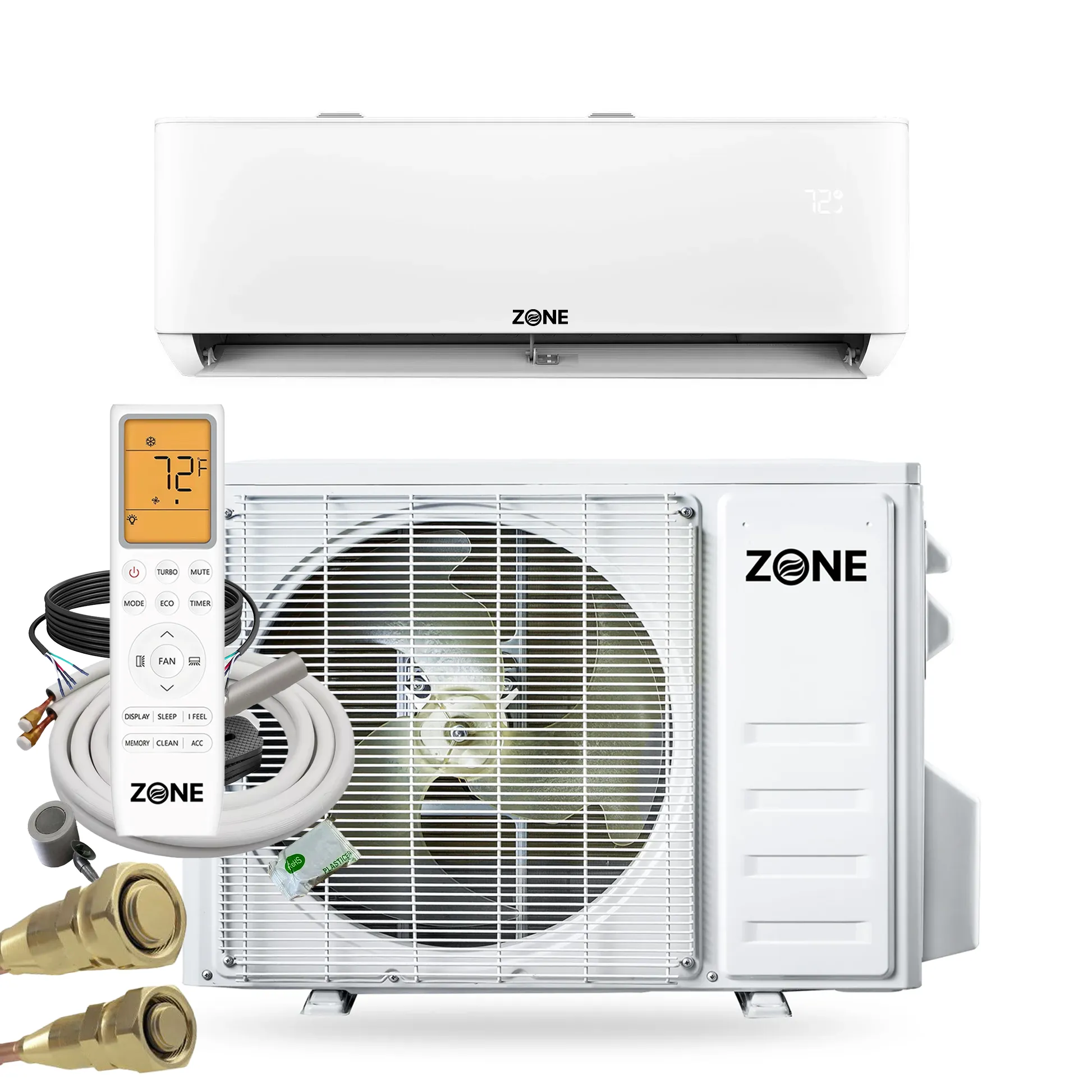
Every 115V mini split ships with the wall-mount indoor unit, outdoor condenser with NEMA 5-15 power cord, 16 ft pre-charged R454B lineset, wireless remote, mounting brackets and hardware, and a 5-year parts / 7-year compressor warranty. Free shipping on every order, 45-day returns, live tech support 9–5 MST. If your run needs to be longer than 16 ft, see our pre-charged lineset extensions — also pre-charged, also no vacuum pump required. Some installs add a decorative lineset cover kit for a clean exterior finish or a heavy-duty mounting bracket for above-grade outdoor unit installs. Neither is required for the system to work.
Frequently Asked Questions About 115V Mini Splits
Common questions about 115V plug-and-play mini splits, sizing, install path, and how they compare to 230V systems.
What is a 115V mini split?
Can I really plug a mini split into a standard outlet?
What size 115V mini split do I need?
115V vs 230V mini split — which should I choose?
Do I need a permit to install a 115V mini split?
Is a 115V mini split powerful enough for my room?
Explore More Mini Split Systems
Compare 230V wall mounts, BTU-specific options, and installation resources.
9,000 BTU Systems
For rooms 200–350 sq ft. The smallest 115V plug-and-play size.
Learn More →12,000 BTU Systems
For rooms 350–550 sq ft. The largest 115V model on the market.
Learn More →Single Zone Systems
One indoor unit, one outdoor unit. Wall, cassette, and concealed.
Learn More →All Wall Mount Mini Splits
Compare 115V and 230V wall mounts side by side.
Learn More →230V Wall Mount Mini Splits
Higher SEER2, 18K BTU available, dedicated circuit required.
Learn More →Dual Zone Bundles
Two indoor units on one outdoor condenser. 230V only.
Learn More →Sizing Calculator
Find the right BTU capacity for your room size and climate.
Learn More →DIY Install Guide
Step-by-step walkthrough with tools and time estimates.
Learn More →Find Your 115V Mini Split
Plug into a standard outlet, install in a weekend, condition the room by Sunday night. The fastest install path of any mini split — and the only one that works for renters. Free shipping on every Zone Air system.
Shop 115V Systems