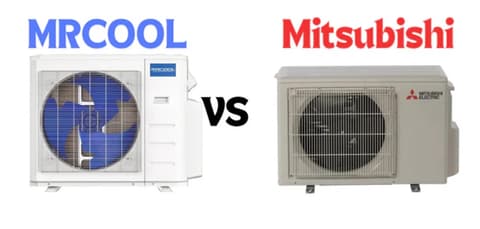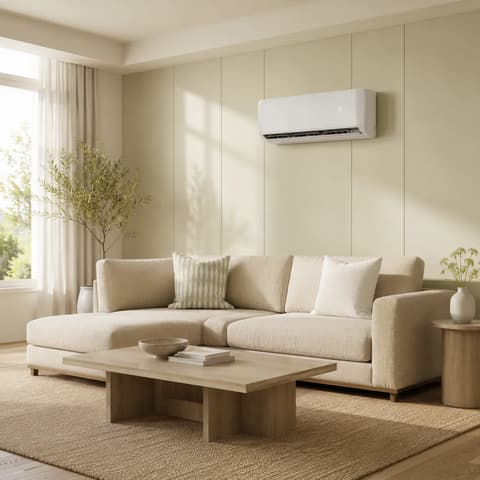
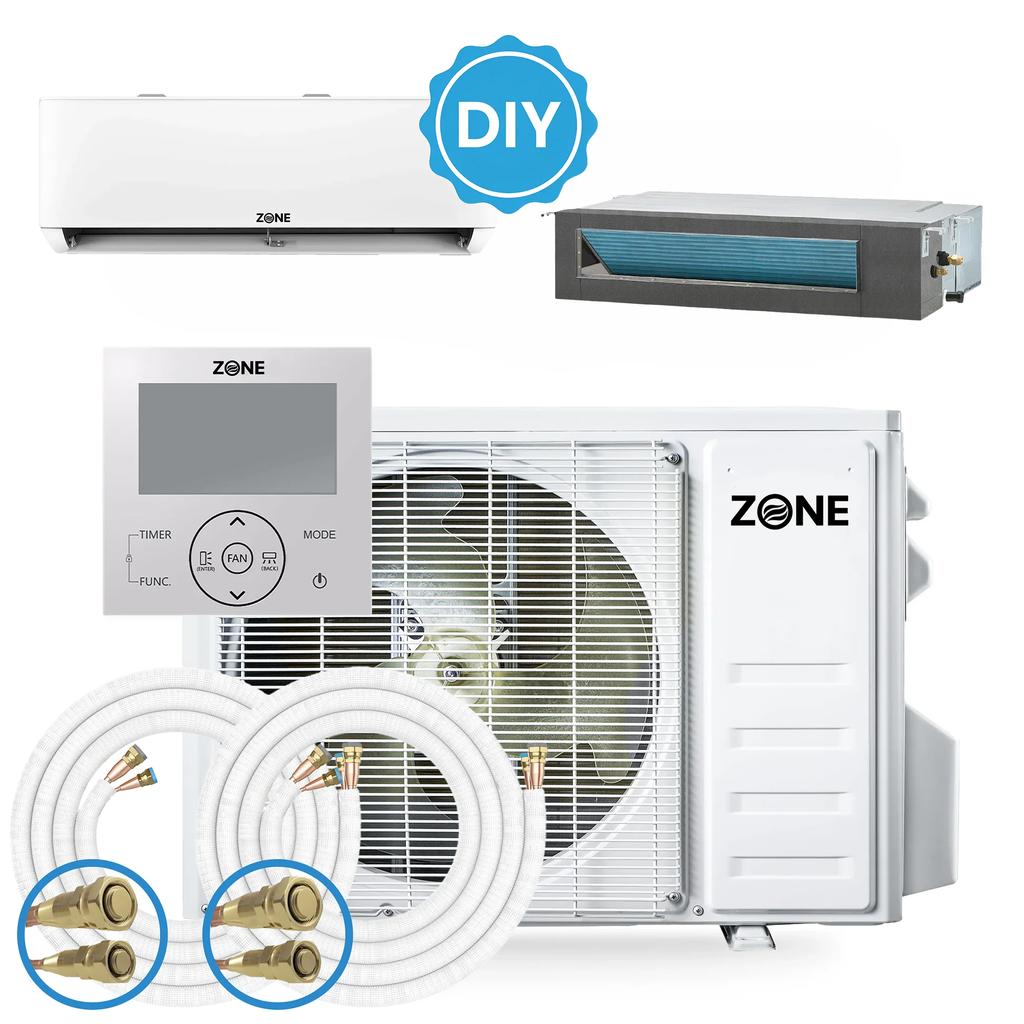
DIY concealed duct multi zone mini splits allow you to have room by room temperature control while still keeping your space aesthetic. Concealed duct mini split systems have indoor air handlers that go in your ceiling, attic or soffit. These heads are connected to your outdoor condenser via refrigerant lines and send heating and cooling through small supply grilles. This guide has what MRCOOL, Cooper & Hunter, and Zone Air actually offer for this kind of system in 2026, then goes through planning, parts, installation, efficiency and maintenance.
The short answer: if you want hidden units in individual rooms and want to install them yourself, Zone Air's Thin-Air line is the only DIY concealed ducted mini split system on the market as of October 2026. MRCOOL's DIY multi zone line uses wall-mount and ceiling cassette heads, and Cooper & Hunter's warranty needs installation by a licensed HVAC technician. For this kind of project, Zone Air also has a few other advantages you might want to consider:
- Concealed ducted units, wall-mount units and ceiling cassette units can all run off of one outdoor unit
- One slim concealed unit that is 7⅞ inches tall can serve two or three rooms
- Pre-charged line sets are cut to the exact length that you measure, from 5 to 75 ft
- Each concealed unit has a condensate pump built in
- Installing it yourself doesn't void the 5-year parts / 7-year compressor warranty
MRCOOL would be the better pick if you need more than three zones or don't mind visible wall or cassette heads. The details are below.
What Is a DIY Concealed Duct Multi Zone Mini Split
A concealed duct multi zone mini split is a heat pump system that uses one outdoor unit with several indoor air handlers that are out of sight. Instead of wall-mounted heads that blow straight into a room, each concealed unit pushes conditioned air through short insulated ducts to ceiling or high-wall supply grilles. You get clean, simple rooms while still conditioning two or three separate zones from a single outdoor condenser. With Zone Air, one concealed unit can even feed two or three rooms next to each other through short supply runs.
Here is how the three main system types compare:
- Single zone mini split: One outdoor unit, one indoor unit. Covers one room or open area. Simplest install.
- Multi zone ductless: One outdoor unit, several wall-mount or cassette indoor units. Each room gets its own head, and the heads are visible on the wall or ceiling.
- Concealed duct multi zone: One outdoor unit, several hidden air handlers sending air through short ducts. The grilles are all you see. A good fit for bedrooms, basements and open-plan spaces where you want clean lines.
- Mixed multi zone: One outdoor unit running a mix of concealed, wall-mount and cassette units. Zone Air is the only DIY brand that offers all three styles on one condenser.
Why you might choose this approach:
- DIY installation with pre-charged quick connect line sets, so you don't need a vacuum pump or refrigerant handling
- There is inverter heat pump efficiency for year-round heating and cooling
- Quiet operation comes from short, properly sized duct runs and variable-speed fans
- There is heating down to -13°F and cooling in summer from the same system
Where Zone Air Has the Edge
Each brand has its strong points, but for a concealed ducted multi zone system that you install yourself, Zone Air has some clear advantages as of October 2026.
- It's the only DIY concealed ducted mini split system on the market. MRCOOL's DIY multi zone condensers pair with wall-mount and ceiling cassette heads only. MRCOOL does make a DIY ducted unit, the DIY Hybrid Air Handler, but it's a full-size 24,000 or 36,000 BTU whole-home air handler matched to single zone condensers, not a slim unit for individual rooms. MRCOOL's slim ceiling-recessed ducted units are part of its Olympus line, which is meant to be professionally installed. If you want a concealed ducted unit for individual rooms and want to install it yourself, Zone Air Thin-Air is your option.
- You can mix concealed ducted, wall-mount and ceiling cassette units on one outdoor unit. Zone Air is the only DIY mini split that lets you combine all three styles on a single condenser. You can put a concealed unit over the bedrooms, a cassette in the kitchen, and a wall-mount in the garage, and run all of it from one 27,000 BTU outdoor unit.
- One concealed unit can serve two or three rooms. Short supply runs (up to 15 feet each) let a single Thin-Air unit feed rooms next to each other that share one setting, such as two kids' bedrooms.
- Fresh air or existing ducts. Thin-Air units can take a fresh-air intake or tie into existing ductwork, which helps in remodels.
- Built for tight ceilings. Each Thin-Air unit is 7⅞ inches tall, takes a rear or bottom return, and has adjustable external static pressure (0.1 to 0.4 in. w.c.) so you can match it to your duct layout. Each one has a built-in condensate pump, so you won't need to buy a separate pump when gravity drainage isn't possible.
- Line sets cut to your measurement. Zone Air sells pre-charged line sets in 16, 25, 33, 50 and 75 ft lengths, or custom cut to any length from 5 to 75 ft. MRCOOL sells fixed lengths of 11.5, 16, 25, 35 and 50 ft and uses couplers for longer runs. Of the three brands here, Zone Air is the only one that cuts your pre-charged line set to the exact length you measure, so there's less extra line to coil behind the condenser.
- DIY install keeps your warranty. Zone Air covers parts for 5 years and the compressor for 7 years, and installing it yourself doesn't void that coverage. There's no registration cutoff either. MRCOOL's DIY warranty is the same length and also needs no registration, so on that point the two are even. Cooper & Hunter's warranty only applies to units installed by a licensed HVAC technician and registered within 60 days.
- Final assembly, testing and inspection in the USA from globally-sourced components.
- Support and policies. Free shipping to the contiguous 48 states, live technical support from 8 AM to 6 PM Mountain Time, and 30-day returns on systems that haven't been installed.
Where MRCOOL is stronger (see the full MRCOOL DIY vs Zone Air comparison): its multi zone condensers go up to six zones (Zone Air tops out at three), its ductless wall heads post higher SEER2 numbers, and its app works with Alexa and Google Assistant. Zone Air's app does not support voice control. If you don't need concealed units and want more than three zones, MRCOOL's DIY multi zone line is worth a look.
How the Three Brands Compare
Specs and warranty terms are as published by each manufacturer as of October 2026.
How Concealed Duct Multi Zone Mini Splits Work
Every concealed duct multi zone system has the same core parts: an outdoor condenser/compressor unit, concealed duct indoor air handlers (one per zone), short insulated ductwork, condensate drains, refrigerant line sets and control wiring. Like other mini splits, these are heat pumps. They heat and cool by switching the refrigerant cycle between seasons.
- The outdoor unit has a variable-speed inverter compressor. In cooling mode, refrigerant absorbs heat indoors and sends it outside. In heating mode, the cycle does switch direction. Both Zone Air and MRCOOL's 5th Gen systems use R-454B refrigerant, which has a lower global warming potential than R-410A.
- One multi zone outdoor unit serves several indoor units, so there's less equipment on the outside of your home. The compressor speeds up or slows down to match the combined demand from all connected zones.
- Each concealed duct indoor unit pulls air from a return grille, passes it over the evaporator coil, and pushes conditioned air through supply ducts to one or more supply grilles.
- Concealed ducted mini splits cut down on the duct losses of a traditional central system because the duct runs are short and insulated. Zone Air limits each supply run to 15 feet, compared with the long main lines in many forced-air homes.
- Wall-mount ductless heads blow air directly into a room. Concealed duct air handlers spread air more evenly through multiple grilles, but they need more attention to static pressure and duct sizing.
Variable-speed fans in both the outdoor and indoor units allow partial-load operation, so the compressor rarely cycles fully on and off. That means smaller temperature changes and lower power use than fixed-speed systems.
Planning Your DIY Installation
Planning is the most important step, before you shop or pick up a drill. Mistakes in duct layout and drainage lead to noise, poor airflow or wasted capacity.
- BTU needs per zone: A Zone Air Thin-Air 9,500 BTU unit covers about 300 to 475 sq ft, and the 11,000 BTU unit covers up to about 550 sq ft. These numbers shift with insulation, ceiling height, window count and climate. A Manual J load calculation gives you the most accurate answer.
- Number of zones: Zone Air concealed systems come in dual zone (19,000 to 22,000 BTU of indoor capacity, up to about 1,100 sq ft) and three zone (28,500 to 33,000 BTU, up to about 1,650 sq ft), all on one 27,000 BTU outdoor unit. Avoid making any one zone too big. An oversized unit short-cycles, dehumidifies poorly and uses more energy than it should. An undersized one can't keep up at peak load.
- Mounting location: Concealed duct air handlers mount in attics, above drop ceilings or inside mechanical closets. A shallow unit makes this easier. Zone Air's Thin-Air units are 7⅞ inches tall and take a rear or bottom return, so they fit in shallow ceiling cavities and soffits where a larger air handler won't. Keep duct runs short and straight. Every 90-degree bend adds pressure drop, so plan the most direct path from the handler to the grilles.
- Grille and filter access: Put the return grille where you can reach it for monthly filter cleaning. Supply grilles should spread air evenly across the zone. Install access panels so you can reach the coil and blower for yearly maintenance.
- Rooms that don't suit a concealed unit: If one room has no attic or ceiling space above it, you don't have to give up on that zone. On a Zone Air system you can put a wall-mount or ceiling cassette there and keep the concealed units everywhere else, all on one outdoor unit.
- Service clearances: The outdoor unit needs the manufacturer's clearances on all sides for airflow. Indoor handlers need room for coil cleaning and motor access.
Zone Air's support team will check room loads, duct paths and model choice with you before you order, which is worth doing on a concealed system since duct layout is the easiest part to get wrong.
Tools, Materials and What Comes in the Box
Most of what you need comes with the system or as pre-charged line sets.
What you'll usually get with a Zone Air concealed multi zone system:
- There is one 27,000 BTU multi zone outdoor unit
- Two or three Thin-Air concealed duct indoor units, with one for each zone
- Communication cable for each indoor unit
- Wireless or wired control
- Pre-charged line sets, ordered separately in the length you need for each zone (16, 25, 33, 50 or 75 ft, or custom cut from 5 to 75 ft). When you measure each run and order that length, there is no extra line to coil up behind the condenser.
Exact box contents for concealed units vary, so check the product page before you start.
MRCOOL's DIY systems also use pre-charged Quick Connect line sets. MRCOOL sells them in 11.5, 16, 25, 35 and 50 ft lengths, each charged with R-454B, and coupler kits extend a run to as much as 75 ft per indoor unit. Line set sizes depend on indoor unit capacity: 1/4" x 3/8" for 6K to 12K units, 1/4" x 1/2" for 18K units, and 3/8" x 5/8" for 24K and larger units, including MRCOOL's DIY Hybrid Air Handler.
Homeowner-supplied tools:
- Drill with hole saw for wall penetrations (usually 3 inches or larger)
- Level, tape measure, nut drivers, screwdrivers
- Adjustable wrenches and a torque wrench for line set fittings
- Safety glasses and gloves
- Duct, collars, grilles, UL-181 tape or mastic and hangers
- Sealant materials (spray foam, neoprene sleeves) for wall penetrations
You won't need a separate condensate pump for Zone Air's concealed units, since each one has a pump built in. Installing a pre-charged mini split takes fewer specialized tools than a traditional HVAC install. Traditional contractor mini splits use flared or brazed line sets that need a vacuum pump, and handling refrigerant needs EPA Section 608 certification. MRCOOL describes its DIY line as needing "no special tools or training" to install, and Zone Air's pre-charged line sets connect without a vacuum pump or refrigerant handling.
Step-by-Step DIY Installation Process
This section covers the overall process. Local electrical codes apply, so review them before you start. Knowing the full sequence prevents going back to fix things.
- Mount the indoor units. Hang the concealed air handlers from ceiling joists or framing using vibration-isolation hangers. Keep each unit level. Leave enough clearance for coil access and filter changes. Only the supply and return grilles will show in the finished room.
- Connect ducts. Attach insulated flex or rigid supply ducts to the handler's discharge collar. Seal every joint with UL-181 tape or mastic. Size ducts to match the handler's rated airflow, because undersized ducts create noise and cut airflow. On Zone Air units, keep each supply run to 15 feet or less and set the static pressure to match your duct layout.
- Manage condensate. Zone Air Thin-Air units have a built-in condensate pump. If you are using gravity drainage on another unit, slope the drain line at least 1/4 inch per foot away from the handler, and add a condensate pump if the handler sits below the nearest drain.
- Route line sets. Drill a sleeved hole through the exterior wall for each zone's line set. Bundle the line set, communication cable and drain line together. Protect outdoor line sets from UV with line-hide covers. Avoid kinks and follow the minimum bend radius in your manual.
- Place the outdoor unit. Set it on a level pad or wall bracket and observe the manufacturer's minimum clearances. In areas with snow, raise the unit on a stand to keep the coil above the drift line.
- Electrical work. The outdoor unit needs a dedicated 208-230V single-phase circuit. Zone Air's 27,000 BTU multi zone outdoor unit uses a 30A double-pole breaker. That one circuit runs every indoor unit on the system. Install a disconnect within sight of the unit per code, and connect line-voltage and communication cables per the wiring diagram. If you aren't comfortable with panel work, hire a licensed electrician. That isn't optional.
- Connect the pre-charged line sets. Clean both ends of each fitting. Hand-tighten, then torque to the spec in your manual. Follow the manual's sequence for opening the refrigerant path, and check every joint for leaks. Skipping the torque spec or working out of order can release refrigerant.
- Power up and test. Turn on the breaker. You can use the controller to set each zone to cooling or heating. Confirm airflow from every supply grille and watch the temperature change over 10 to 15 minutes. Listen for unusual noise or vibration, and check for error codes. Make sure condensate is draining under load.
Pre-charged DIY systems let you handle the mechanical and refrigerant connections yourself, and with Zone Air and MRCOOL, doing so doesn't affect your warranty. An electrician should still handle any panel work you aren't qualified to do, and a licensed HVAC technician can review the system after startup if you want a second set of eyes.
Energy Efficiency, SEER2 Ratings and Operating Costs
Homeowners choose multi zone mini splits to lower utility bills and condition only the rooms they use.
- SEER2 numbers: Zone Air's concealed dual zone systems are rated 19 SEER2. The three zone systems 22 SEER2. MRCOOL's DIY multi zone condensers range from 21.8 to 23.9 SEER2 (23.9 on the 18K three zone condenser, 23 on the 27K and 36K, 21.8 on the 48K, and 22 on the 55K), but those figures are for ductless wall and cassette heads. Ducted equipment is tested at higher external static pressure under the SEER2 procedure, so ducted systems generally rate lower than ductless ones. For reference, the federal minimum for new central AC from 2015 was 13 or 14 SEER depending on region.
- Cooper & Hunter lists multi zone efficiency up to 22 SEER2.
- Inverter technology: Instead of turning on at full power and shutting off, an inverter compressor ramps up and down to match the load. That cuts electricity use and keeps room temperatures steadier.
- Zoning saves energy: Multi zone systems let you condition only occupied spaces. Being able to mix unit styles helps here too, because each room can get the unit type that suits it instead of forcing ducts into a room that doesn't need them. With schedules, you can keep bedrooms at 68°F overnight while an empty office drifts to 75°F.
- Cold-climate heating: Zone Air's systems heat down to -13°F. MRCOOL's DIY multi zone condensers from 18K to 48K also operate down to -13°F, and its 55K condenser goes to -22°F. Heat output drops as it gets colder, so in very cold climates, you'll want to size for your design temperature or keep a backup heat source.
- Upkeep matters: Efficiency over 10 to 15 years depends on clean filters, clean coils and sealed ducts. A neglected system won't match its rated numbers.
Controls, Smart Features and Multi-Zone Comfort Tuning
- Independent zones: Each zone has its own setpoint. Set bedrooms to 66°F at night and the living space to 72°F during the day without affecting other zones. (Rooms fed by the same concealed unit share one setting.)
- Apps: Zone Air systems include Wi-Fi app control for scheduling and adjusting setpoints from your phone. MRCOOL's DIY app adds Alexa and Google Assistant voice control and a Follow Me feature that reads temperature at the remote. Check the features list for your specific model before you buy.
- Fresh air: Zone Air's Thin-Air units can take a fresh-air intake, which helps in tight, well-sealed homes and finished basements.
- Fan settings: Auto mode changes fan speed to the load. Running the fan on low continuously in mild weather can even out temperatures through the duct network.
- Setbacks: When zones sit empty for hours, use schedule-based setbacks. The outdoor unit works less, and the compressor lasts longer.
Maintenance, Troubleshooting and Warranty Considerations
Even a DIY-friendly system needs regular maintenance to keep its efficiency and its warranty coverage.
Routine homeowner tasks:
- Check and clean filters monthly (every two weeks during heavy use)
- Clean indoor coils once a year with a soft brush and coil cleaner
- Clear leaves, debris and snow from around the outdoor unit
- Inspect condensate drains and pumps for clogs each season
- Make sure duct connections stay sealed and insulated
Common performance problems and fixes:
- Reduced airflow: dirty filter, blocked return grille or collapsed flex duct
- Uneven temperatures: undersized ducts, sharp bends, wrong static pressure setting or wrong fan settings. Units with adjustable static pressure, like Zone Air's, let you correct this without redoing the ductwork.
- Noisy ducts: undersized duct diameter or poor duct support causing vibration
- Not cooling or heating: check breakers, replace remote batteries and reset the unit. If the problem continues, call a licensed HVAC technician.
You can handle filter cleaning, breaker resets, battery swaps and clearing condensate backups yourself. Refrigerant leaks, compressor repairs and internal electrical faults need a professional.
Warranty terms by brand:
- Zone Air: 5 years parts, 7 years compressor. DIY installation doesn't void coverage, and there's no registration cutoff. Labor isn't covered.
- MRCOOL DIY 5th Gen: 5 years parts, 7 years compressor, with no registration needed. Labor isn't covered.
- Cooper & Hunter: 5 years parts, 7 years compressor on retail listings. The limited warranty applies only to products installed by a licensed HVAC technician, and the unit must be registered within 60 days of installation.
For a self-installed concealed system, Zone Air's terms are the most DIY-friendly of the three: the same coverage length as MRCOOL, on the only concealed ducted units of the three that you can install yourself without losing coverage.
Is a DIY Concealed Duct Multi Zone Mini Split Right for You?
This isn't a weekend project for everyone. It's realistic if you're comfortable with basic carpentry and power tools and can bring in an electrician for panel work.
- Homes that benefit most: Older homes without ductwork, additions, finished basements, converted garages and multi-level homes with hot and cold spots. Homes with some existing ductwork can also benefit, since Thin-Air units can connect to existing ducts. Concealed duct systems can also cost less than retrofitting full central ductwork, which often means opening walls and ceilings.
- Budget: As of October 2026, Zone Air concealed dual zone systems are $4,039.99 and three zone systems are $4,809.99, with pre-charged line sets ordered separately (a 16 ft set for a 9K or 12K unit is $229.99). DIY installation can save a large share of the labor cost of a contractor install. Leave room in your budget for duct, grilles, electrical materials and any permit fees.
- Timeline: Give yourself more time than you think. Running ducts in an attic or above a ceiling is slower than hanging a wall unit.
- Core advantages: Room-by-room comfort, inverter heat pump efficiency, quiet operation and no visible equipment in your living space.
If you want hidden units in individual rooms and want to install them yourself, Zone Air Thin-Air is the system built for that. You can pair it with wall-mount or cassette units on the same outdoor unit where a concealed unit doesn't fit. If you need four or more zones and don't mind visible heads, MRCOOL's DIY multi zone line covers more zones per condenser.
Specs, prices and warranty terms are as published by each manufacturer as of October 2026 and can change. Verify current details before you buy.