DIY Air Conditioner FAQ
Answers to the most common questions about homemade AC builds, swamp coolers, and DIY-installable mini splits. Many DIY AC and DIY air conditioning builds use a fan and ice. Ice is the cooling source in these setups, so they can help with limited-area relief but can’t match conventional air conditioning for cooling an entire room.
What's the cheapest homemade portable air conditioner I can build?
A box fan with a tray of ice is the cheapest DIY AC option at $0–$15 if you already own a fan. Output is modest — enough to cool a personal zone in front of the fan, not a whole room. The next step up in price-per-cooling is a styrofoam cooler with PVC vents, and a styrofoam box or styrofoam cooler works well here because the insulation helps hold the cold, at around $25–$45 with measurable cooling in a small space.
Can a homemade air conditioner actually cool a room?
A small one (10×10 ft or smaller), yes — the styrofoam cooler, copper-coil, or 5-gallon bucket builds all produce real, measurable cool air in a personal zone or small space, not across the entire room. Using frozen bottles can drop outlet air by roughly 8–15°F in a personal zone or small area. None of them move enough cold air to cool an entire room as effectively as conventional air conditioning the way even a small window AC does, and ice-based builds run out of cold in 1–4 hours. For a room you actually live in, a window AC unit ($50–$150 used) or a
DIY-installable 9,000 BTU mini split ($1,899) is the realistic answer.
Do DIY evaporative coolers (swamp coolers) work in humid climates?
No. Evaporative cooling depends on dry air absorbing water vapor — at 50%+ relative humidity, the air can't absorb much more, so the cooler just adds humidity without dropping temperature. Evaporative builds — a wet-sheet fan, a 5-gallon bucket swamp cooler, or a solar-powered cooler — are great in Arizona, Nevada, New Mexico, west Texas, and other arid Western states. Stick with ice-based builds or a real AC in the South, Midwest, Northeast, and coastal regions.
How long do the ice cubes last in a DIY ice-based AC?
Cubed ice melts in 30–90 minutes, and many bucket-style units give about five to six hours of cool air depending on ice mass and airflow. You can freeze water into larger pieces or use loose ice cubes, but larger blocks generally last longer. Block ice (frozen 2-liter bottles, large freezer blocks, or store-bought block ice) lasts 3–5 hours. You can add ice as needed, and salt in the ice water can help slow melting and extend runtime. The trash-can build with 50 lb of bagged ice runs 4–8 hours. If you need longer runtime, a copper-coil ice-water build re-uses melt water through a closed loop and stretches a single ice batch further. Just note that if the ice is made in a home freezer, the overall house can see a net warming effect because that heat is dumped back indoors during freezing.
How many BTUs does a DIY air conditioner produce?
Most DIY builds deliver between 100 and 1,200 effective BTUs, depending on design. For comparison, a small window AC is rated 5,000 BTU; a 9,000 BTU mini split delivers 9,000 rated BTU continuously. DIY builds are useful for personal cooling, sleeping, small spaces, or emergency outage cooling — these builds are meant to help you stay cool in a personal space during summer heat, not to match central or window air conditioning output.
What is the most efficient DIY air conditioner?
For dry climates, a 5-gallon bucket swamp cooler is the most efficient — continuous cooling on the wattage of a small fan and water pump (~30 W), no ice needed. For humid climates, a copper-coil ice-water build gives the most cooling-per-watt of any ice-based hack, since it works by circulating cold water through copper tubing in front of the fan as a simple cooling system, rather than having the fan blow air directly over exposed ice, and the closed water loop reuses cold rather than melting ice directly into the air.
Is there a permanent DIY air conditioner I can install myself?
Yes — a
pre-charged DIY mini split is the practical permanent option if you want to save money versus a contractor-installed system. Traditional split-system AC installs require an EPA Section 608-certified technician to evacuate the line set and charge the system with refrigerant.
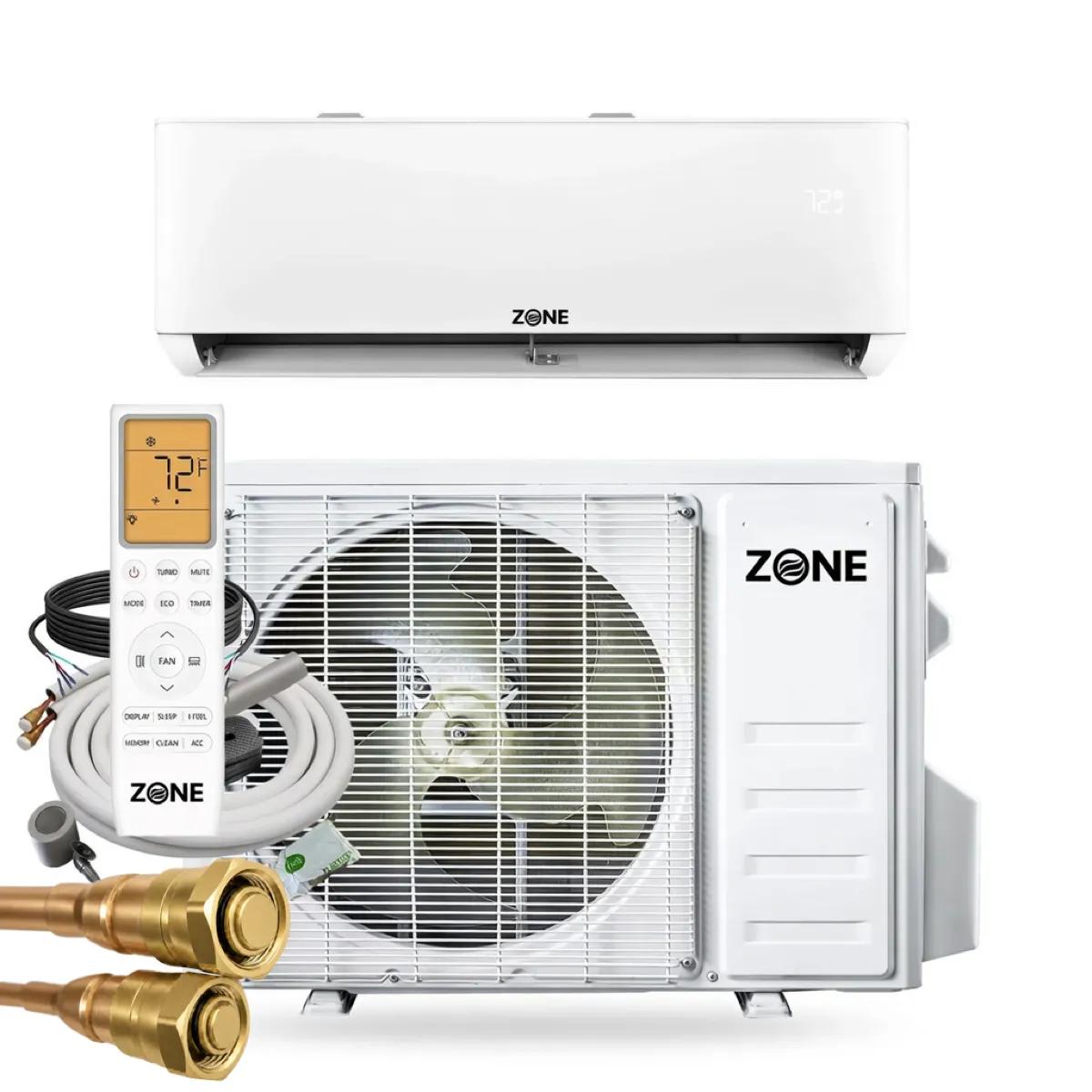
Pre-charged DIY mini splits ship with refrigerant already loaded; quick-connect couplings hand-tighten and torque to spec, so the homeowner never opens the refrigerant circuit. No EPA license, no vacuum pump. The 115V models plug into a standard outlet — no electrician either. A first-time install of a single-zone wall mount takes 4–8 hours, and it's a better long-term solution for a hot summer than a temporary homemade build.
Is a DIY mini split actually DIY, or do I still need a contractor?
Genuinely DIY for the mechanical install. Zone Air pre-charged systems with quick-connect linesets are designed for homeowner install with basic hand tools — no vacuum pump, no nitrogen pressure test, no refrigerant handling, no EPA certification. In daily use, keeping windows closed during the day helps the system cool more efficiently, and ceiling fans can improve airflow for better comfort. The electrical side depends on the model: 115V wall-mount units (9K and 12K BTU) plug into a standard 15A outlet (no electrician needed); 230V units may need a dedicated circuit ($300–$600 if you don't have one). See our
step-by-step DIY install guide.
Window AC vs DIY mini split — which is the better DIY choice?
For a renter or one-summer use, a window AC is cheaper and faster, and it is the closest off-the-shelf option to a homemade portable air conditioner. A bucket-based personal AC is fine for one seat or bedside use, while a mini split is the better choice for real room coverage. For a homeowner who wants permanent cooling, year-round heating, room-by-room control, and energy efficiency, a DIY mini split wins on every metric except up-front price. Window AC: $50–$300, 10–12 EER, cooling only, blocks a window, ugly, lifespan 5–8 years. DIY mini split: $1,899–$2,599, 22–25 SEER2, heat pump heating to -13°F, no window block, lifespan 15–20 years. The math favors the mini split as soon as you keep it more than 2–3 years, and it is the perfect solution when you want permanent comfort rather than a temporary personal device.
How much does a real DIY-installable air conditioner cost?
A
9,000 BTU 115V Zone Air mini split runs $1,899 — plug-and-play install, covers a 200–350 sq ft bedroom, includes the pre-charged R454B lineset. A
12,000 BTU 115V model at $2,189 covers most master bedrooms and living rooms. Compare that with a contractor-installed mini split at $4,500–$6,000 (equipment + labor) or a central AC retrofit at $8,000–$15,000. The homeowner reaches the point of biggest savings by avoiding the $1,500–$3,000 labor charge, which is the whole idea behind pre-charged linesets and quick-connects.