
Are DIY Mini Split Systems Any Good?
The short answer is yes — for most single rooms, garages, additions, and smaller homes. The honest answer depends on the brand you pick, how carefully you install it, and whether the system actually fits your space. Here is the full, balanced breakdown.
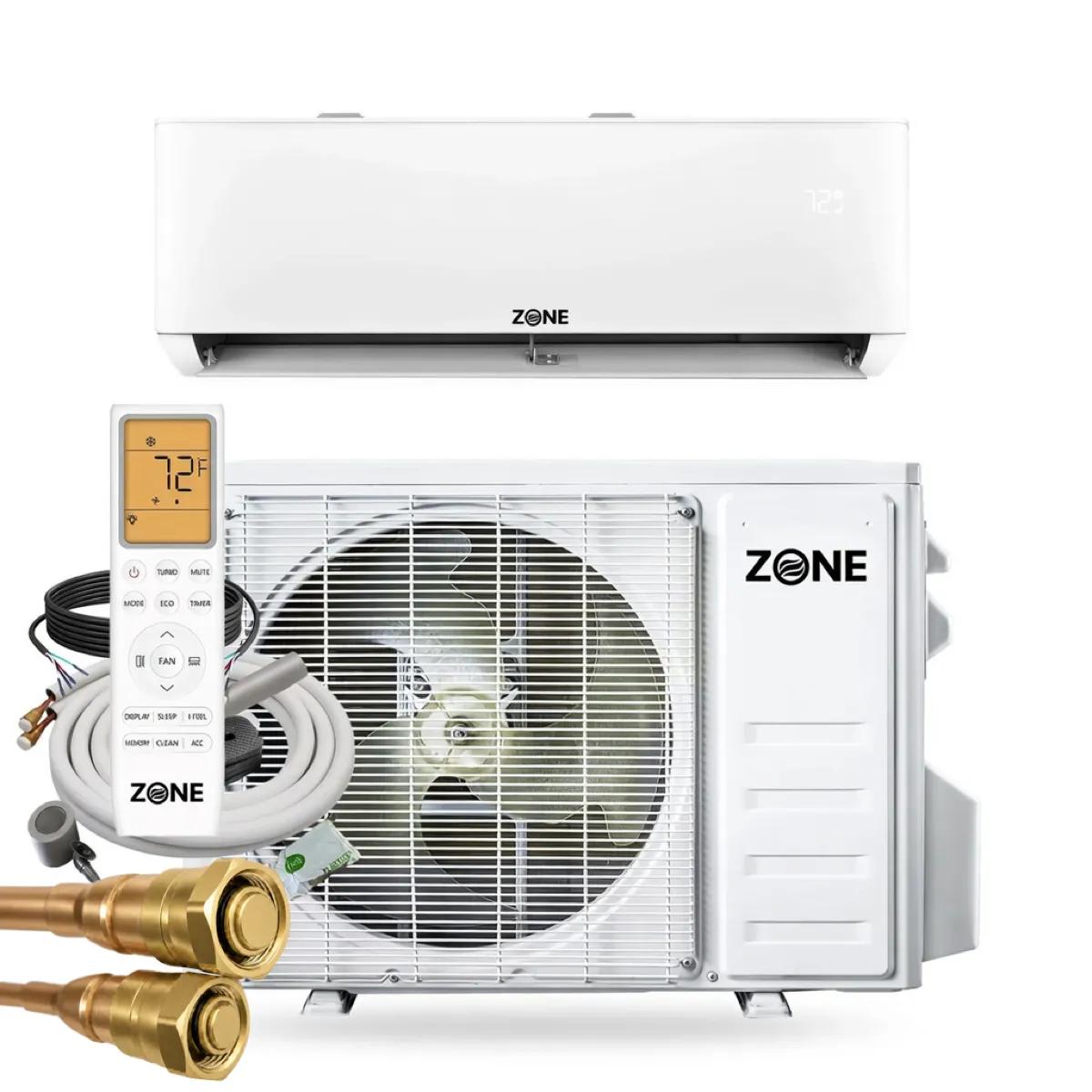
Are DIY Mini Splits Actually Worth It?
Modern DIY mini splits are genuinely good for most single rooms, garages, additions, and smaller homes. They are far more efficient than window units and portable ACs, run much quieter (as low as ~30 dB indoors versus 55–60 dB from a window unit), and provide both heating and cooling from one system — often cutting energy use 20–30% versus older equipment.
The financial picture is the headline. A typical installed central-air or ducted heat-pump project runs $7,000–$18,000 once you add ductwork, labor, and equipment. Most DIY mini splits — Zone Air included — land in the $1,500–$4,000 range per zone even with electrical work, letting you bypass the $3,000–$5,000 in labor a contractor adds.
MrCool made "DIY mini split" a household phrase and remains the most recognized name in the category. The category as a whole has matured — and brands like Zone Air now offer up to SEER2 24, cold-climate split systems with a similar or easier DIY install. If you want quiet, efficient heating and cooling without paying a contractor thousands in labor, a Zone Air DIY mini split is a strong option worth serious consideration.
What Is a DIY Mini Split System?
A ductless heat pump designed so a homeowner can install it without handling refrigerant or hiring an HVAC tech. Single-zone systems pair one indoor unit with one outdoor unit; multi-zone systems run several indoor units from one condenser. Four core parts:
Outdoor condenser
The heat-pump unit outside that moves heat in or out of your home.
Indoor air handler(s)
One or more units that blow conditioned air into the room — wall-mount is the DIY-friendly default.
Pre-charged line sets
Factory-sealed refrigerant lines with quick-connect fittings — no brazing, no vacuum pump, no EPA license.
Controls + drainage
Mounting hardware, a remote or WiFi app, and a condensate drain to carry away moisture.
Pros & Cons vs Traditional Systems
DIY mini splits can be excellent — how good depends on your expectations, the brand, and how well you handle the install. For the trade-offs that apply to any ductless system, not just DIY ones, see our honest guide to the disadvantages of mini split systems.
Where they shine
High energy efficiency
Often 18–24 SEER2 (Zone Air reaches up to 24) versus 13–16 for traditional AC — real savings every season, up to ~30% on energy bills.
Zoned comfort
Heat or cool only the rooms you actually use instead of conditioning the whole house.
No ductwork
Ideal for older homes, basements, garages, and additions — and it avoids the ~30% energy loss leaky ducts cause.
Major labor savings
DIY installs commonly save $3,000–$5,000 versus a full-service contractor quote on a comparable system.
Trade-offs to weigh
It is still real work
Basic tools, safe ladder use, drilling through an exterior wall, and some electrical comfort. Rushing or skipping steps raises the risk of problems.
Visible indoor unit
A wall-mounted air handler is more visible than hidden ducts — an aesthetic trade some people weigh.
Local service can vary
Some HVAC companies are hesitant to service homeowner-installed systems, especially certain mass-market brands.
Sizing matters
Most "temperature swing" complaints trace back to improper sizing or placement, not the technology itself.
What a DIY Install Actually Involves
"Easy install" means "no refrigerant work," not "no work at all." A careful DIYer can install a Zone Air system in a day, but it is a substantial project — most single-zone installs run 4–8 hours.
Plan the layout
Choose locations for the indoor air handler and outdoor unit, keeping the line-set run and bend limits in mind. Zone Air pre-charged line sets are 16 ft standard, extendable to 25 ft with a pre-charged extension.
Mount and drill
Mount the indoor bracket level on the wall and drill a 2–3" hole through to the outside for the line set and condensate drain, angled slightly downward to drain.
Hang and route
Hang the air handler on the bracket and route the pre-charged line set, drain, and wiring out through the wall.
Set outdoor unit and connect
Mount the condenser on a pad or wall brackets, then mate the quick-connect fittings and torque to spec — the refrigerant circuit stays sealed throughout.
Power and commission
Run a dedicated circuit (often 15–30A at 240V) to a disconnect by the condenser — or, on Zone Air 115V models, just plug into a standard outlet. Open the valves, power up, and test heating and cooling.
Efficiency, Comfort & Lifespan
Modern DIY mini splits can match or beat contractor-installed equipment. SEER2 measures cooling efficiency — higher is better — and Zone Air models reach 22–24 SEER2 versus older central air at 10–14 SEER.
Room size and insulation matter too — the same unit performs differently in a sealed bedroom versus a drafty garage.
Steady temperatures
Inverter-driven compressors adjust speed continuously instead of cycling on and off, minimizing swings.
Whisper-quiet
Zone Air indoor units run as low as ~30 dB in quiet mode — far below the 55–60 dB of a typical window AC.
Better humidity control
Steady-state operation pulls humidity more consistently than a window unit that cycles aggressively.
DIY Mini Split vs AC, Central Air & Ducted
The right choice depends on your layout, budget, and whether you have good existing ducts.
DIY mini split wins
Better efficiency, quieter, cleaner-looking, and it heats as well as cools year-round. A single-zone unit fits the same small rooms a window unit would.
Depends on your ducts
Central air is better for whole-house uniform cooling if you already have good ducts. Mini splits win for zoned control and retrofits where new ducts would cost $9,000–$20,000+.
Mini split is DIY-able
Ducted is less visible but far more invasive to retrofit and typically cannot be homeowner-installed legally. A DIY mini split keeps the project in your hands.
1950s homes without ducts, attic conversions, sunrooms, garage gyms, finished basements — a single-zone mini split shines in every one. Need several rooms? A multi-zone outdoor unit pairs with two to five air handlers.
Why Brand Choice Matters So Much
Forums and YouTube show a wide range of DIY mini split experiences — and most of that variance comes down to brand, model selection, and install quality. MrCool popularized the concept and, as the most widely sold DIY brand, naturally generates the largest volume of reviews across the spectrum; some HVAC pros then generalize those experiences to the whole category, which is not accurate.
When you compare brands, weigh the things that actually predict a good long-term outcome: efficiency, cold-climate rating, depth of support, parts availability, and whether the system was truly engineered for DIY rather than repackaged from a trade-only line. Common pain points with bargain imports are control-board reliability, hard-to-source parts, and long warranty timelines — and many manufacturers void coverage if a licensed tech did not install the unit.
That last point is where Zone Air is deliberately different: it supports DIY installation without voiding coverage when the procedures are followed, and backs systems with higher-end components, a homeowner-focused support team, and a 30-day return policy built for buyers rather than trade-only channels.
Who DIY Mini Splits Are For
Great fit
Comfortable with tools
You can follow detailed instructions and handle a drill, level, and basic wiring (or hire out just the circuit).
Adding/upgrading a room
A single room, ADU, or office roughly 250–1,000 sq ft — exactly where DIY mini splits shine.
Older homes without ducts
No ductwork, or ducts that would be expensive to repair or extend.
Budget-conscious
You want to keep the $3,000–$5,000 a contractor would charge in labor.
Lean toward a pro (or hybrid)
Whole-house, multi-story
Complex load calculations (Manual J) across many zones are better handled by a pro.
Replacing a failing central system
Where a like-for-like ducted replacement may simply be simpler.
Not comfortable at height or with electrical
If working on a ladder or in the panel feels unsafe, hand off those parts.
The hybrid path
Do the mechanical install yourself and hire a licensed electrician for the panel work — keeping most of the savings.
Minnesota garage workshop
Reliable heat down to −13°F — a Zone Air cold-climate model fits.
New Jersey office over a garage
Too hot in summer, freezing in winter — an ideal single-zone project.
1990s Texas bonus room
The central system barely reaches it — a 12,000 BTU wall unit solves it.
Choosing the Right Size
Oversizing or undersizing ruins comfort and efficiency even with a great brand. Use these as a starting point — ceiling height, windows, insulation, and climate all shift the math.
Zone Air single-zone systems run 9K–18K BTU; 24K and above comes as a multi-zone bundle pairing one outdoor unit (up to ~30,000 BTU) with several air handlers. Not sure? Try the mini split sizing calculator.
Indoor unit types
Wall-mounted
The most common and DIY-friendly — one hole for the line set and drain. Zone Air’s default for DIY customers.
Ceiling cassette
Flush-mounted for a low-profile look and even distribution, but needs joist access and more advanced work — best for pro-assisted installs.
Floor console
Sits low on the wall for rooms with large windows or low ceilings where high mounting is impractical.
What It Costs — and What You Get Back
Equipment, materials, possible electrician fees, and operating cost over time. Zone Air single-zone systems start at $1,899 with free shipping; premium cold-climate units typically run $1,899–$3,500 by BTU and features. A new 240V circuit, if needed, is often $300–$800 — and 115V models can skip it entirely.
What Is the $5,000 HVAC Rule?
The $5,000 rule is a quick repair-or-replace test: multiply your HVAC unit's age in years by the repair quote. If the result tops $5,000, replace the system instead of fixing it. A 12-year-old unit facing a $500 repair scores 6,000 — replace it. That same $500 repair on a 4-year-old unit scores 2,000 — fix it.
| Cost component | DIY mini split | Contractor-installed |
|---|---|---|
| Equipment (single zone) | $1,500–$3,500 | $2,000–$4,500 |
| Line set | Included (pre-charged) | $150–$600 |
| Refrigerant & evacuation | $0 (factory pre-charged) | $200–$500 |
| Electrical (if 240V needed) | $0–$800 | $300–$800 |
| Installation labor | $0 (self-install) | $3,000–$5,000 |
| Typical total | $1,500–$4,000 | $7,000–$18,000 |
Ranges reflect typical 2026 U.S. figures per zone and vary by region, home, and model; verify current pricing before purchasing.
Are They Reliable? Warranty & Maintenance
Budget-brand units may last only 3–7 years; quality systems with basic maintenance run 10–15+ years. Upkeep is minimal:
Clean filters
Wash the air filters every 4–8 weeks for steady airflow and efficiency.
Clear the outdoor unit
Keep leaves, snow, and debris away from the condenser seasonally.
Check the drain
Inspect the condensate drain for clogs about once a year.
Occasional pro check
An electrical and operation check every few years is optional but easy on quality units.
Common DIY Mini Split Projects
Fast, targeted comfort upgrades without reworking the whole home's HVAC.
Garage workshops
A steady 72°F in January and July without conditioning the whole house.
Finished basements
Home theaters and game rooms that the main system never quite reaches.
Backyard offices & ADUs
Studios and suites built during the remote-work boom.
Bonus rooms over garages
The room that was always too hot or too cold on the central system.
Example: a 400 sq ft Colorado hobby shop stays comfortable year-round on a 9,000 BTU Zone Air unit and a standard 115V outlet; a 500 sq ft New York in-law suite uses a 12,000 BTU cold-climate model for primary heat. Zone Air's WiFi control also lets you pre-condition the space before you arrive.
DIY Mini Split FAQ
The questions homeowners ask most before committing.
Can I really install a DIY mini split myself, or do I need an HVAC license?
You can install it yourself. Systems like Zone Air use pre-charged line sets and quick-connect fittings, so there is no vacuum pump, refrigerant handling, or EPA certification required. You may want an electrician for the circuit if you need 230V. Always check local building codes and permits.
How long does a DIY mini split installation usually take?
Most competent DIYers complete a single-zone wall-mount install in 4–8 hours. Multi-zone or ceiling-cassette installs take longer.
Do DIY mini splits work in very cold climates for primary heat?
Cold-climate rated models do. Zone Air cold-climate systems heat down to −13°F, while many budget brands struggle below 25–30°F. Choose a cold-climate certified unit if you are in climate zones 5–7.
How loud are mini split indoor air handlers compared to window ACs?
Zone Air indoor units run as low as ~30 dB in quiet mode — roughly the volume of a quiet library — versus 55–60 dB for a typical window AC.
Will a DIY mini split void my home warranty or insurance?
Not typically, but check your policy. Insurance and home warranties generally focus on whether the work was done to code, not on whether a contractor did it — so install to local codes and keep your documentation.
How long do mini splits last, and what maintenance do they need?
A quality mini split can last 15–20 years with basic maintenance: clean the filters monthly, clear the outdoor unit seasonally, and check the drain annually.
What makes Zone Air different from other DIY mini splits I see online?
Zone Air is engineered for DIY homeowners — 115V plug-and-play options, cold-climate ratings to −13°F, up to 24 SEER2 efficiency, a 7-year compressor and 5-year parts warranty, 30-day returns on uninstalled systems (25% restocking fee applies), and US-based support from Salt Lake City. It is built for the DIY customer from the ground up, not adapted from a contractor-only line.
Is MRCOOL the only DIY mini split brand?
No. MRCOOL popularized the pre-charged, quick-connect DIY approach, but it is not the only true-DIY option. Zone Air also ships pre-charged line sets — no vacuum pump, gauges, or EPA 608 certification required — with up to 24 SEER2 efficiency and cold-climate heating to −13°F, and its warranty stays valid on a self-install. Pioneer and Senville are marketed as budget-friendly but generally use flare fittings or require professional installation.
What are the benefits of DIY mini splits?
The main benefits are labor savings of $3,000–$5,000 versus a contractor, high efficiency (up to 24 SEER2 on Zone Air), zoned room-by-room comfort, no ductwork or duct losses, cold-climate heating to −13°F, and a fast install — a single-zone wall-mount system typically goes in over an afternoon. Pre-charged line sets remove the need for refrigerant handling or an EPA license.
So — Are DIY Mini Splits Any Good?
Yes — when you choose a quality DIY-built brand, size it correctly, and install it carefully (or bring in an electrician where needed). Strong efficiency, zoned comfort, no ductwork, real labor savings, and cold-climate heating to −13°F make a DIY mini split one of the highest-ROI home upgrades available.