
Disadvantages of Mini Split Systems: Pros and Cons Before Buying
Updated July 5, 2026
Mini split systems earn their reputation for efficiency and flexibility — but they come with real trade-offs that deserve honest attention before you spend the money. Here’s a straight look at the downsides, and where they matter most.
Weighing it up? See what a DIY system actually costs
Want the full pros-and-cons breakdown?
Not sure what size you’d need?
Open the Mini Split Sizing Calculator →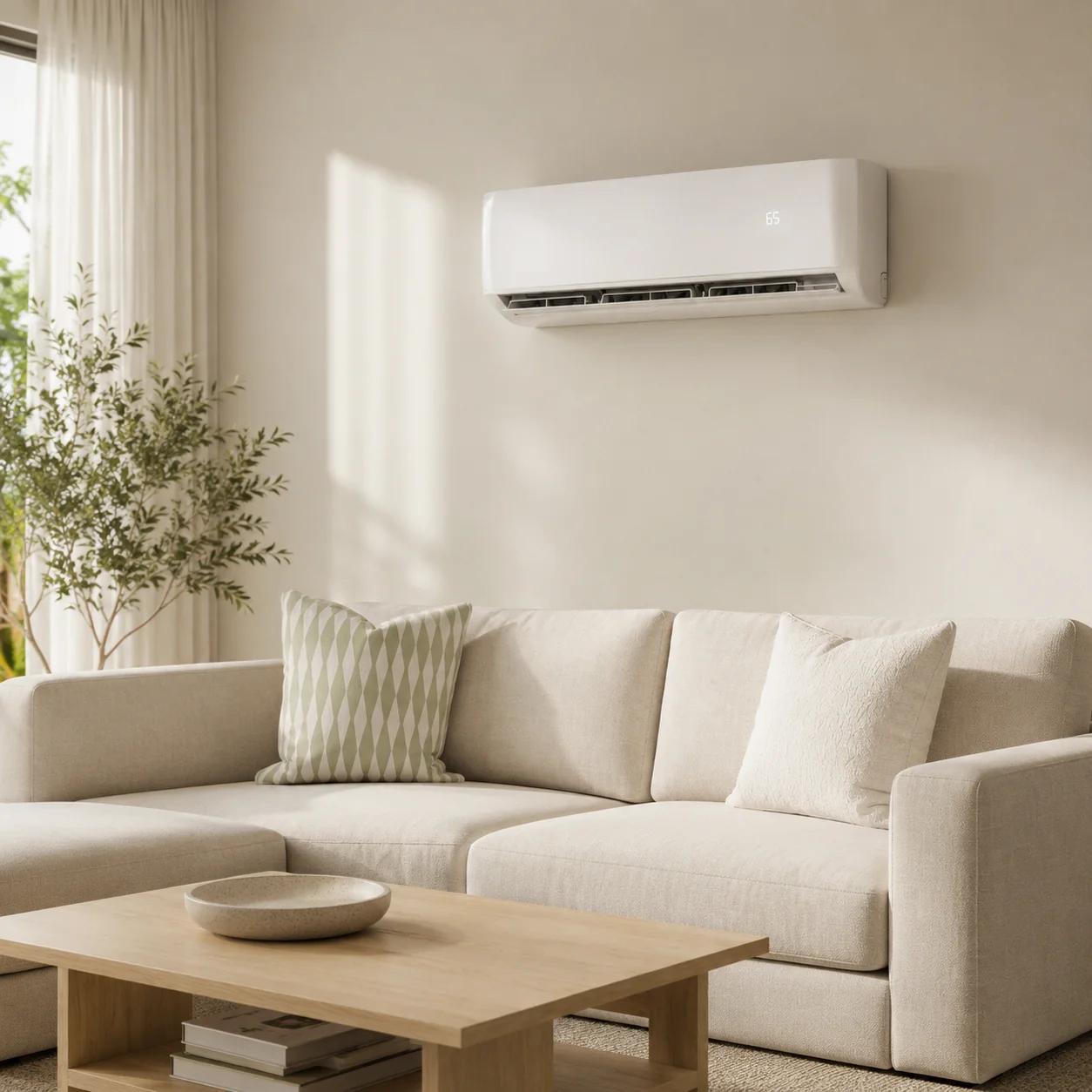
Quick Answer: The Main Disadvantages of Mini Split Systems
The main disadvantages of mini split systems come down to six things: a higher upfront cost, visible indoor units in every room, ongoing filter maintenance, careful sizing and planning, weaker heating in extreme cold, and coverage limits in large homes.
- Mini splits typically cost more per unit of capacity than window units — and often more than comparable central air.
- Wall-mounted indoor air handlers are always visible in each zone they condition.
- Filters need cleaning every few weeks to stay efficient, and every indoor head is its own maintenance point.
- Get the sizing wrong and you lose efficiency and humidity control — oversizing is as much a problem as undersizing.
- Standard (non-cold-climate) models lose heating capacity below freezing and may need backup heat.
- Covering a whole house can take several indoor heads and, sometimes, more than one outdoor unit.
These trade-offs apply to ductless systems from any brand — including DIY options like Zone Air. Below, we break each one down and weigh it against the upside, so you can judge the balance for your own home.
What Is a Ductless Mini Split System?
A ductless mini split pairs an outdoor condenser with one or more indoor air handlers, linked by slim refrigerant lines instead of bulky ductwork. It’s worth a quick definition, because a few of the disadvantages come straight from that design.
- No ducts means none of the 20–30% energy loss that leaky ductwork causes in a typical forced-air home.
- Each indoor head is its own zone, so you can set different temperatures room by room.
- The design shines in room additions, garages, bonus rooms, and older houses that never had ducts.
Zone Air builds DIY-friendly ductless systems with pre-charged line sets — but we’d rather you understand the downsides going in than discover them later.
Higher Upfront Cost Compared to Traditional HVAC
Mini split upfront cost in 2026 runs about $1,800–$6,000 installed for a single zone and $8,000–$15,000 for multi-zone, though DIY-install systems like Zone Air’s start at $1,899.99 and avoid $3,000–$5,000 in labor. Cost is the disadvantage homeowners bring up most, and it catches people off guard when they compare a mini split to a window unit or a single central system.
- For equivalent capacity, mini splits often run 20–30% more than conventional HVAC. A single-zone system usually lands between $1,800 and $6,000 installed; multi-zone setups covering several rooms commonly reach $8,000–$15,000.
- Every indoor head you add raises the total — each one needs its own line set, wiring, and a wall penetration.
- The math tilts toward mini splits for one or two rooms; whole-home coverage is where the upfront cost climbs fastest.
- Professional installation is a big chunk of that. Going DIY with pre-charged line sets — the approach Zone Air uses — can save roughly $3,000–$5,000 in labor, though the equipment itself is still a premium product.
- Part of the price buys efficiency: high SEER2 ratings (Zone Air systems run 22–24 SEER2) and heat-pump heating cost more up front but pay back on your monthly bills.
Aesthetic Considerations and Indoor Unit Visibility
Aesthetics are a genuine mini split disadvantage in 2026: every conditioned zone gets a visible indoor unit, typically a white wall-mounted head roughly three feet wide. If concealed equipment matters to you, this is a genuine drawback. Central systems hide behind ductwork and low-profile registers; a ductless system puts a visible air handler in every zone.
- A white, roughly three-foot-wide wall unit above the sofa is hard to ignore, and it can compete with artwork or shelving for wall space.
- Indoor heads mount on walls or ceilings, and plenty of homeowners simply don’t love the look next to a concealed ducted system.
- You do get options — wall-mounted, floor-mounted, and recessed or ceiling-cassette styles — but every one of them is still visibly present in the room.
- Even sleek modern designs, from major brands and DIY lines like Zone Air alike, can’t make the equipment disappear entirely.
Maintenance, Cleaning, and Repair Challenges
Mini split maintenance in 2026 means cleaning each indoor head’s reusable filter about monthly — every couple of weeks in dusty or pet-heavy homes — plus an annual professional coil cleaning per zone. A ductless system moves maintenance out of the attic and into your living space — and multiplies it by the number of indoor heads.
- The reusable filters need regular cleaning — monthly is the baseline, and dusty or pet-heavy homes may need it every couple of weeks.
- Plan on professional service about once a year for the deeper coil and blower-wheel cleaning that keeps the air healthy.
- Skip the filter cleaning and a highly efficient system quietly turns into an energy waster — and its lifespan shortens.
- Repairs can get complicated: inverter boards, sensors, and proprietary parts vary by brand, and a slow refrigerant leak in a line set isn’t always obvious.
- Zone Air’s systems are built to be more serviceable, but refrigerant and electrical repairs usually still call for a licensed HVAC pro.
Planning, Sizing, and Installation Complexity
Skipping ductwork doesn’t mean skipping the planning. Sizing is where a lot of mini split disappointment actually starts.
- Each room really needs its own heat-load calculation. Oversize the unit and it short-cycles and won’t dehumidify; undersize it and you get hot and cold spots.
- Every indoor head adds a refrigerant run, a condensate path, and another wall or ceiling penetration — which complicates retrofits in finished homes.
- Pre-charged line sets (like Zone Air’s) take the hardest step off your plate, but you still have to respect clearances, line-length limits, and the connection procedure.
- Leaning on a real load calculation — even a free mini split sizing calculator — lowers the risk, but it doesn’t erase the planning work.
Performance Limits in Extreme Temperatures
Standard mini splits shed heating capacity below about 15–20°F, while cold-climate models like Zone Air’s heat pumps are rated to keep heating down to -13°F in 2026. Not every heat pump handles a cold snap the same way, and this is the disadvantage most tied to where you live.
- A standard, non-cold-climate unit starts shedding heating capacity around 15–20°F, and can lose more than half its rated output by 0°F — which is when people reach for electric baseboard backup.
- In a brutal heat wave, a marginally sized system runs at high fan speed to keep up, and that means more noise.
- Cold-climate, Energy Star–certified models — including certain Zone Air heat pumps — hold their heating output far lower, but they run about $500–$1,500 more.
- Misjudging these limits is one of the main reasons some people conclude a mini split “wasn’t worth it.”
Coverage Limits in Large or Complex Homes
Mini splits are hard to beat for an addition or a garage, but leaning on them as a whole-house system in a big, multi-story home is where the design pushes back.
- One outdoor condenser only supports so many indoor heads and so much total capacity — a larger home may need a second outdoor unit, which adds cost and more visible equipment.
- A single wall head doesn’t move air around corners, down hallways, or between floors the way ducted airflow does.
- For all its duct losses, a central forced-air system can sometimes distribute air more evenly across a large footprint.
- Multi-zone systems help, but past a certain square footage a hybrid setup — some ductless, some ducted — is often more practical, and every added unit adds cost. If you’re set on going all-ductless, see whole home mini split systems.
Noise, Air Quality, and Comfort Trade-Offs
Modern mini splits are genuinely quiet and comfortable, but a few trade-offs still show up in real homes.
- Even a “quiet” head makes audible fan noise right there in the room — often 18–22 dB on low, but 30–35 dB by medium speed, which can bug a light sleeper.
- A ductless system recirculates and filters the air in each room, but it doesn’t pull in fresh outdoor air the way a ventilation system does — so rooms can feel stuffy without separate ventilation.
- Let the filters and coils go too long and dust and biofilm build up inside the heads, undercutting the clean-air benefit people expect.
- Central setups can fold in whole-home filtration, an ERV, or humidification. If air quality is a priority, plan on a separate ventilation or filtration add-on.
Comparing Advantages and Disadvantages: When Mini Splits Are a Good Fit
On the plus side of the 2026 ledger, Zone Air’s DIY mini splits reach up to 24 SEER2 on 230V models, heat down to -13°F, and carry a 5-year parts / 7-year compressor warranty with a 4.8/5 average across 141 verified reviews. Weighing the disadvantages against the upside is really the whole decision. The advantages are just as real: no ducts means no duct losses, inverter compressors modulate output instead of cycling on and off, and the most efficient ductless models reach well into the 30s SEER2 — far beyond typical central AC. That efficiency shows up as lower monthly bills and precise, room-by-room comfort that window units can’t match.
Mini splits are usually worth it when:
- You’re conditioning a single room, a finished basement, a garage, or a smaller home without ducts — where a one- or two-zone DIY system makes clear economic sense.
- You’re willing to keep up with routine filter cleaning and basic upkeep.
- Your climate is covered by a cold-climate-certified heat pump, so you get reliable heating all winter.
The disadvantages weigh heavier when:
- You have a large home with strict aesthetic standards that would need many indoor units across a lot of zones.
- You live somewhere brutally cold and don’t buy cold-climate equipment, leaving you dependent on a backup heat source.
- You want DIY’s upfront savings but aren’t prepared to commit to the ongoing filter maintenance.
One more thing to factor in: the federal 25C tax credit for heat pumps ended for systems placed in service after December 31, 2025. But state and utility rebates — and income-qualified programs like HEEHRA (up to $8,000) — can still offset a meaningful chunk of the upfront cost, which shifts the math back toward high-efficiency ductless heating. Check what your ZIP code qualifies for with the AC rebate calculator before you rule anything out.
Line up your home’s size, layout, climate, and DIY comfort against these trade-offs. If they work in your favor, take a look at Zone Air’s DIY ductless mini split systems — or get a load calculation from a local HVAC pro before you buy.
Why Is Your Mini Split Electric Bill So High?
A mini split usually runs up your electric bill for one of five reasons: it’s oversized and short-cycling, the filters are dirty, it’s undersized and running flat-out, backup or auxiliary heat is kicking in below the unit’s rated temperature, or a low-SEER2 unit is doing whole-home duty it was never sized for. A right-sized, high-SEER2 inverter heat pump rarely does any of this — the bill spikes come from the setup, not the technology.
- An oversized head cools or heats in short bursts, never settling into the efficient low-and-slow inverter range — and it stops dehumidifying, so you run it colder to feel comfortable.
- Clogged filters choke airflow; the system works harder for the same result. This is the single most common, and most fixable, cause.
- Below a standard unit’s rated temperature, electric-resistance backup heat takes over — and resistance heat can cost three to four times what the heat pump itself does.
- A low-SEER2 bargain unit simply draws more watts for every BTU it moves; the efficiency you skipped up front shows up on every monthly statement.
This is where efficient equipment earns its keep. Zone Air’s systems run 22–24 SEER2 with a variable-speed inverter and cold-climate heating down to -13°F, so the compressor modulates instead of cycling and auxiliary heat rarely has to engage — the two failure modes behind most high winter bills.
Mini Split vs Central Air vs Window AC: The Trade-Offs Compared
Every disadvantage above is really a trade-off against the alternatives. Here’s how a ductless mini split stacks up against central air and a window unit on the dimensions people weigh most in 2026.
| Consideration | Ductless Mini Split | Central Air | Window AC |
|---|---|---|---|
| Upfront cost (installed) | $1,800–$6,000 per zone (DIY from $1,899.99) | $8,000–$20,000 | $150–$600 |
| Indoor unit visibility | Visible head in each zone | Hidden (ducts & registers) | Blocks a window |
| Duct energy losses | None | 20–30% | None |
| Room-by-room control | Yes | Limited (one thermostat) | Per-unit only |
| Cold-climate heating | Down to -13°F (cold-climate models) | Needs a furnace | Cooling only |
| Maintenance | Filter cleaning per head; annual coil service | Filter + duct service | Filter cleaning; seasonal removal |
Cost and performance ranges reflect typical 2026 U.S. figures and vary by home, climate zone, and installer; verify current pricing before purchasing.
Mini Split Disadvantages: Frequently Asked Questions
What are the biggest disadvantages of a mini split system?
The main disadvantages of a mini split are a higher upfront cost than a window unit, a visible indoor air handler in every conditioned zone, filters that need cleaning roughly monthly, careful per-room sizing, weaker heating below freezing on standard (non-cold-climate) models, and the need for several heads — sometimes a second outdoor unit — to cover a large home.
Why is my mini split electric bill so high?
A mini split usually runs up the bill for one of five reasons: it is oversized and short-cycling, the filters are dirty, it is undersized and running flat-out, backup or auxiliary heat is engaging below the unit’s rated temperature, or a low-SEER2 unit is doing whole-home duty. A right-sized, high-SEER2 inverter heat pump such as Zone Air’s (22–24 SEER2, cold-climate heating to -13°F) rarely triggers any of these.
Do mini splits work in extreme cold?
Standard mini splits start losing heating capacity around 15–20°F and can shed more than half their output by 0°F. Cold-climate-certified heat pumps hold usable heat far lower — Zone Air’s cold-climate models are rated to -13°F — which is what keeps auxiliary heat from taking over and spiking the bill.
Are mini splits worth it despite the disadvantages?
For a single room, an addition, a garage, or a smaller home without ducts, a one- or two-zone mini split is usually worth it: no duct losses, inverter efficiency, and room-by-room control outweigh the trade-offs. The disadvantages weigh heavier in large homes with strict aesthetics, or in brutally cold climates without cold-climate equipment.
Can you avoid the high installation cost of a mini split?
Yes — professional labor is $3,000–$5,000 of a typical multi-zone install, and DIY-friendly systems remove it. Zone Air’s DIY series ships with pre-charged linesets — no vacuum pump, gauges, or EPA 608 certification required — so a capable homeowner can connect the system without hiring an HVAC crew.
Decide With the Full Picture
If the trade-offs work for your home, see how a pre-charged DIY system compares — priced without the contractor markup.
Secure checkout. Fast shipping. 30-Day Returns. 5-yr parts / 7-yr compressor warranty.