
Short answer: no — a true pre-charged, quick-connect mini split does not need to be vacuumed. Systems like MRCOOL DIY, Perfect Aire QuickConnect, Zone Air, and a handful of other brands ship the line set sealed and charged at the factory, so you never open the refrigerant circuit and there is no vacuum step. The systems that do require a vacuum pump are traditional mini splits — including Mitsubishi, Daikin, Fujitsu, LG, and most Pioneer/Senville/Cooper&Hunter SKUs — which legally and mechanically require a vacuum pump and an EPA Section 608 certification to install correctly. Skip the vacuum on one of those and you'll trap moisture and air in the refrigerant loop, where it forms hydrochloric and hydrofluoric acid that attacks the compressor windings and voids the manufacturer's warranty (Cooper&Hunter, OLMO, and most others spell this out in their warranty terms).
EPA 608 callout
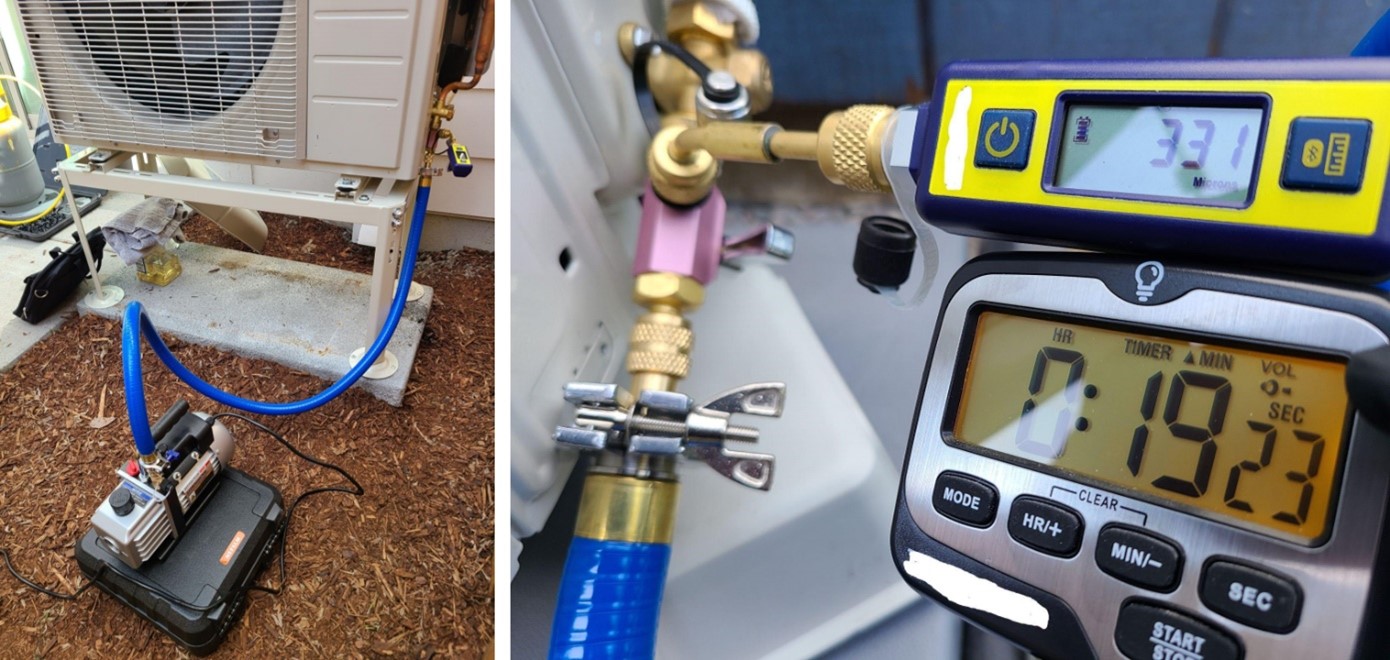
Federal law (EPA Section 608, 40 CFR Part 82, Subpart F) makes it illegal for an uncertified person to "open" a refrigerant circuit on most systems — that includes flaring fittings and connecting line sets on a traditional mini split. Pre-charged "No-Vac" systems are exempt because the line set arrives factory-sealed and you only break a single brass quick-connect that mechanically charges the loop. That's the whole reason this category exists. If you're going traditional, rent a vacuum pump for ~$60, pull a deep vacuum to 500 microns or below and hold for 15 minutes (measured with a $60–$120 micron gauge, not a manifold gauge), and either get 608-certified or pay an HVAC tech for the final hookup.
This guide compares the leading quick-connect systems honestly — where they make sense, where they don't, and the real efficiency / cost / warranty trade-offs against a traditional vacuum-pump install. Use the mini split sizing calculator first to confirm BTU, then come back here to pick between DIY methods.
Note on case studies in this article: Customer scenarios in this guide are composite examples drawn from real Zone Air installs and verified MRCOOL/Perfect Aire owner reports — not single individuals. Numbers reflect typical Tampa, Phoenix, and Minneapolis climate-zone math at 2026 EIA electricity rates.
DIY Mini Split Easy: How No-Vacuum, Pre-Charged Systems Work
There are two ways a mini split line set arrives, and which one you buy decides whether a vacuum pump ever enters the picture.
The Real Trade-Off (and the Old Myth)
For years the conventional wisdom was that no-vacuum systems were a gimmick — easier to install but stuck at SEER2 17-19, noisy, and overpriced per BTU. That was true of the first generation of quick-connect units, and it's still true of the cheapest ones today. It is no longer true across the board.
The category split into two tiers:
Budget quick-connect (the old reputation): SEER2 16-19, a 5°F heating floor, proprietary line sets, 5-year parts-only warranties. You pay a convenience premium for mediocre efficiency.
High-efficiency pre-charged (where the category went): SEER2 22-24, cold-climate heat pump operation well below 0°F, longer compressor warranties — and the same no-vacuum install. This tier, led by Zone Air, closes the efficiency gap that once made "just rent a vacuum pump" sound like good advice.
Bottom line: the no-vacuum install is no longer something you trade efficiency to get. The question isn't quick-connect vs traditional anymore — it's which pre-charged system gives you traditional-grade efficiency without the pump, the gauges, and the EPA certification. That's what the rankings below sort out.
Vacuum-Free Mini Split: Top 5 Pre-Charged Systems 2026
Every system here ships with a sealed, pre-charged line set and quick-connect fittings — no vacuum pump and no EPA Section 608 license on any of them. The table below ranks them on what actually separates them once the vacuum step is off the table.
Every system above is pre-charged and vacuum-free, so the ranking comes down to efficiency, cold-climate range, warranty, and price. Here's the short case for each.
#1 — Zone Air Easy Install · Best Overall
Zone Air broke the old rule that no-vacuum means low-efficiency: a factory-sealed, pre-charged R454B line set with SEER2 24 and true cold-climate heat pump performance. Every other system here asks you to accept a SEER2 17–19 ceiling for the same convenience. Zone Air doesn't.
Best for: DIYers who want a real, efficient, cold-climate system without a vacuum pump — and anyone keeping it 3+ years. Verdict: the only system here with traditional-grade efficiency and a true no-vacuum install — best overall and best lifetime value. Pre-charged lineset extensions reach 25 ft and stay vacuum-free.
#2 — Perfect Aire QuickConnect · Best Budget Value
Genuine quick-connect technology at a lower upfront price than most of the category, with a better-than-average compressor warranty. If budget is the hard constraint and you're in a moderate climate, it's the value pick.
Best for: budget-first buyers in moderate climates and supplemental cooling. Verdict: the best of the budget no-vacuum systems — good warranty, low entry price, just not Zone Air's efficiency or cold-climate range.
#3 — Klimaire DIY (E-Z Kuick Connect) · Solid Mid-Tier
A real pre-charged "E-Z Kuick Connect" line set that lands in the solid middle of the pack — better efficiency than the bottom tier and broad sizing, but a thinner support ecosystem than the leaders.
Best for: mid-budget DIYers who want better-than-entry efficiency, and multi-room projects needing varied heads. Verdict: a sensible middle choice — more efficient than the budget tier, less complete than Zone Air on warranty, cold climate, and support.
#4 — Della QuickConnect · Budget Option
Competitive pricing and acceptable specs — a reasonable entry point if you're cost-driven, with the usual lesser-known-brand caveats.
Best for: budget DIY installs and supplemental cooling in warm climates. Verdict: acceptable on a tight budget, but you're trading efficiency, warranty, and cold-climate range for the lower sticker.
#5 — MRCOOL DIY · Most Recognized, Outclassed on Value
MRCOOL pioneered the consumer quick-connect category and is still the most recognized name in it — which is why so many DIYers start here. But the field has caught and passed it on efficiency, cold-climate range, price per BTU, and line set cost. Name recognition is mostly what keeps it from ranking lower.
Best for: buyers who specifically want the most-documented brand, or warm-climate short-run installs. Verdict: a solid system and the safe-feeling name — but for about $199 more, a 12K Zone Air gives you the same no-vacuum install at SEER2 24 (vs 17) with a 7-year compressor warranty; the difference pays back in ~3 years. Most buyers comparing on value end up at #1.
Pre-Charged DIY vs Traditional Flare Install: The Real Math
The honest comparison isn't pre-charged vs pre-charged on convenience — they all skip the vacuum. It's a pre-charged DIY system against the traditional flare-fitting route most homeowners are quoted by a contractor.
Scenario 1: Basic 12K BTU Installation
Zone Air (pre-charged DIY):
- Equipment: $1,799 (pre-charged R454B line set included)
- Installation tools: $50 (basic hand tools + torque wrench)
- Vacuum pump / gauges / EPA cert: $0
- Installation time: 3-4 hours
- Total: $1,849
- SEER2: 24
- Annual cooling cost: ~$215
Traditional flare system, DIY with rented tools:
- Equipment: $1,500
- Vacuum pump rental: $60
- Manifold + micron gauge: $80
- Flaring tool: $50
- Installation time: 5-6 hours (plus tool sourcing)
- Total: $1,690 — and you must be EPA 608 certified to do it legally
- SEER2: 18-20
- Annual cooling cost: ~$260
Traditional flare system, professionally installed:
- Equipment + labor: $3,500-5,500
- Installation: a scheduled appointment, not your weekend
- Total: $3,500-5,500
Comparison: the pre-charged DIY route costs about the same as renting tools — without the vacuum pump, the gauges, the flaring, or the EPA certification — and runs more efficiently year after year. Against a pro install it saves $1,700-3,700 in labor.
Scenario 2: Two-Zone Installation
2× Zone Air (pre-charged DIY):
- Equipment: $3,598
- Tools: $50
- Total: $3,648, with no vacuum step on either zone
- Annual energy cost: ~$430
2× traditional flare, professionally installed:
- Equipment + labor: $7,000-10,000
- Annual energy cost: ~$490
Comparison: the more zones you install, the more the pre-charged DIY route saves — both in avoided labor and in lower yearly running cost from the higher SEER2.
Conclusion: the old "rent a vacuum pump and buy traditional" advice was built for a time when no-vacuum systems were all stuck at SEER2 17-19. With a high-efficiency pre-charged system, you no longer trade efficiency for the easier install.
When a Traditional Flare Install Still Makes Sense
Pre-charged isn't the right answer 100% of the time. Be honest with yourself about these cases:
1. Line runs longer than the pre-charged reach Pre-charged line sets are sealed at a fixed length — 16 ft standard, up to 25 ft with a pre-charged extension. If your outdoor unit has to sit farther from the indoor head than that, the extra run has to be field-charged, which brings back the vacuum pump and gauges.
2. You already own the tools and you're 608 certified If you have a vacuum pump, a micron gauge, and the certification, a traditional flare system can carry a slightly lower equipment sticker. For everyone else, the tool and cert cost erases that gap.
3. A specific high-end unit you want is flare-only Some premium brands (Mitsubishi, Daikin, Fujitsu) don't offer a pre-charged line. If you specifically want one of those, you're on the traditional path.
For most homeowners installing one to three zones within a normal line-run distance, none of these apply — and the pre-charged route wins on tools, time, certification, and lifetime cost.
Why Zone Air Leads the Pre-Charged Category
Every system in the top 5 skips the vacuum pump. What puts Zone Air at #1 is what's left once that's off the table:
Equipment:
- Zone Air 12K BTU system: $1,799-2,399
- Pre-charged R454B line set included (16 ft; extendable to 25 ft, still vacuum-free)
- 7-year compressor and 5-year parts warranty
- SEER2 24 — 26-41% more efficient than budget quick-connect systems
- True cold-climate heat pump operation below 0°F
Tools needed: basic hand tools and a torque wrench. No vacuum pump, no gauges, no flaring tool, no EPA 608 certification.
The process:
- Mount the indoor and outdoor units
- Route the pre-charged line set and hand-tighten the quick-connect couplings
- Torque each fitting to spec
- Open the service valves and test
Total time: 2-4 hours for a first-time single-zone install.
Installation Difficulty Reality Check
Mounting the units, running the line, wiring, and drainage are ~90% of the job and identical either way. The difference is the refrigerant step:
The Truth: the hard 90% of any install — mounting units, running the line, wiring, drainage — is identical either way. The pre-charged route simply removes the specialized, certification-gated refrigerant steps. That's why a first-timer finishes a pre-charged single-zone in 2-4 hours.
Efficiency Comparison: Pre-Charged Systems Head to Head
Peak SEER2 across the pre-charged field, same no-vacuum install on every one:
Over a 15-year lifespan, the lower-efficiency systems waste roughly $600-1,050 in electricity versus Zone Air — for the same no-vacuum install. The vacuum pump was never the real cost; efficiency is.
Customer Experiences
Zone Air Owner (DIY install, 3 years):
"Hand-tightened the pre-charged line, torqued the fittings, done in an afternoon — no vacuum pump, no license. Three years in it's quiet, the heat works through real winter, and my electric bill is lower than my neighbor's MrCool. Wish I'd done my other zones the same way."
MRCOOL DIY Owner (2 years):
"Install was genuinely easy and the brand was everywhere online, which is why I bought it. But it's loud and my bill is higher than I expected. If I were buying again I'd compare efficiency first — I didn't realize how far behind the newer pre-charged systems it was."
Perfect Aire Owner (1 year):
"Quick-connect install was painless and the price was right. Unit works fine, a little noisy, and the bills are a bit higher than I'd hoped — about what you'd expect at this efficiency tier."
Our Final Recommendation
For most DIYers: buy a high-efficiency pre-charged system — and start with #1.
You do not need a vacuum pump, gauges, or an EPA license to install a modern mini split yourself. The only real decision is which pre-charged system, and the answer comes down to efficiency, cold-climate range, warranty, and lifetime cost.
- No-vacuum install is table stakes now — every system in the top 5 has it.
- Efficiency is what separates them — SEER2 24 vs 17-19 is ~$70/year and $600-1,050 over the system's life.
- Cold-climate range matters if you heat — a 5°F floor isn't enough in much of the country.
- Warranty and support — a 7-year compressor term and U.S.-based help beat parts-only coverage.
What To Buy
Best overall: Zone Air Easy Install
- Pre-charged R454B line set — no vacuum pump, no EPA 608
- SEER2 24 (26-41% more efficient than budget quick-connect)
- True cold-climate heat pump (heats below 0°F)
- 7-year compressor / 5-year parts warranty
- U.S.-based support
- Price: $1,799-2,399
Tightest budget, moderate climate: Perfect Aire QuickConnect — lowest entry price with a 7-year compressor warranty, at SEER2 17-18.
Most name recognition: MRCOOL DIY — the most documented brand, but the category's lowest efficiency at a premium price.
Frequently Asked Questions
Do I need a vacuum pump to install a pre-charged mini split?
No. A true pre-charged, quick-connect system — Zone Air, MRCOOL DIY, Perfect Aire, Klimaire DIY, and a handful of others — ships with the refrigerant sealed inside the line set at the factory. You never open the refrigerant circuit; you hand-tighten the brass quick-connect couplings and torque them to spec, and the sealed fitting charges the loop. No vacuum pump, no manifold gauges, no EPA Section 608 certification. The only systems that require a vacuum pump are traditional flare-fitting mini splits (Mitsubishi, Daikin, Fujitsu, and most Pioneer/Senville/Cooper&Hunter SKUs), where you physically open the circuit and must remove air and moisture before releasing refrigerant.
Which pre-charged mini split is the best?
Zone Air leads the category because it's the only no-vacuum system that doesn't make you trade efficiency for the easier install: SEER2 24, cold-climate heating below 0°F, a 7-year compressor warranty, and a pre-charged R454B line set, at $1,799-2,399 for 12K BTU. Klimaire DIY and Perfect Aire fill the value middle with SEER2 in the high teens to low twenties. MRCOOL DIY is the most recognized name but the lowest-efficiency of the group (SEER2 17-19) at a premium price — fine if brand familiarity matters most to you, but most buyers comparing on value land on Zone Air. See our full Zone Air vs MrCool comparison for the head-to-head.
Is MRCOOL DIY worth it?
MRCOOL is a legitimate system and the most documented brand in the category, which is why so many people start there. The catch is value: at SEER2 17-19 it's 26-41% less efficient than Zone Air while often costing the same or more, and it carries a 5°F heating floor, proprietary (expensive) replacement line sets, and a parts-only warranty. For roughly $199 more than a 12K MRCOOL, a 12K Zone Air gives you the identical no-vacuum install with SEER2 24 and a 7-year compressor warranty — the efficiency difference pays that back in about three years. Buy MRCOOL if brand familiarity and the largest tutorial library are your priorities; otherwise the value case points to #1.
What happens if I skip the vacuum on a traditional (flare) mini split?
You'll ruin it. On a traditional system you physically open the refrigerant circuit, so air and moisture get trapped inside. Air doesn't compress like refrigerant — it cuts cooling capacity 10-30% immediately — and moisture forms acids that attack the compressor windings, typically killing the system in 2-5 years instead of 15-20. That's also why it's an EPA 608-regulated job. This failure mode is the entire reason the pre-charged category exists: the line set is sealed and evacuated at the factory, so there's no field vacuum to skip in the first place. (This risk applies only to traditional flare systems — not to a sealed pre-charged unit.)
Do pre-charged line sets really stay vacuum-free if I extend them?
Yes — as long as you use a matching pre-charged extension and stay within the rated length. Zone Air single-zone runs ship at 16 ft and extend to 25 ft total with a pre-charged R454B extension kit, still with no vacuum pump and no EPA license. The no-vacuum advantage only ends if your run needs to be longer than the pre-charged line reaches, at which point that extra section has to be field-charged like a traditional install.
Can I install a pre-charged mini split without an electrician?
For the 115V models, yes. Zone Air 9K and 12K wall mounts plug into a standard 15A 115V outlet — no electrician, no breaker work, no permit in most jurisdictions. The 18K and larger units (and most cassette/concealed configurations) need a dedicated 20A 230V circuit; most homes with central AC or an electric dryer have the spare panel capacity, and many people hire an electrician just for the new circuit (~$300-600) while doing the mechanical install themselves.
Conclusion
So — do you need to vacuum a pre-charged mini split? No. A true quick-connect system is sealed and charged at the factory, so it skips the vacuum step entirely, along with the gauges and the EPA 608 certification.
The newer, more useful question is which pre-charged system to buy — and the answer has changed. The old advice to "rent a vacuum pump and buy traditional for the efficiency" made sense only when every no-vacuum unit was stuck at SEER2 17-19. That's no longer the case. A high-efficiency pre-charged system gives you traditional-grade efficiency and cold-climate heating with none of the vacuum-pump work.
The Math Is Clear:
- No-vacuum install: 2-4 hours, basic hand tools, no EPA license
- Efficiency: SEER2 24 (Zone Air) vs 17-19 (budget quick-connect)
- Lifetime energy difference: $600-1,050 in favor of the high-efficiency system
- Labor saved vs a pro flare install: $1,700-3,700 per zone
Our Recommendation:
- Watch the install video (Zone Air DIY Series covers it end to end)
- Confirm your size with the load calculator
- Buy a high-efficiency pre-charged system — Zone Air for the best value
- Hand-tighten, torque to spec, and skip the vacuum pump entirely
Questions About Installation? Call Zone Air's technical support: (801) 882-2324 - We'll walk you through it.
Ready for a Better System?
- View Zone Air's pre-charged systems
- Use our load calculator
- Read our DIY installation guide
- Call (801) 882-2324 for installation support
Related Resources: