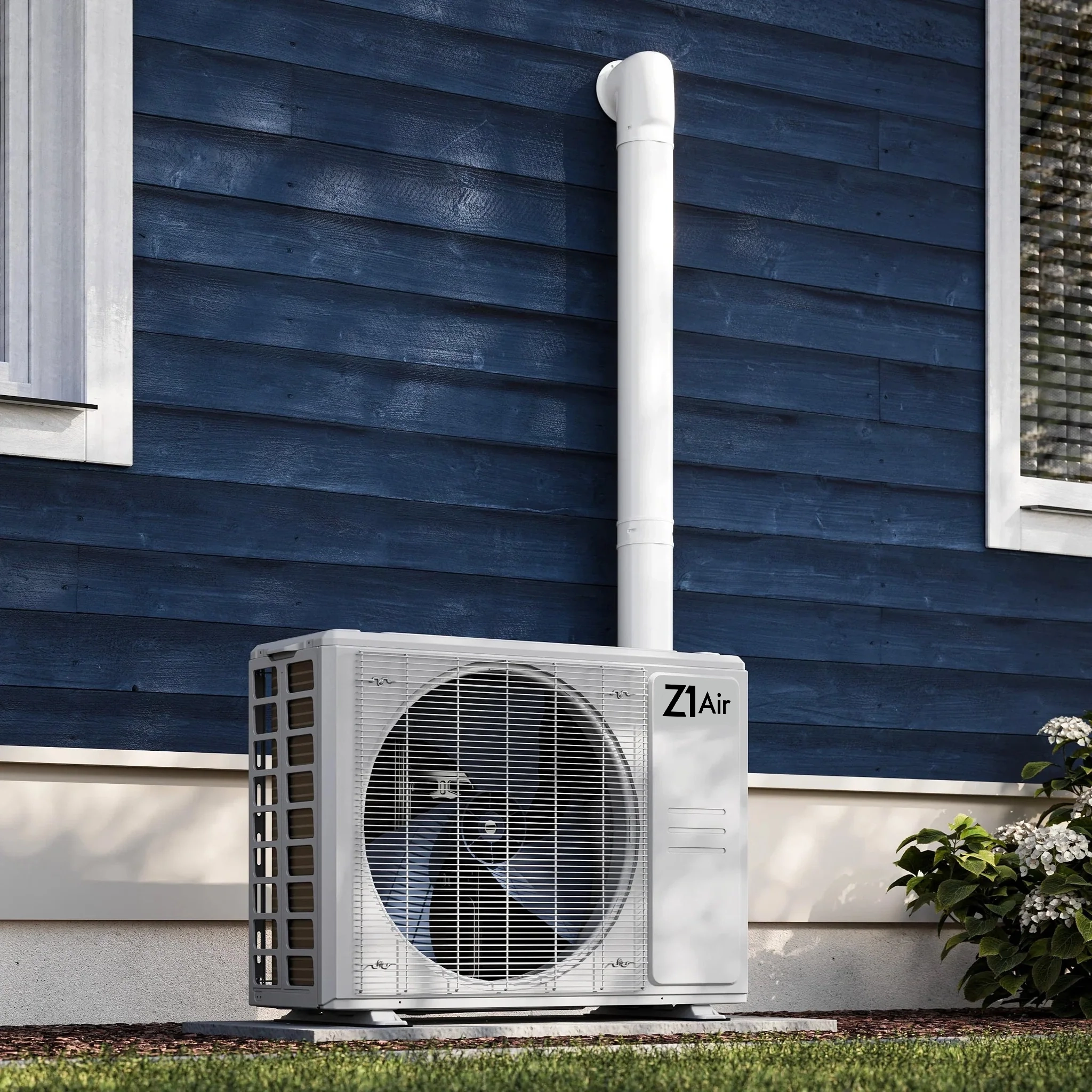

Yes, you can DIY install a mini split. Companies like Zone Air have made it possible with their pre-charged quick-connect lineset systems. All Zone Air systems come with everything you need for a DIY install — no EPA certification needed, no vacuum pump, no refrigerant handling.
Ready to install yourself? You can purchase a DIY mini split system here.
DIY Guide
Essential tools:
Included with your Zone Air DIY mini split system:
May need to buy ($50–$400):
Pre-Installation Planning (Do This First!)
1. Unit Placement
2. Electrical Check
Mini Split Installation Step by Step
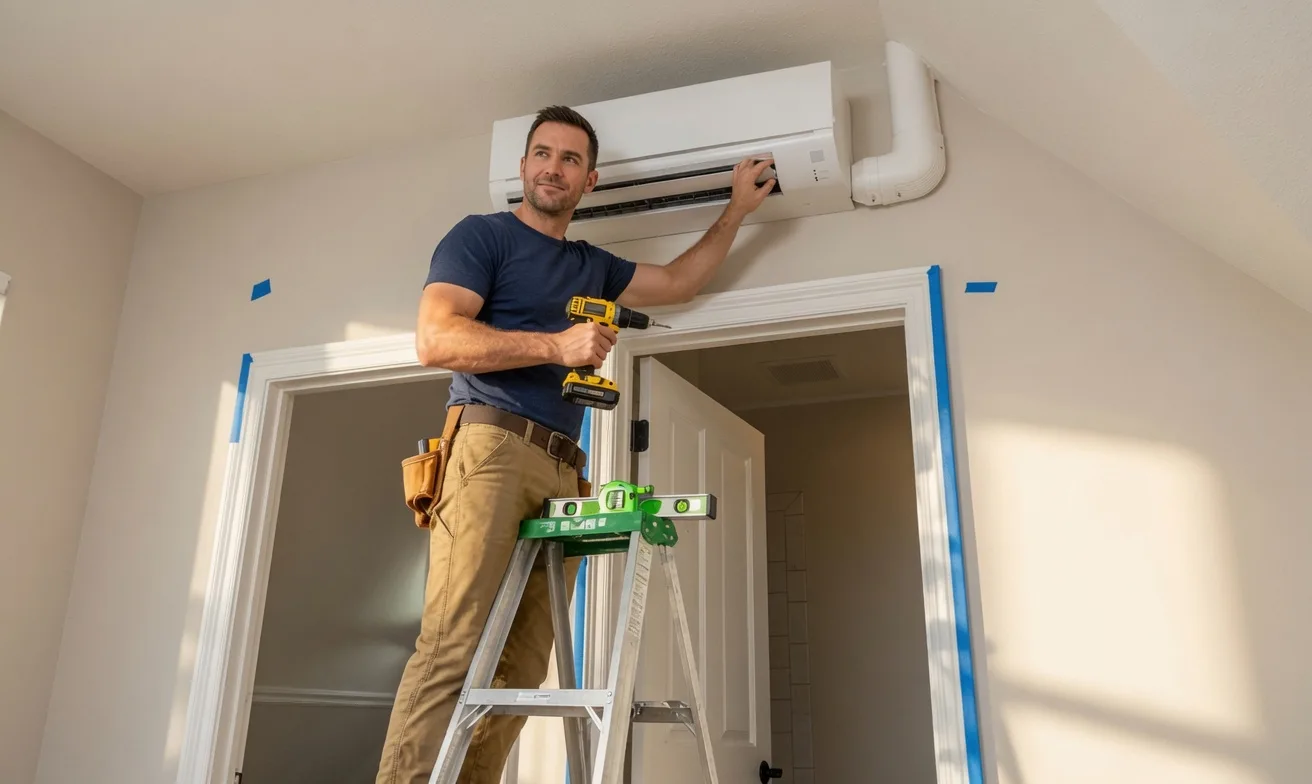
Step 1: Mount the Indoor Bracket
- Find studs with a stud finder and mark the locations.
- Measure 7–8 ft up from the floor.
- Mark a perfectly horizontal, level line (critical!).
- Use the template to mark the screw holes.
- Drill pilot holes into the studs (or use heavy-duty anchors).
- Start all screws, verify level, then tighten.
- Pull-test: the bracket must hold 30–50 lbs without flexing.
Step 2: Drill the Hole (15–30 min)
- Mark the location behind the indoor unit, slightly lower than the unit bottom.
- Check for wires/pipes behind the wall (stud finder).
- Drill with a 3" hole saw, inside to outside, slow and steady.
- Angle downward — 1/4" drop per foot toward the outside.
Step 3: Install the Outdoor Unit
Ground mount (recommended):
- Place a concrete pad/pavers (3–6" above ground).
- Verify perfectly level.
- Position the unit with 12" clearance on all sides.
- Secure to the pad (or use anti-vibration feet).
Wall mount:
- Install the bracket (hit studs, verify level).
- Attach the unit to the bracket.
- Verify level.
Step 4: Connect the Line Set
There are two installation paths depending on the system you bought. Pre-charged systems (Zone Air and similar) use sealed quick-connect fittings — no vacuum pump or refrigerant work required. Traditional flared systems require flaring, nitrogen pressure testing, and evacuation, and EPA Section 608 certification is required to release the factory charge. Pick the path that matches your hardware.
Flare-nut torque specs (always confirm against your unit's manual):
Path A: Pre-charged quick-connect (Zone Air, MrCool DIY, etc.)
- Uncoil the line set carefully. No kinks — restricted refrigerant flow kills capacity. Use a gentle 4" minimum bend radius.
- Feed it through the wall hole, low side first.
- Hand-tighten both fittings at the indoor unit until snug.
- Torque to spec with a calibrated torque wrench (see the table above).
- Repeat at the outdoor unit. Open the service valves with a hex key only after both ends are torqued.
- Seal the wall penetration with foam backer rod and exterior-grade silicone or polyurethane caulk.
⚠️ Over-torqueing is the #1 DIY failure mode. It crushes the brass flare and creates a slow refrigerant leak that takes weeks to show up as warm air. Use a torque wrench, not a "feels tight" wrench.
Path B: Traditional flared install (most non-DIY systems)
This path is what HVAC techs do. EPA 608 certification is required because you handle refrigerant. If your system shipped without a sealed pre-charge, you're on this path.
- Cut and deburr the line ends square. Remove every burr — burrs slice flare gaskets.
- Slide the flare nut on first (every DIYer forgets this once and has to start over).
- Flare to a 45° cone with a flaring tool. The flare face should be smooth, even, and slightly proud of the die.
- Hand-tighten, then torque to the values in the table above.
- Pressure test with dry nitrogen to 500 psi. Hold for 15 minutes minimum (ASHRAE recommends 10 minutes; manufacturers typically spec 15). Any drop means a leak.
- Evacuate the system to below 500 microns with a vacuum pump and micron gauge. Hold for 15 minutes after pump-off; if it climbs above 1000 microns, you have moisture or a leak. Triple evacuation (pull, break with nitrogen, pull again) is best practice in humid conditions.
- Open the service valves to release the factory charge into the system.
- Seal the wall penetration as above.
⚠️ Skipping the pressure test or vacuum hold is the #1 reason traditional installs fail in year one. Moisture inside the lines reacts with refrigerant and oil to form acids that destroy the compressor.
Step 5: Install the Drain (15–30 min)
- Attach the drain hose to the indoor unit.
- Ensure a continuous downward slope (1/4" per foot).
- Terminate outside, away from the foundation.
Step 6: Wire the Electrical
115V systems (9K–12K BTU)
- Run a dedicated 12 AWG copper home run on a 20A breaker (or 14 AWG / 15A for the smallest 9K units).
- Many 115V systems plug into a 5-15R or 5-20R receptacle near the indoor unit — verify the cord and plug match your receptacle.
- Land the inter-unit communication cable per the manufacturer's color-coded diagram. Reversing 1↔2 throws a comm fault but causes no damage.
208–230V systems (18K+ BTU)
- Install a fused or non-fused disconnect within sight of the outdoor unit (NEC 440.14). Even on a dedicated circuit, this is required.
- Run a flexible liquid-tight whip from the disconnect to the unit's electrical compartment.
- Pull copper THHN/THWN-2 conductors per the table below.
- Land L1, L2, and the equipment ground per the wiring diagram on the inside of the access panel.
- Torque every terminal screw to the value stamped on the unit — typically 1.4–2.0 N·m. Loose terminations are the #1 cause of arcing and board failure in the first year. A torque screwdriver is $30 well spent.
- Bond the equipment ground to the green grounding screw on the metal cabinet.
- Run the inter-unit comm cable; match colors exactly.
Step 7: Hang the Indoor Unit (5–10 min)
- Verify all connections are complete.
- Carefully lift the unit onto the bracket.
- Hook into the bracket clips.
- Verify it's secure.
- Tuck lines/wires neatly behind the unit.
Step 8: Test and Start the System
Final inspection:
Power on:
- Turn on the breaker.
- The indoor unit should power up.
- The display will light up.
Initial test run:
- Set to cooling mode.
- Set the temperature 5°F below room temp.
- You should hear the compressor start within minutes.
- Feel for cold air from the indoor unit (within 5–10 min).
Post-Installation
First 24 hours:
DIY Installation: Costs vs. Savings
Your savings: $2,611
Frequently Asked Questions
How long does DIY mini-split installation really take?
First-time: 6–10 hours. Most complete single-zone installations in one Saturday. Time breakdown: indoor bracket (30–60 min), wall penetration (15–90 min depending on material), outdoor unit (45–90 min), linesets (30–60 min), electrical (30–120 min), testing (15–30 min). Second installations go faster (4–6 hours) once you know the process. Multi-zone systems: 14–18 hours total, or 5–6 hours per zone.
Do I need EPA certification to install a mini-split with pre-charged lines?
No. Pre-charged systems require no EPA Section 608 certification because you never open the refrigerant circuit or handle refrigerants directly. You're assembling pre-charged components (like connecting a window AC unit), not performing refrigerant work. Traditional installations require certification because technicians vacuum-evacuate lines, add refrigerant charges, and check pressures. With pre-charged linesets, you skip all refrigerant handling entirely.
Can I install a mini-split if I'm not an electrician?
Yes, if comfortable with basic electrical. 9K–12K BTU units use standard 115V outlets (about ceiling-fan complexity). 18K+ units need 230V circuits (like dryer outlets) — more complex but DIYable if you're experienced with 240V work. Hybrid option: hire an electrician for the new 230V circuit ($300–$600) while you handle the mechanical installation — saves $1,200–$1,800 vs. a full professional install. Check local codes; some require licensed electricians.
What's the hardest part of DIY mini-split installation?
Mentally: overcoming intimidation. Physically: drilling the 3" wall penetration (irreversible, must angle downward, avoid studs/wires). Wood walls: 15–30 minutes. Masonry: 45–90 minutes with a hammer drill ($100–200 to hire for this step alone). Second challenge: lifting the 60–100 lb outdoor unit (requires a helper for wall mounts; ground mounts are easier). Electrical and linesets prove easier than expected — color-coded diagrams and straightforward connections.
Will installing it myself void the warranty?
No — if you register within 30–60 days and follow the instructions. Zone Air covers DIY installations with a 7-year compressor warranty and 5-year parts warranty. Unlike premium brands requiring certified dealer installation, Zone Air supports direct-to-consumer DIY. Warranty excludes installation damage (wrong drill angle, over-tightened connections, etc.) whether DIY or pro-installed. Keep installation photos and registration confirmation.
Do I really save money installing myself or should I hire a pro?
Yes — save $1,500–$2,500 per zone. Professional: $3,550–$5,500 (equipment + labor + permits). DIY: $2,339–$2,439 (equipment + materials). That's $120–$500/hour for 6–10 hours of work. Multi-zone bundles compound the savings ($3,000–$5,000 across three zones). Hire a pro if you have zero DIY experience, are uncomfortable with heights, have brick/concrete walls, a commercial property, or are time-constrained. Hybrid option: DIY most of the work and hire an electrician ($300–$600) or a handyman for masonry drilling ($100–$200) — saves $1,000–$1,800.
Questions? Our technical team is available 9–5 MST to guide you through your DIY installation.
Save $1,500–$3,000 by installing yourself with Zone Air's DIY-friendly wall-mounted mini splits.