Concealed Duct Mini Split Systems
Concealed mini splits — also called ducted mini splits, slim-duct mini splits, or ducted heat pumps — hide the indoor air handler completely above the ceiling, typically in an attic, soffit, or dropped ceiling cavity. Short, small-diameter duct runs deliver heating and cooling to discreet vents in 2–4 rooms. The cleanest aesthetic in ductless HVAC: only the vents are visible.
- ✓Up to 19.6 SEER2 energy efficiency
- ✓Completely hidden above the ceiling — only vents visible
- ✓Short duct runs to 2–4 rooms from one indoor unit
- ✓Heat pump heating down to -13°F year-round
- ✓Pre-charged linesets for simpler installation
Benefits of a Concealed Duct Mini Split
Why a concealed ducted mini split is the right pick for finished spaces where aesthetics matter — and how short duct runs differ from full-house central ductwork.
Fully hidden install
The air handler tucks above the ceiling in an attic, soffit, or dropped ceiling cavity. Only the supply vents and one return grille are visible — no wall head, no cassette frame, no exposed HVAC.
Short duct runs only
Concealed ducted mini splits run 8–15 ft branches per vent. No whole-house ductwork, no air-handler closet, no return-air trunk lines. Plan one cavity, condition 2–4 rooms.
Up to 19.6 SEER2 efficiency
Inverter compressors hit 19.6 SEER2 in the concealed lineup — meaningfully higher than the 14–16 SEER2 typical of central AC, and on par with other ductless form factors.
Heat and cool from one unit
Heat pump operation works to -13°F outdoor for heating and 122°F outdoor for cooling. One concealed unit replaces a central AC plus a furnace or space heater across the full year.
Whisper-quiet — air handler hidden
Indoor sound as low as 39 dB in quiet mode — and the air handler is tucked above the ceiling, so you hear airflow at the vents, not motor noise. The compressor lives outdoors.
One unit conditions 2–4 rooms
Branch ducts split a single concealed head across a master bedroom plus en-suite plus closet, or a great room plus a connecting hallway. Whole-house? Use a multi-zone bundle instead.
Concealed Duct Mini Split Systems
Hidden slim-duct mini splits that install above the ceiling. Short duct runs to multiple rooms with only discreet vents visible. Up to 19.6 SEER2.
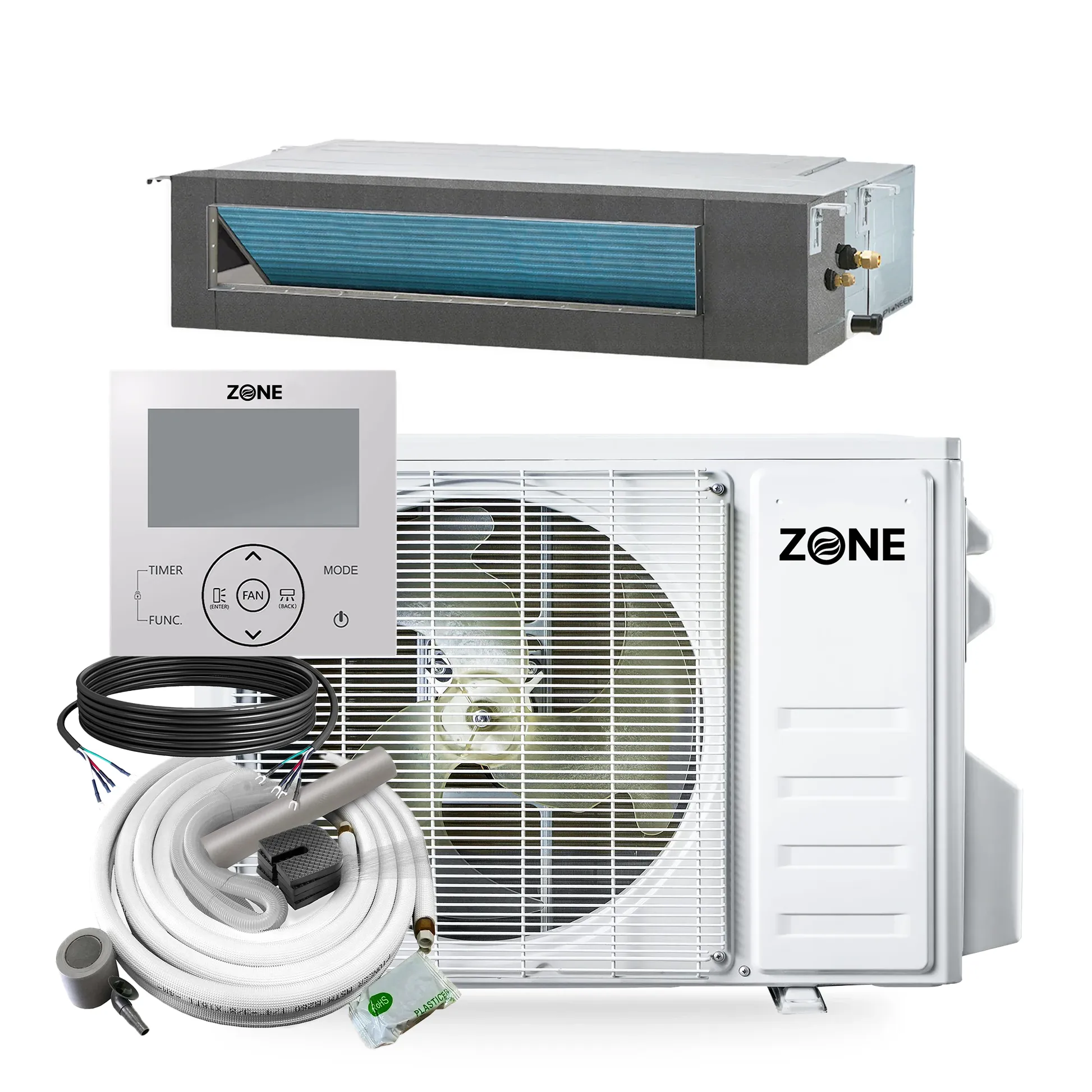
Zone Air® Thin-Air 9,500 BTU 19.6 SEER2 230V Concealed Mini-Split Heat Pump AC - Up to 475 Sq Ft
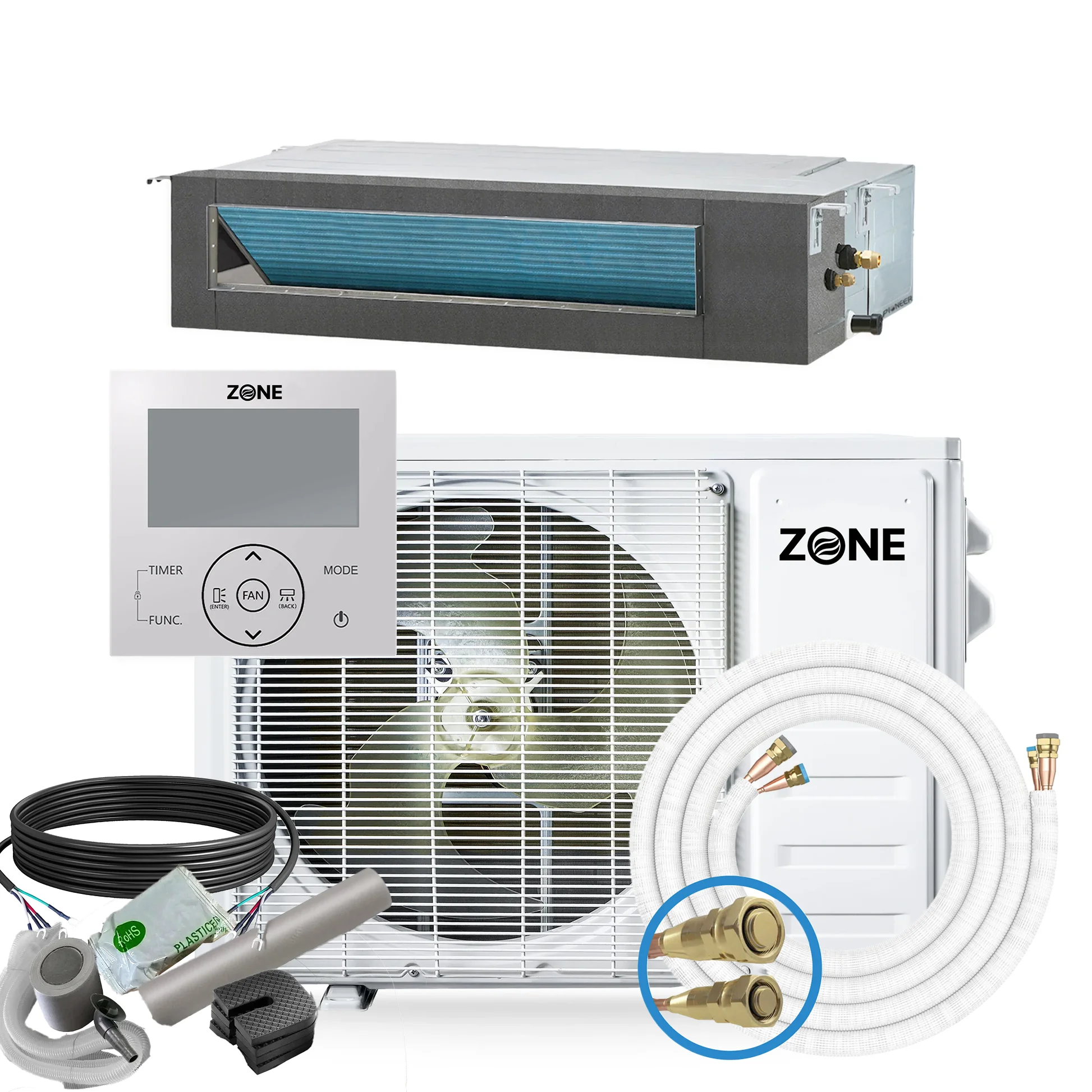
Zone Air® Thin-Air 11,000 BTU 19 SEER2 230V Concealed Mini-Split Heat Pump AC - Up to 550 Sq Ft
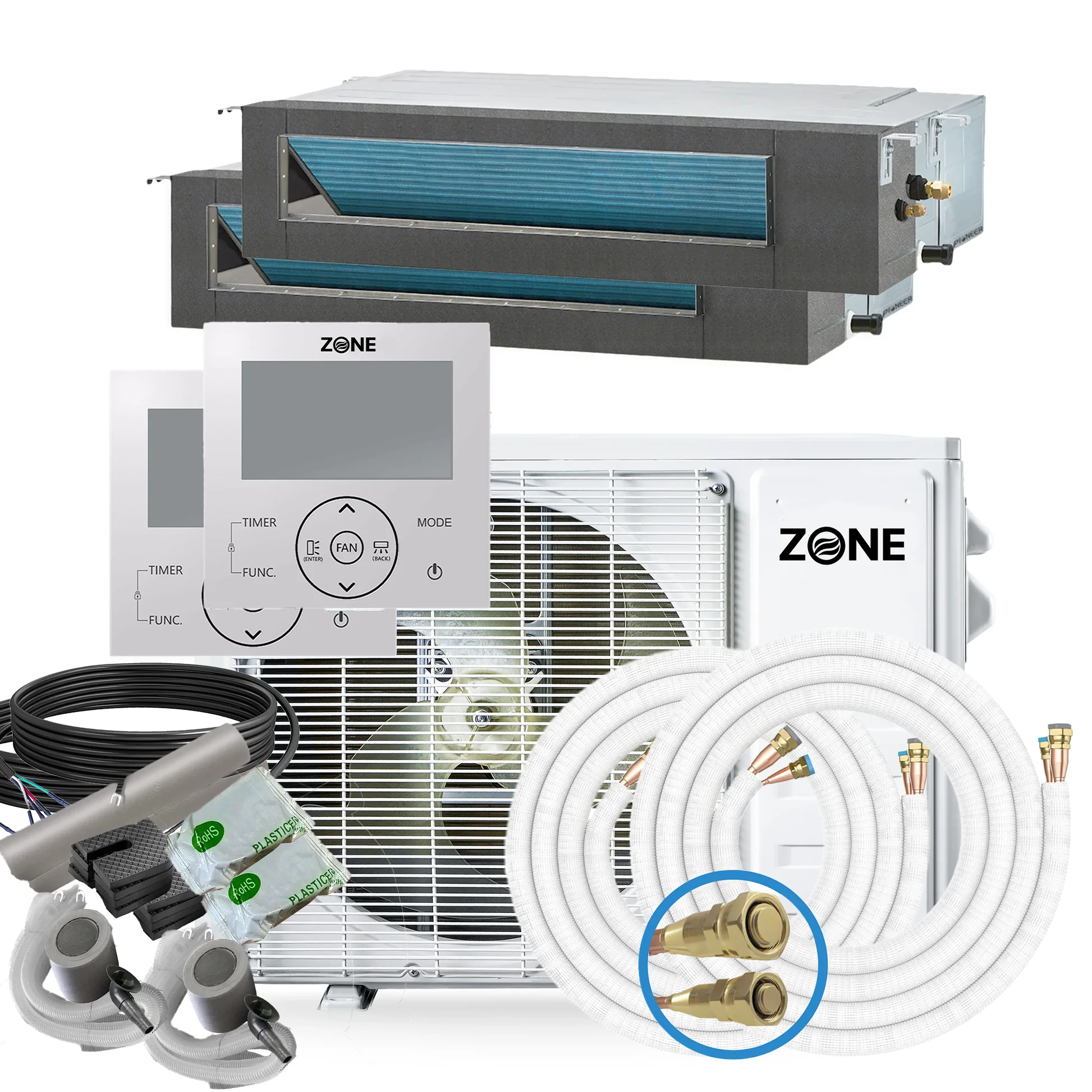
Zone Air® Thin-Air DUAL ZONE 19,000 BTU (9.5K+9.5K) 19 SEER2 230V Concealed Mini-Split Heat Pump System - Up to 950 Sq Ft
Zone Air® Thin-Air DUAL ZONE 20,500 BTU (11K+9.5K) 19 SEER2 230V Concealed Mini-Split Heat Pump System - Up to 1,025 Sq Ft
Zone Air® Thin-Air DUAL ZONE 22,000 BTU (11K+11K) 19 SEER2 230V Concealed Mini-Split Heat Pump System - Up to 1,100 Sq Ft
Concealed (ducted) mini splits hide completely above the ceiling or in an attic. Only small supply and return grilles are visible in the room — the air handler, refrigerant lines, and ductwork are all out of sight. Ideal for homeowners who want powerful heating and cooling without any visible equipment.
How They Work
A compact air handler installs above the ceiling and pushes conditioned air through short duct runs to recessed vents. Unlike central air with long ductwork throughout the house, ducted mini splits use short runs (under 15 ft) that avoid the 20–30% energy loss typical of traditional systems.
Installation
Concealed systems need 8–12 inches of clearance above the ceiling. Our pre-charged linesets simplify the refrigerant connection, but we recommend working with an HVAC contractor on the ductwork layout. All models require 208–230V service and include a built-in condensate pump.
Efficiency & Noise
Up to 19.6 SEER2 with inverter-driven compressors. Indoor noise runs at just 39 dB in quiet mode — with the air handler tucked above the ceiling, sound in the room is minimal. A single unit can condition 2–4 rooms depending on duct layout.
What's Included
Slim-duct indoor air handler, outdoor condenser, pre-charged 16 ft lineset, wireless remote, built-in condensate pump, and all installation hardware. Ductwork and grilles are sourced separately to match your layout. 5-year parts / 7-year compressor warranty with live support (9–5 MST).
Concealed vs Ducted Mini Split — What's the Difference?
There isn't one. "Concealed mini split" and "ducted mini split" refer to the same product class — an indoor air handler hidden above the ceiling that delivers conditioned air through short duct runs to ceiling vents. You'll also see the terms slim-duct mini split, ducted heat pump, horizontal ducted mini split, and hidden ductless mini split used interchangeably. The naming splits along audience lines: residential shoppers tend to search "concealed mini split" because the visual outcome (no visible head) is what they want; HVAC contractors and spec writers tend to write "ducted mini split" because that describes how the air actually moves. Both refer to the same hardware. If you want a visible indoor unit instead, compare with wall mount mini splits or ceiling cassettes.
BTU to Ton Conversion for Concealed Systems
Sizing a concealed duct mini split uses the same BTU-to-square-foot math as any other mini split, but with one wrinkle: short duct runs introduce a small static-pressure penalty, so most manufacturers list the rated capacity slightly below the BTU class. Zone Air's 9K concealed is rated at 9,500 BTU; the 12K concealed is rated at 11,000 BTU. Below is the standard BTU-to-ton conversion for reference, plus where Zone Air's concealed inventory currently sits:
| BTU/hr | Tons | Typical room size | Concealed availability |
|---|---|---|---|
| 6,000 | 0.5 | 150–250 sq ft | n/a — too small for ducted |
| 9,000 | 0.75 | 200–350 sq ft | 9K concealed single-zone |
| 12,000 | 1.0 | 350–550 sq ft | 12K concealed single-zone |
| 18,000 | 1.5 | 600–850 sq ft | dual-zone bundle covers this range |
| 24,000 | 2.0 | 900–1,200 sq ft | dual-zone concealed bundle |
| 36,000 | 3.0 | 1,400–1,800 sq ft | tri-zone bundle |
| 48,000 | 4.0 | 1,800–2,400 sq ft | quad-zone bundle |
Zone Air's single-zone concealed inventory tops out at the 12K class. If you need more than 12,000 BTU of hidden capacity, multi-zone bundles add a second concealed head on the same outdoor condenser — usually a better fit than trying to oversize a single concealed unit, because short duct runs work best when the air handler matches the served area, not when one head pushes air through 40 ft of branch duct.
Sizing a Concealed Duct System
Concealed sizing differs from wall-mount sizing in one important way: the duct runs themselves cap how far conditioned air can travel before throw and pressure drop kill the result. Plan for short runs — 8 to 15 ft per branch — and treat the served area as the rooms within that radius, not the entire floor.
- 14×16 master bedroom + en-suite via duct branch — 224 sq ft of bedroom plus a small bath. The 9K (rated 9,500 BTU) concealed handles both spaces from one ceiling-cavity install with a short branch to the bath vent.
- 18×22 great room — 396 sq ft of open living. The 12K (rated 11K) concealed is correctly sized when ceilings are 8 ft and there's no kitchen heat load. With vaulted ceilings, derate to two heads via a dual-zone bundle instead of pushing the 12K beyond its short-duct comfort range.
- 2 adjacent bedrooms with shared ceiling cavity — tempting to feed both from one 12K with a tee branch, but separate thermostats matter for sleep. Pick a dual-zone bundle with two heads sharing one outdoor unit and you get independent control.
- Whole-house concealed — not recommended. Concealed mini splits are designed around short duct runs and a 2–4 room footprint per head. If you want hidden HVAC across an entire floor plan, the right answer is multiple concealed heads on a multi-zone outdoor unit, not one oversized head pushing air through 40+ ft of branch duct. Concealed isn't a substitute for central ducted HVAC.
How to Choose a Concealed Duct Mini Split
Three decisions, in order:
1. Confirm concealed is right for your space. Concealed wins when you have ceiling cavity, attic, or soffit access above the rooms you want conditioned and the aesthetic of a hidden indoor unit matters. If your ceiling is on a slab with no cavity, wall mount is the right pick. If you have a drop ceiling and want a visible-but-recessed unit with four-way airflow, ceiling cassettes install faster and cost less than a full concealed system.
2. Plan your duct path. Walk the ceiling cavity or attic and confirm you have headroom for the air handler (Zone Air concealed units are about 8 inches tall) plus space for short branch ducts to each room vent. Map out where the supply vents land in the rooms below and where the return-air grille goes. Soffit-mount installs are the cleanest path when an attic isn't available. If duct runs would exceed 15 ft per branch, split the load across two concealed heads via a dual-zone bundle instead.
3. Pick BTU class. Use 20 BTU per square foot of conditioned area as a starting point, derate for sun-facing walls (–15%), vaulted ceilings (–10% per foot over 8 ft), and open kitchens (–25%). A 14×16 bedroom plus en-suite lands on 9K. An 18×22 great room or master suite lands on 12K. For two separate rooms, skip single-zone concealed and pick a dual-zone bundle so each room gets its own thermostat.
The most common concealed sizing mistake we see is upsizing "for headroom." A 12K in a room that wanted 9K short-cycles, removes less humidity, and uses more electricity. Concealed installs amplify this because short duct runs make the inverter compressor sensitive to load mismatches. If you're between sizes, derate before you upsize.
What's Included with Every Zone Air Concealed System
Every concealed duct mini split ships with the indoor air handler, outdoor condenser, 16 ft pre-charged R454B refrigerant lineset, wireless remote, built-in condensate pump, mounting hardware for both indoor and outdoor units, and a 5-year parts / 7-year compressor warranty. Free shipping on every order, 45-day returns, live tech support 9–5 MST. Honest tradeoff: concealed installs cost a few hundred more than the equivalent wall mount and require ceiling cavity access plus 2–4 hours of additional install time for ductwork. In exchange you get a fully invisible indoor unit and conditioned air to 2–4 rooms from a single head.
Frequently Asked Questions About Ducted Mini Splits
Common questions about concealed mini split systems, installation, and pricing.
What is a concealed mini split?
How is a ducted mini split different from central air?
Can a concealed mini split cool multiple rooms?
What does ducted mini split installation involve?
How much does a concealed mini split cost?
Is a concealed mini split right for my home?
Explore More Mini Split Systems
Browse our full range of mini split systems, bundles, and accessories.
9,000 BTU Systems
For rooms 200–350 sq ft. The 9K concealed is rated 9,500 BTU, hidden above the ceiling.
Learn More →12,000 BTU Systems
The most-installed size — master bedrooms, living rooms 350–550 sq ft. 12K concealed available.
Learn More →Single Zone Systems
One indoor unit, one outdoor unit. Wall, cassette, and concealed options 9K–18K BTU.
Learn More →Wall Mount Systems
Wall-mounted mini splits for individual rooms. 9K–18K BTU, 115V and 230V options from $1,899.
Learn More →Dual Zone Bundles
Two indoor units, one outdoor unit. Independent temperature control in two rooms from $4,299.
Learn More →Ceiling Cassettes
Ceiling-mounted mini splits with 4-way airflow for offices, commercial spaces, and modern homes.
Learn More →Line Set Extensions
Pre-charged refrigerant line extensions for longer runs. No vacuum pump needed.
Learn More →Accessories
Professional mounting brackets, wall caps, and installation accessories.
Learn More →Sizing Calculator
Find the right BTU capacity for your room size, insulation, and climate.
Learn More →Installation Guide
Step-by-step DIY mini split installation walkthrough with tips and tools.
Learn More →SEER Rating Guide
Learn how SEER2 ratings affect energy efficiency and your utility bills.
Learn More →Invisible Comfort, Powerful Performance
Concealed mini splits hide completely above the ceiling — delivering heating and cooling to multiple rooms with only discreet vents visible. Free shipping on every order.
Shop All Products