
Best HVAC Systems for Apartments
The best HVAC systems for apartments are often compact, easy to install, and semi-permanent. At Zone Air, we design all of our air conditioners around these considerations. If you’re looking for the perfect apartment HVAC solution, check out our mini split systems for apartments →
Ready to find the right system for your apartment?
Not sure what size you need?
Use the Mini Split Sizing Calculator →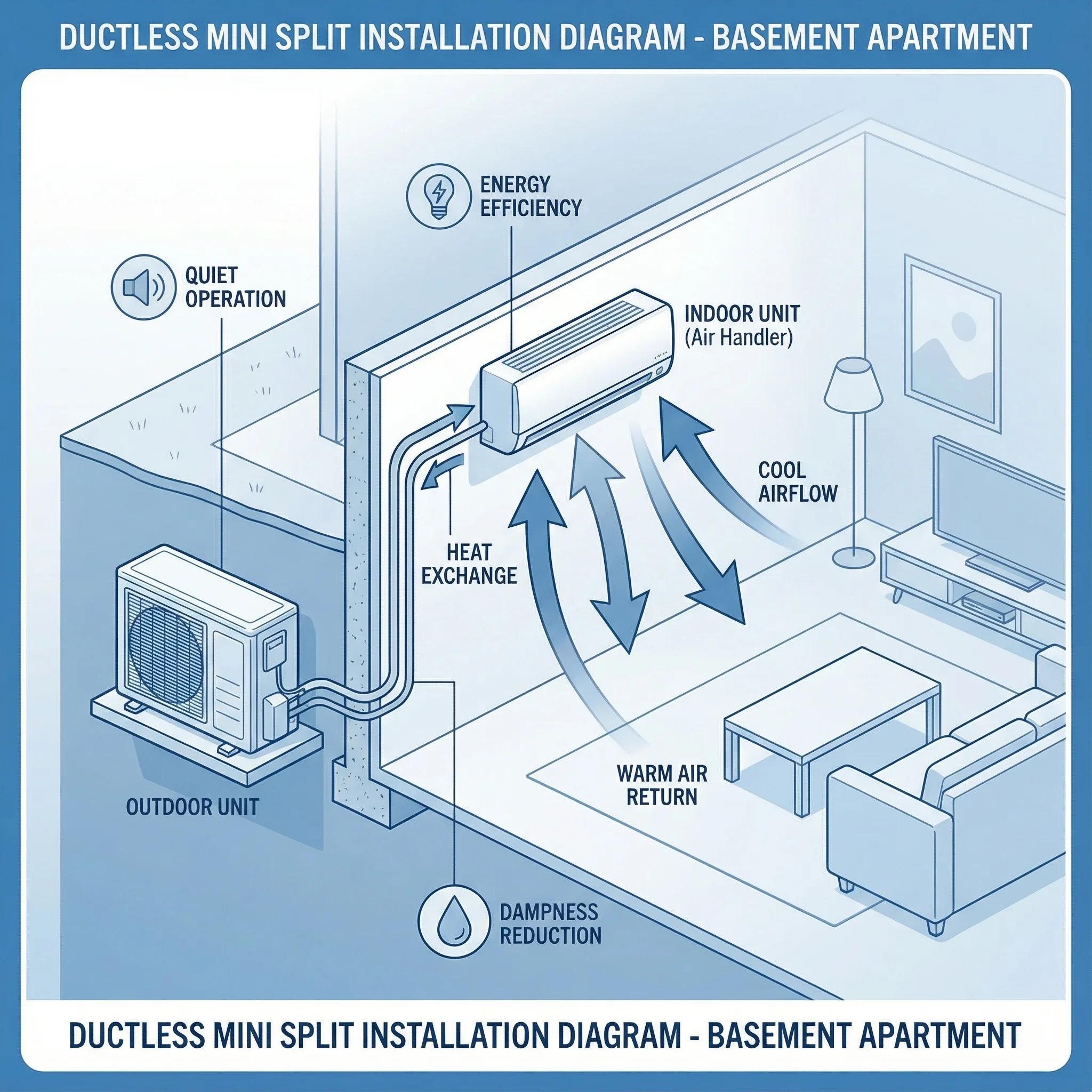
Types of HVAC Systems in Apartment Buildings
Different types of HVAC systems are used depending on building age, system size, and layout. The three main categories are centralized systems, decentralized in-unit systems, and hybrid approaches like ductless mini splits. Property managers typically maintain centralized equipment, while individual unit owners handle decentralized cooling and heating needs.
Centralized Systems
Centralized systems distribute air from a single location, usually a mechanical room housing chillers, boilers, and large air handlers. Conditioned air or water travels through risers and ducts to fan coil units in each apartment, giving property owners consistent comfort across multiple units.
Pros: Easier for property managers to maintain, potentially lower per-unit maintenance costs, and uniform heating and cooling across the building.
Cons: Limited individual temperature control for tenants, energy losses in long duct runs, and risk of system-wide failure affecting the entire building.
Decentralized & In-Unit Systems
Decentralized systems provide individual units for each apartment. PTAC units are self-contained and often installed under windows, providing both heating and cooling without requiring ductwork modifications. Other options include through-the-wall air conditioners, small furnaces, or packaged forced air systems.
Residents benefit from their own thermostat and separate energy bills, giving them greater control over different temperatures in different zones. The drawback is more total cooling equipment and cooling systems to maintain across apartment complexes, with variable efficiency between older and newer models.
Ductless Mini-Split Heat Pumps for Apartments
Ductless mini-split systems require no ductwork for installation, making them ideal for spaces without existing ductwork. They consist of an outdoor condenser and one or more indoor units connected by small refrigerant lines. Each indoor unit has its own thermostat, providing zoned temperature control without requiring ductwork.
Ductless mini-splits can be up to 3x more efficient than traditional systems like baseboard heaters or conventional furnaces, and installation is generally easier than other systems. They are ideal for buildings needing flexible heating and cooling solutions. Apartment HVAC systems often use units that do not require extensive ductwork, and mini splits fit that need perfectly.
Zone Air offers DIY-oriented, pre-charged mini-split systems with efficiency ratings up to 24 SEER2, designed for apartments, studios, and condo units. Compare options among our single-zone systems for one room or multi-zone systems for larger units. The same ductless approach solves the equivalent problem in a mobile or manufactured home, where the under-floor ducting is usually the first thing to fail.
Key Considerations When Choosing an Apartment HVAC System
Whether you are a property manager, condo board member, or individual owner, keep these factors in mind:
- Apartment size and layout: The system’s BTUs must match the square footage of the apartment. Proper unit sizing is critical for HVAC system efficiency and effectiveness. Use a mini split sizing calculator to match capacity to your space.
- Climate: In mild regions, standard-efficiency equipment works fine. In colder regions, cold-climate rated heat pumps are essential for efficient heating below 0°F.
- Efficiency ratings: High SEER ratings indicate better energy efficiency. Look for SEER2 and HSPF2 ratings that translate to lower utility costs over 10–15 years.
- Noise: Noise levels should be considered when selecting HVAC systems for small spaces, especially with shared walls. Quiet ductless systems often run under 30–40 dB indoors.
- Ownership rules: Landlord or HOA approval may be needed for exterior condensers. Check building façade restrictions before purchasing.
- Controls: The thermostat controls the temperature setpoint, and smart thermostats improve HVAC energy efficiency by optimizing usage patterns automatically.
- Warranty: Regular maintenance and the right warranty are important for HVAC system longevity.
Energy Efficiency, Comfort & Operating Costs
Energy efficient HVAC systems reduce energy bills significantly, a fact that matters to both tenants seeking lower electricity costs and property managers aiming for tenant satisfaction. Units with high SEER ratings help minimize monthly energy bills, while cold-climate heat pumps can be up to 3x more efficient than traditional systems like electric resistance baseboard heaters or older air conditioners.
Heat pumps are up to 3x more efficient than conventional furnaces paired with central AC because they move heat rather than generate it. Heat pumps can reduce energy bills compared to fossil fuel systems, and zoned temperature control enhances energy efficiency in apartments by conditioning only occupied individual rooms.
Practical steps to reduce energy bills
- Set heating to 68°F and cooling to 76°F during occupied hours.
- Use setback schedules when away.
- Keep doors closed between zones in multi-zone setups.
- Seal drafts around windows and exterior doors.
Many U.S. states and utilities offer rebates. (The federal 25C tax credit ended for systems placed in service after December 31, 2025.) Zone Air systems are designed to qualify for common state and utility incentives, helping offset upfront costs and maximize long-term savings. Check what’s available in your area with our rebate calculator.
Find the right HVAC system for your apartment, or size it first with the free calculator.