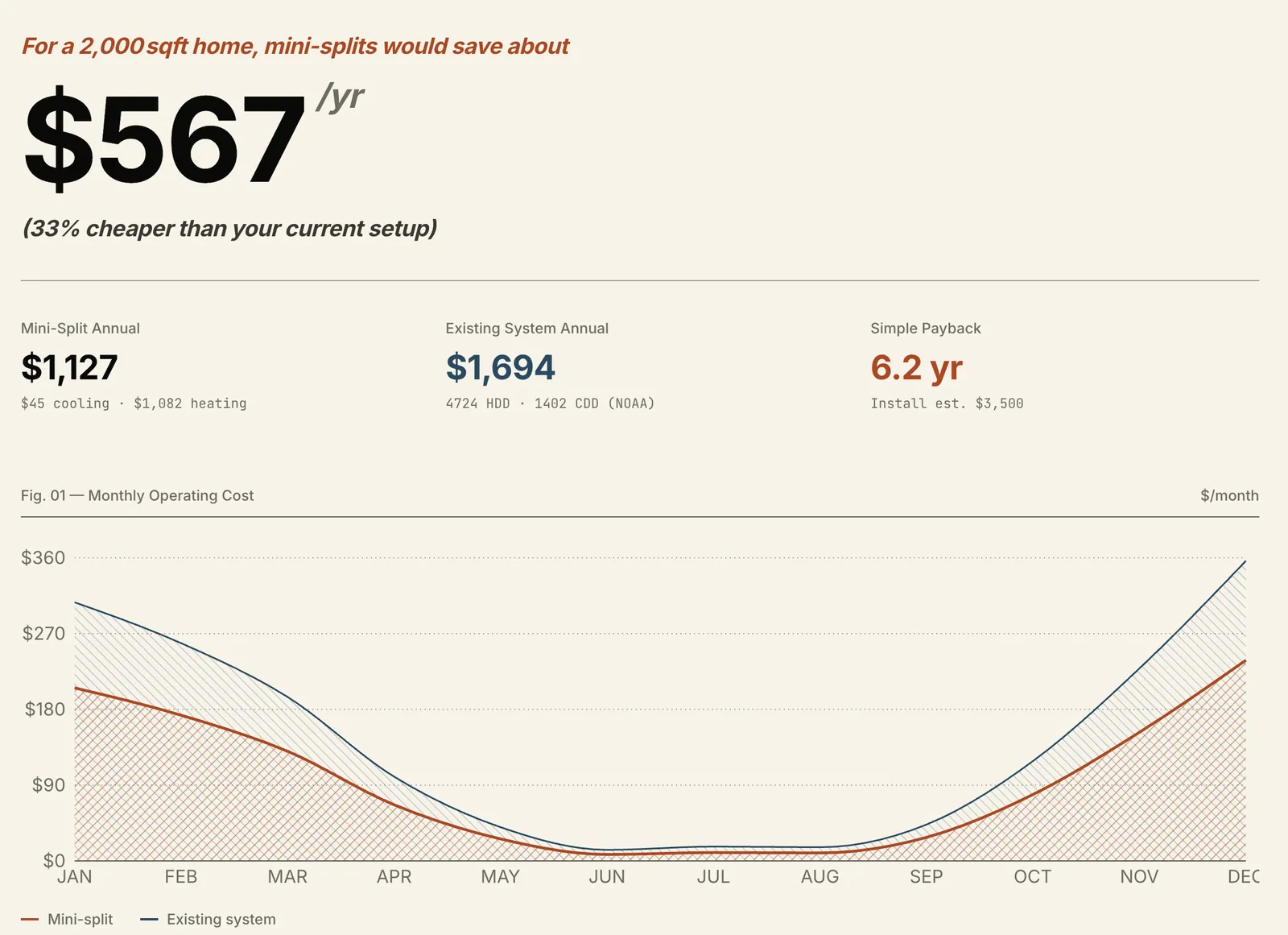

Answer: Mini-splits are almost always the more cost-efficient choice for homeowners versus traditional central heating and air. They typically save 30–50% on heating and cooling costs compared to traditional systems. Because mini-splits avoid the energy loss of long duct runs, they transfer energy between the outside and inside far more efficiently. For most homeowners that works out to $500–$1,000 per year, or $7,500–$15,000 over the system's 15–20 year lifespan.
To get specific run-cost savings for your own home, use this handy run-cost calculator.
💰 Interactive savings tools: Run your own numbers with our Whole Home Savings Calculator and Energy Savings & ROI Chart.
Estimated Monthly Cost to Run a Mini Split Heat Pump
By system size, based on 8 hours/day at $0.14/kWh:
ENERGY STAR Efficiency: Cost Impact
A higher-efficiency system widens the gap every month. For a 2,000 sq ft home in a moderate climate, here is a 24 SEER2 Zone Air mini split against a standard 14 SEER2 central system (figures vary by region):
That gap reflects better energy efficiency: mini-splits often post SEER ratings above 20, while most central AC systems fall between 13 and 16. As a benchmark, a SEER 25 mini-split cuts the electricity bill roughly 36% versus a SEER 16 system.
How to Reduce Your Mini Split Operating Cost and Electric Bill
The tactics below are ranked roughly by effort-to-savings ratio. Combined, they typically cut a mini split's operating cost by 40–60% versus running it at default settings.
Combined savings potential: a 40–60% reduction.
Real-World Cost Examples
Annual savings for a 2,000 sq ft home across three climates:
Standby Power Consumption
Even when they are not actively heating or cooling, mini-splits draw a trickle of power. A typical indoor unit uses 3–10 watts in standby — about $0.30–$1.00 per month, or $3.60–$12.00 a year. To trim it, switch the unit fully off when you will be away for weeks at a time; modern units already have very low standby draw.
Peak vs Off-Peak Rates
If your utility offers time-of-use pricing, summer daytime cooling might run $0.25/kWh while overnight drops to $0.12/kWh. Pre-cool during off-peak hours and lean on ECO mode during peak windows to shift load off the expensive periods — a 20–30% saving for most time-of-use households.
Seasonal Cost Variation
A typical annual pattern in a moderate climate:
That averages about $35/month, or $420/year.
Total Annual Operating Cost
Electricity is the main operating cost and varies with use; ductless mini-split systems can cut energy consumption 50–60% versus many traditional setups. Add light maintenance and the occasional repair, and the all-in picture looks like this:
Over their lifespan, ductless systems also avoid more than 4,500 pounds of greenhouse-gas emissions.
Bottom Line: Do Mini Splits Save Money?
The answer is a resounding yes — a smart investment for long-term home comfort and lower operating costs. Mini-splits typically cost 30–50% less to operate than the alternatives, especially versus standard systems that bleed efficiency through ducts via heat transfer and other losses.
Frequently Asked Questions
How much does it cost to run a mini split per month? Running a mini split costs $25–$75/month depending on usage and system size. A 12K BTU unit running 8 hours daily costs $30–$45/month for cooling or $50–$70/month for heating. Year-round use (cooling + heating) averages $40–$60/month — 30–50% less than central air or electric baseboard heat for the same space.
How much does a mini split increase your electric bill? A mini split adds $25–$75/month ($300–$900/year) depending on usage. But if it is replacing electric heat, window AC units, or central air, your total bill typically decreases by 30–50%. Since heating and cooling account for about half of a typical household energy bill, replacing an inefficient system has an outsized impact on total costs.
What is the cheapest way to run a mini split? Minimize costs by (1) setting 78°F cooling / 68°F heating, (2) using zone control to condition only the occupied space, (3) cleaning filters monthly, (4) using sleep/eco modes, (5) setting temps back when away, (6) ensuring proper insulation, and (7) choosing a 20+ SEER2 system. Together these strategies can cut costs 30–40%.
How much does it cost to run a mini split 24/7? A 12K BTU mini split run 24/7 costs roughly $60–$110/month ($720–$1,320/year) depending on whether you are heating or cooling. Continuous operation at low inverter fan speeds is often more efficient than on/off cycling — though most homes do not need 24/7 operation outside extreme climates.
Is it cheaper to run a mini split or central air? A mini split is often the more efficient option for the same area. A 12K BTU mini split costs $30–$45/month versus $50–$70/month for equivalent central air. The savings come from higher SEER ratings and from ductless refrigerant tubing that connects the outdoor unit to a wall-mounted indoor unit — transferring heat without ductwork losses, which add up across the whole house when you only condition the rooms you use. Annual savings: $200–$400 per zone.
What are the best alternatives to electric heat? For most homeowners, a mini split is a better whole-room option than space heaters or gas-based heating — lower operating costs and steadier comfort. For many homes, swapping standard systems for mini-splits is simply the practical HVAC decision when efficient heating and cooling matter most.
Related Articles & Hubs:
- Mini Split Sizing Calculator — free Manual J BTU calculator
- 2026 Mini Split Rebates by State — HOMES, HEAR, and utility programs up to $15,000+
- 10 Best Mini Splits of 2026 — ranked by SEER2, warranty, and price
- Best Mini Split for a Garage — sizing for 1-, 2-, and 3-car
- Can One Mini Split Cool a Whole House? — sizing tables
- SEER Rating Explained
- Mini Split Installation Cost
- Shop 9,000 BTU Mini Splits (200–350 sq ft)
- Shop 12,000 BTU Mini Splits (350–550 sq ft)
- Shop 18,000 BTU Mini Splits (600–850 sq ft)
- Shop Dual Zone Bundles — multi-room cooling, biggest savings
- Shop Concealed Duct Mini Splits — hidden above the ceiling