
If you have spent any time researching ductless mini split systems for your home, you have probably seen MRCOOL dominate the conversation. So is MRCOOL the only DIY mini split on the market? The short answer is no — and the longer answer matters if you care about reliability, cold-climate performance, and where your equipment is actually built.
Quick Answer: Is MRCOOL the Only DIY Mini Split?
MRCOOL is not the only true DIY mini split. Zone Air DIY systems are the other fully DIY option that ships with a pre-charged line set, a sealed refrigerant circuit, and quick-connect fittings — no vacuum pump, no EPA license, and no HVAC certification required.
Plenty of companies market "easy installation" mini splits. Brands like Pioneer and Senville advertise "pre-charged condensers," but in most cases the line set itself ships empty. That means you still need a vacuum pump, manifold gauges, and a licensed tech to handle refrigerant legally. Those are not real DIY — they are DIY-friendly at best.
As of 2026, Zone Air and MRCOOL are the two major brands offering true DIY ductless mini split heat pump systems with pre-charged line sets designed specifically for homeowner installation. Every other brand falls short of that standard in some meaningful way.
Why does it matter? A true DIY install skips contractor labor entirely — no scheduling headaches, no weeks-long wait times — and you still get professional-grade heating and cooling.
What Makes a Mini Split "Real DIY" (And Why Most Are Not)
A genuine DIY system means you can install it without pulling a vacuum, handling refrigerant, or hiring a licensed HVAC pro — using tools most homeowners already own: a drill, a wrench, a level. Here is what separates a true DIY unit from a "DIY-friendly" one:
Contrast that with brands like Senville, where the outdoor condenser is pre-charged but the line set ships empty. Extend the lines or break the seal and you have to vacuum the system and add refrigerant — tasks that legally require an EPA-certified installer. A genuinely pre-charged line set removes that requirement.
Both MRCOOL and Zone Air ship their DIY systems as complete ductless heat pumps with all refrigerant pre-loaded into the line set. That is what makes them legitimate DIY for typical homeowners with moderate skills. For why a sealed line needs no vacuum, see do you need to vacuum a pre-charged mini split.
MRCOOL DIY Mini Splits: What They Offer
The MRCOOL DIY series is one of the first widely marketed consumer DIY ductless heat pump lines in North America. The company built its reputation by making a system accessible to homeowners who previously had no option but to call a contractor. A typical MRCOOL DIY unit includes:
Capacity: single-zone units from ~9,000 BTU up to 36,000 BTU; a 12,000 BTU model typically covers ~500 sq ft, with multi-zone options for multiple rooms.
Efficiency and cold climate: the 4th-generation line reaches up to ~22–23.9 SEER2; standard DIY models heat down to about -13°F, and Hyper Heat variants are rated to roughly -22°F. Energy Star certification matters for rebate eligibility.
Warranty: 5-year parts and 7-year compressor when properly registered, and MRCOOL's DIY line does not require professional installation to keep coverage. Always read the fine print — warranty length tends to track expected reliability.
MRCOOL DIY systems can be installed in a few hours by one homeowner, with no specialized tools and no HVAC certification required.
Zone Air DIY vs MRCOOL: The Two True DIY Mini Splits
Zone Air is the other true DIY option — a direct-to-consumer manufacturer focused specifically on DIY ductless heat pump systems. Both brands check the "true DIY" box; the differences show up after you open the box.
USA-based assembly and testing: Zone Air systems are assembled, inspected, and tested in Salt Lake City, Utah. Every unit goes through quality control before it ships, which targets the defects — corrosion, refrigerant leaks, compressor failures — that shorten a system's life. By contrast, many MRCOOL units are manufactured overseas (often by Midea).
Installation: both use pre-charged line sets with quick-connect fittings. The Zone Air flow: mount the air handler, route the line set through the wall, connect the communication wire, hang the outdoor unit, torque the fittings, and power up — hours, not days. See the step-by-step install guide.
Efficiency: Zone Air DIY systems reach up to 24 SEER2, matching or edging out MRCOOL's best, and carry Energy Star and cold-climate certifications for rebate eligibility.
Cold-climate heating: Zone Air models are rated to -13°F, holding useful heating output well below freezing — enough for northern states and border climates.
Warranty and support: Zone Air includes a 5-year parts warranty, a 7-year compressor warranty, and a 45-day satisfaction guarantee, with U.S.-based direct-to-consumer support for parts and service questions.
Sizes: 9,000, 12,000, 18,000, and 24,000 BTU — covering garages, bonus rooms, home offices, and small apartments.
When shoppers ask "is MRCOOL the only DIY mini split," the real short list is MRCOOL and Zone Air. Every other brand still requires a vacuum and a pro for the refrigerant circuit. For a deeper head-to-head, see Zone Air vs MrCool.
How DIY Mini Splits Work: Components, Line Sets, and Wiring
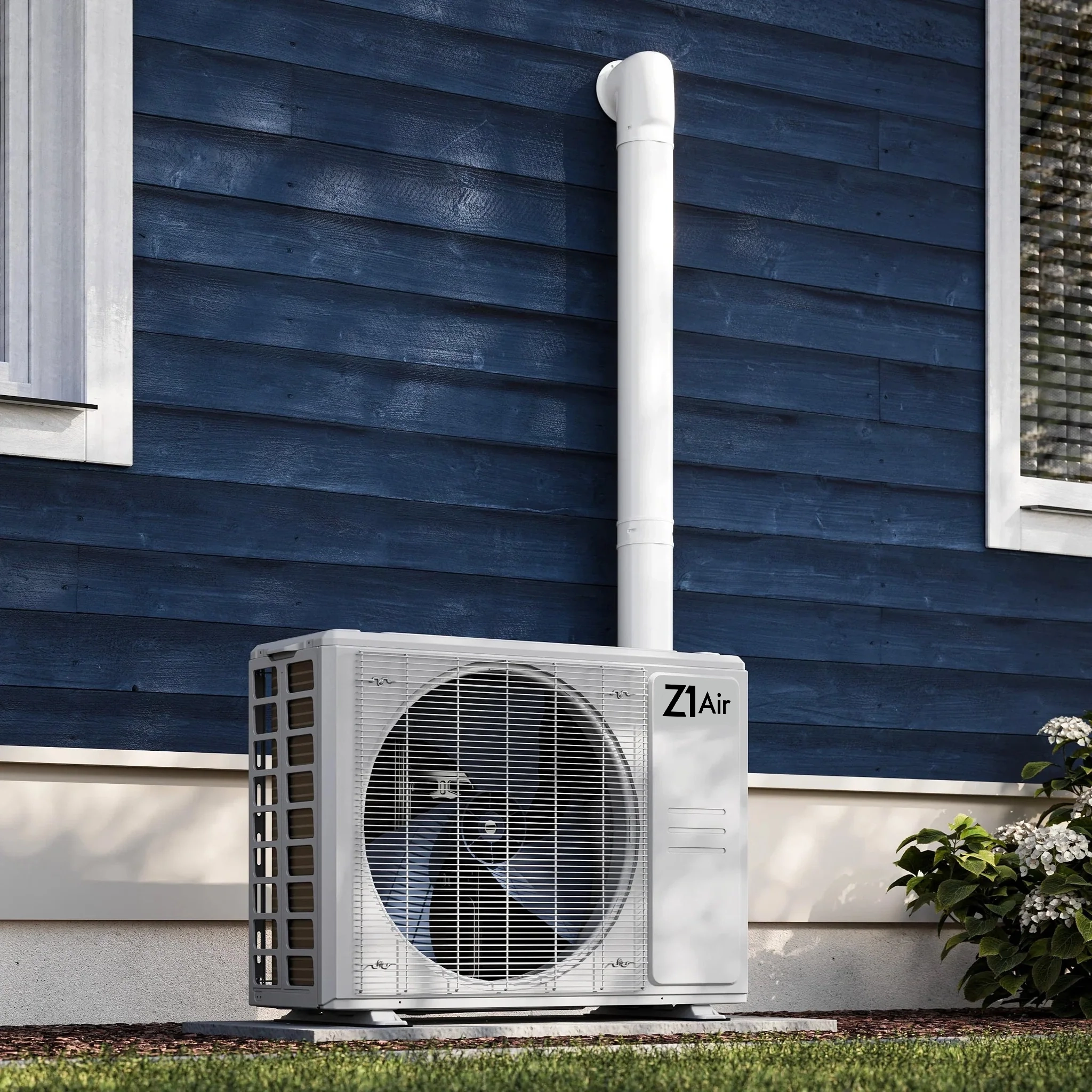
All true DIY mini splits share the same core components: an outdoor condenser, an indoor air handler, a refrigerant line set, and electrical/communication connections.
Choosing the Right DIY Mini Split Size and Features
Correct sizing drives comfort, efficiency, and lifespan. Oversizing causes short cycling and poor dehumidification; undersizing overworks the compressor. A general guide:
Run your exact room through the mini split sizing calculator before buying — it accounts for insulation, ceiling height, sun exposure, and climate zone. In a cold climate, size up slightly or choose a cold-climate certified model to hold full heat output near 0°F.
Single-zone vs multi-zone: many homeowners start with a single-zone unit for one problem room — a garage, bonus room, or addition — rather than retrofitting the whole house. Need several rooms? See multi-zone systems. Check local rebates and tax credits for high-efficiency, cold-climate heat pumps to offset the cost.
When a DIY Mini Split Makes Sense (And When It Does Not)
DIY ductless systems are designed for homeowners, but not every situation is ideal for self-installation.
DIY skill check: you should be comfortable drilling through an exterior wall, mounting brackets to studs, running a dedicated circuit (or hiring an electrician for that step), and handling the pre-charged line set without kinking or over-bending it.
Zone Air offers U.S.-based technical support, clear manuals, and an assembly-and-test process built to make installation smooth for non-professionals. For most homeowners, a DIY mini split heat pump is the most cost-effective path to efficient, inverter-driven comfort.
Why Zone Air Focuses on DIY Ductless Mini Splits
MRCOOL popularized the DIY mini split category and opened up a market that barely existed a decade ago. Zone Air is pushing that category forward with a focus on reliability, USA-based assembly, and cold-climate performance.
The goal is straightforward: homeowners should get contractor-level heating and cooling in a DIY package without giving up quality control or long-term reliability. Because every system is assembled, inspected, and tested in the U.S., you get leak-free line sets, properly charged circuits, and quiet operation out of the box.
Zone Air will keep refining high-SEER2, Energy Star, and cold-climate models so DIY homeowners in both mild and very cold climates can rely on a ductless mini split for primary heating and cooling — whether that is a single room or a multi-zone setup.
Frequently Asked Questions
Is MRCOOL the only DIY mini split?
No. Zone Air and MRCOOL are the two major brands offering true DIY ductless heat pumps with factory pre-charged line sets. Brands like Pioneer and Senville are "DIY-friendly" at best — their line sets usually ship empty, so the refrigerant work still needs a vacuum pump and an EPA-certified tech.
What makes a mini split "true DIY"?
A factory-sealed, pre-charged line set with quick-connect fittings, so you never open the refrigerant circuit, pull a vacuum, or need EPA Section 608 certification. You connect the lines, torque to spec, run the communication wire and power, and the system is ready.
Is Zone Air or MRCOOL better for cold climates?
Both heat well below freezing. Zone Air models are rated to -13°F and MRCOOL Hyper Heat variants to about -22°F. For most homes either is more than enough; verify the specific model's cold-climate rating before buying.
Where are Zone Air and MRCOOL made?
Zone Air systems are assembled, inspected, and tested in Salt Lake City, Utah, while many MRCOOL units are manufactured overseas (often by Midea). Zone Air's U.S.-based assembly adds a quality-control step before each unit ships.
The Bottom Line
MRCOOL is not the only DIY mini split. Zone Air is the other true DIY line on the market — built around efficient, cold-climate comfort and the reliability that comes from USA-based assembly and testing. When you are ready to take control of your home's climate without waiting on a contractor, explore the Zone Air DIY lineup.