Three Factors That Might Influence Your Buying Decision
- Does the refrigerant line come pre-charged with quick-connect fittings? This is what can make a mini split DIY in the first place. If the line set has to be flared and pulled into a vacuum, you need a vacuum pump, a micron gauge and the know-how to use them, or you need to hire someone for that step.
- Does the line set fit your wall, or do you fit your wall to the line set? Fixed lengths mean you end up coiling extra line behind the condenser or adding a coupler. A length that matches your run is cleaner and easier.
- Does a homeowner install keep the warranty? Some brands have DIY installs covered in writing. Others say a DIY install ends coverage, or they tie coverage to a licensed tech and a registration deadline.
Four Systems, Four Different Right Answers
1. Zone Air DIY - Best for True DIY
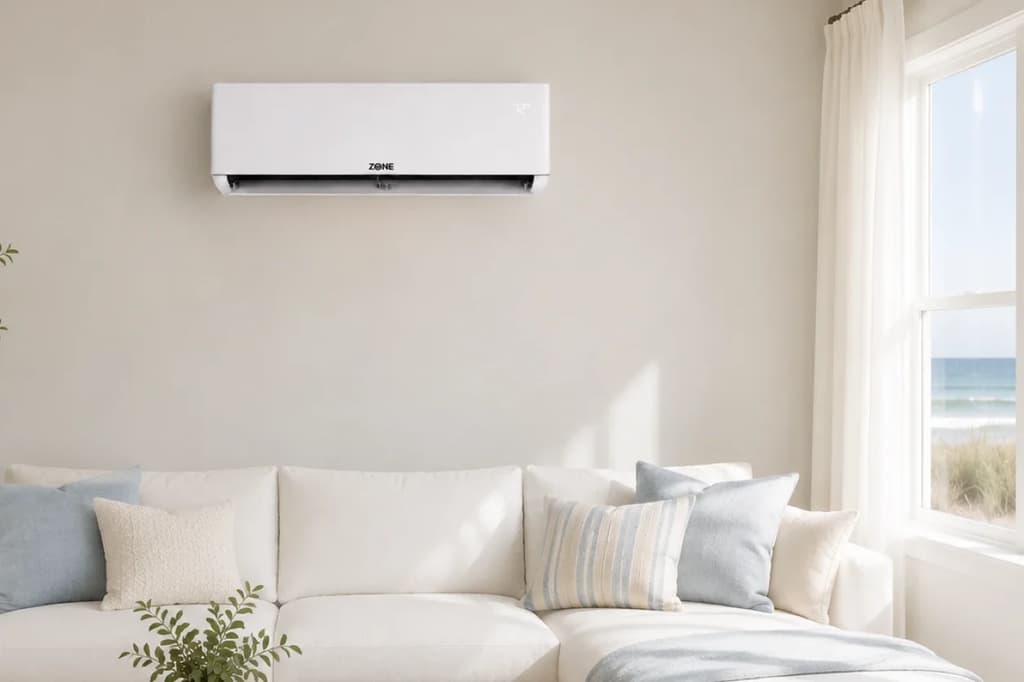
Zone Air might be the easiest system on this list to install yourself, and three things set it apart from the other brands here.
Our 9,000 and 12,000 BTU 115V systems can be plugged into an outlet with our optional cord kit (a dedicated 15A GFCI outlet, where local code allows), and no other systems from brands on this list can do that. That can make a bedroom, garage or office install a lot simpler. MrCool's 115V DIY models, by comparison, are hardwired to the circuit.
The second is what you can put on one outdoor unit. As of October 2026, Zone Air is the only DIY mini split that lets you mix wall-mount, ceiling cassette and concealed ducted indoor units on one condenser. So a wall unit in the bedroom, a cassette in the kitchen and a ducted unit hidden above the hallway ceiling can all run off the same outdoor unit, and you still install it yourself. MrCool's DIY multi-zone has wall and cassette units, but it doesn't have a concealed ducted DIY unit.
The third thing to look at is the line set. Every Zone Air system uses a pre-charged line set with quick-connect fittings. That means you do not need to do any flaring, you do not need a vacuum pump, and you do not need to handle refrigerant. You can choose from standard lengths of 16, 25, 33, 50 or 75 feet, but what really sets Zone Air apart is that you can order a line set cut to your exact measurements, anywhere from 5 to 75 feet. Of the four brands we're comparing, Zone Air is the only one that offers this. That makes a bigger difference than you might think.
With a fixed-length line set, you usually end up with too much or too little. If it is too long, MrCool actually tells you in their installation manual to coil the extra tubing behind the condenser. If it is too short, you will need to connect two line sets together, so that is another connection you have to worry about. With Zone Air, you can just measure the distance you need and order that exact length, so you get a cleaner installation without extra copper tubing coiled up outside your house.
The rest of the package is strong too. Efficiency is up to 24 SEER2 on the 230V systems and 23 SEER2 on 115V, and heating works down to -13°F. The warranty is 5 years on parts and 7 on the compressor, installing it yourself does not void it. There is no registration deadline to keep coverage. Each system goes through final assembly, testing, and inspection in the USA. Live tech support answers from 8AM to 6PM MT, shipping is free to the 48 contiguous states, and uninstalled systems can be returned within 30 days.
2. MrCool DIY 5th Gen - Easiest to Find
MrCool is the brand that showed you could install your own mini split. It is still the easiest one to buy in person. Home Depot and Lowe's carry it, every HVAC board knows it. The install path is well written up. The line sets are pre-charged quick-connect too, sold in fixed lengths (11.5, 16, 25, 35 and 50 ft, with connectors to join them), and MrCool's own manual says to keep any extra line coiled behind the condenser. The 9K and 12K models are hardwired and run on 115V.
Efficiency is strong, up to 23.6 SEER2 on the 9K. The common DIY 5th Gen operates down to about -13°F, and higher-tier DIY models are rated lower. The warranty is 5 years on parts and 7 on the compressor with no registration needed, and support is US-based in Kentucky. Returns will depend on which seller you buy from. If "a known name I can pick up today" is at the top of your list, this is a solid choice. For the head-to-head, see our Zone Air vs MrCool review.
3. Pioneer - Best Budget Pick With Tools
Pioneer has served value-minded buyers for years, and its prices beat most of this list. Its higher-end Quantum Hyperformance line goes up to 25 SEER2 and heats down to -22°F. Pioneer is sometimes sold as DIY-friendly, but in our view it's DIY-adjacent: the standard line sets are flare-type, so the system has to be evacuated with a vacuum pump before you open the valves. That is fine if you own the tools or you're happy to hire out just the refrigerant step.
You'd want to read the warranty terms before you buy. Pioneer's warranty page asks you to register within one week after a proper installation to get up to 5 years of coverage, and units that are not registered get 1 year.
4. Senville - Best Cold-Climate Value With a Pro
Senville's Arctic Series heats down to -22°F (its Standard models are rated to 5°F), efficiency goes up to 25.5 SEER2, and the warranty is 10 years. That's a lot of system for the money. The catch is the install. Senville uses flare connections that have to be evacuated, and its warranty needs that step to be done by a licensed HVAC pro. Senville says that a DIY install will void the warranty. Plenty of buyers do a hybrid job, where you mount the units and run the line yourself, then pay a tech to finish. Just budget for that visit.
Side by Side
Prices change with size, season and seller, so we compare relative cost instead of listing numbers that will be out of date by spring. You'll want to factor in the cost of a vacuum pump or a tech visit for the flare-type systems. If you're not sure what size you need, start with our mini split sizing calculator.
Bottom Line - Match the System to Your Situation
- You want to do the whole install yourself, with a line set that fits your run and a warranty that covers you: Zone Air DIY.
- You want a well-known name you can pick up locally today: MrCool DIY 5th Gen.
- Budget comes first and you own a vacuum pump, or don't mind hiring out the refrigerant step: Pioneer.
- You live somewhere very cold and plan to have a pro finish the install: Senville Arctic Series.
Specs, warranty terms and availability are as published by each manufacturer as of October 2026 and can change. It is a good idea to check the manufacturer's current terms before you buy. MRCOOL® is a trademark of its owner. Zone Air is not affiliated with or endorsed by MRCOOL.
Quick Answer: If you want the cheapest possible system price, Senville is a great option (requires professional install). For true DIY units, Zone Air's DIY systems tend to be the most popular in 2026.
DIY Mini Split Systems 2026: Key Brand Differences
The main difference between brands is how they handle installation — specifically, the line set technology and whether homeowners can complete the job without specialized HVAC equipment.
MrCool uses pre charged lines that ship factory-sealed with refrigerant. No vacuum pump, no manifold gauges, no EPA Section 608 license required.
Zone Air DIY systems undergo final assembly, testing, and inspection in the USA from globally-sourced components, giving them a unique quality advantage. Like MrCool, they require no vacuum pump and feature pre-charged line-set technology for straightforward DIY installation.
Pioneer sells traditional split systems where the outdoor unit may arrive pre-charged, but the copper line set still requires flaring, evacuation with a vacuum pump, and refrigerant adjustment. Some DIY systems require vacuum pumps and manifold gauges for proper installation — Pioneer is a clear example.
Senville is a direct-to-consumer brand known for competitive pricing on its aura series and leto series. However, Senville systems require vacuuming and charging by a technician, and their warranty may require professional installation for full warranty coverage — check current Senville terms.
The 2026 market has also seen a major transition in refrigerants. The EPA mandates R-454B refrigerant transition by 2025, and newer models from MrCool and Zone Air's DIY line now ship with R-454B, which has a lower Global Warming Potential than the older R-410A. This transition matters for homeowners looking to access tax credits and rebates tied to energy efficiency and environmental compliance. We break down R-32 vs R-454B in DIY mini splits separately.
The industry is seeing an increase in DIY mini-split systems that are plug-and-play, and that trend is accelerating into 2026. Mini-splits are more efficient than traditional window units, last 15 to 20 years with proper maintenance, and can deliver climate control across virtually any space in your house.
Comparing Pre-Charged Line Set Systems (MrCool vs Zone Air)
Pre-charged line sets contain refrigerant and have "quick-connect" valves that open upon connection. The homeowner uncoils the line set, routes it between the indoor and outdoor unit, and tightens the quick-connect fittings. No vacuum, no brazing, no gauges. Our guide to installing a mini split without a vacuum pump walks through exactly how this works. If you're still asking whether these systems hold up, read are DIY mini splits any good.
DIY mini splits can save homeowners $3,000 to $5,000 on installation compared to hiring a professional. DIY systems often aim to avoid contractor costs by facilitating self-installation, and pre-charged systems deliver on that promise most reliably. See the full breakdown of what it costs to install a mini split.
Traditional Line Set Systems (Pioneer, Senville)
Traditional systems ship with copper line sets that must be cut to length, flared or brazed, evacuated with a vacuum pump to deep vacuum, and then charged with the correct refrigerant amount based on line length.
Performance and Efficiency Ratings
Ductless systems feature a range of efficiency ratings, often measured in SEER. In 2026, the SEER2 standard provides more realistic performance data than the older SEER metric, reflecting actual installed conditions. Energy efficiency ratings for HVAC systems often include SEER and COP values, along with HSPF2 for heating performance. If you're new to the metric, here's what a SEER rating actually means for your bills.
Premium Efficiency Leaders
Energy cost impact: Upgrading from a 14 SEER2 system or replacing window units with a 22+ SEER2 mini split can cut monthly cooling costs significantly. For a space running older equipment, savings of $90 or more per month during summer are realistic. HVAC systems can have energy savings and tax credit options that further offset the purchase.
Budget-Focused Performance
Trade-offs: Lower-priced units deliver adequate cooling for less demanding applications, but DIY systems can have shorter lifespans compared to professionally installed systems if installation quality suffers. Performance at a budget price point is achievable — just understand that you're trading some efficiency and cold-weather capability.
Warranty Coverage and Support
Warranty coverage in 2026 can make or break the value proposition of a diy mini split. A voided warranty turns a money-saving project into an expensive mistake. Warranty coverage starts from the original installation date, so registration timing matters.
Comprehensive DIY Warranty Protection
Total Cost Analysis
DIY mini splits cost between $1,500 and $5,000 depending on capacity, brand, and system complexity. But the true total installed cost goes well beyond equipment price — you need to figure in tools, electrical work, permits, and potential contractor fees.
All-Inclusive DIY Systems
Suitability and Applications
DIY mini splits excel in additions, sunrooms, a garage conversion, workshops, ADUs, and any space where running ductwork through walls is impractical or too expensive. They can replace window units with dramatically better energy efficiency, quieter operation, and year-round climate control. Mini-splits can last 15 to 20 years with proper maintenance, making them a long-term solution rather than a temporary fix. (See our best mini split for a garage guide for that use case.)
Best DIY Mini Split System 2026: Which Brand to Choose
Selecting the right brand depends on three factors: your installation capability, your climate zone, and your budget.
Frequently Asked Questions
What is the best DIY mini split in 2026?
For a true no-vacuum-pump install that keeps your warranty valid, Zone Air Easy Install and MrCool DIY lead the field — Zone Air adds USA assembly, testing, and inspection, while MrCool brings the widest size range and Hyper Heat cold-climate options. Pioneer and Senville can be cheaper on equipment but require traditional flare-and-vacuum installation. See the full Zone Air vs MrCool comparison.
Is a Pioneer or Senville system cheaper than MrCool or Zone Air?
The equipment is often $200–$500 cheaper, but once you add a vacuum pump, gauges, and flaring tools ($500–$1,000) or a contractor ($1,500–$5,000), the pre-charged systems usually cost less installed. See the full cost to install a mini split.
What refrigerant do 2026 DIY mini splits use?
The newest 2026 systems from Zone Air and MrCool use R-454B, a low-GWP refrigerant replacing R-410A under EPA rules — which also helps with rebate and tax credit eligibility. Some budget Pioneer and base models still ship with R-410A.
Is MRCOOL the only DIY mini split?
No — that's a common assumption because MRCOOL is the DIY brand stocked in big-box stores, but Zone Air ships the same true pre-charged quick-connect installation with USA assembly and testing. The full answer, brand by brand, is in is MRCOOL the only DIY mini split?
What are the disadvantages of mini split systems?
The honest list: a wall-mounted indoor unit is visible in the room, multi-zone sizing takes more planning than a single ducted system, and very cold climates need a cold-climate-rated model or backup heat. We cover all of them in disadvantages of mini split systems — most are design considerations rather than dealbreakers.
What is the $5,000 rule for HVAC?
Multiply the age of your current system by the repair quote — over $5,000, replacement usually beats repair. A DIY mini split shifts that math further toward replacement because installation labor drops out. Full explanation: the $5,000 HVAC rule.
What is the best multi zone mini split system for whole-house DIY?
Zone Air and MrCool both extend the pre-charged DIY approach to 2–5 zones. Our best multi zone mini split systems guide compares DIY multi-zone against contractor-installed options room count by room count.
Not sure what size you need? The free mini split sizing calculator gives you a Manual J–style BTU recommendation in about 60 seconds. No signup, no email.