Ceiling Cassette Mini Split Systems
Recessed ceiling-mounted mini splits with 4-way 360° airflow. 21 SEER2, 9K–12K BTU for offices, commercial spaces, and modern homes.
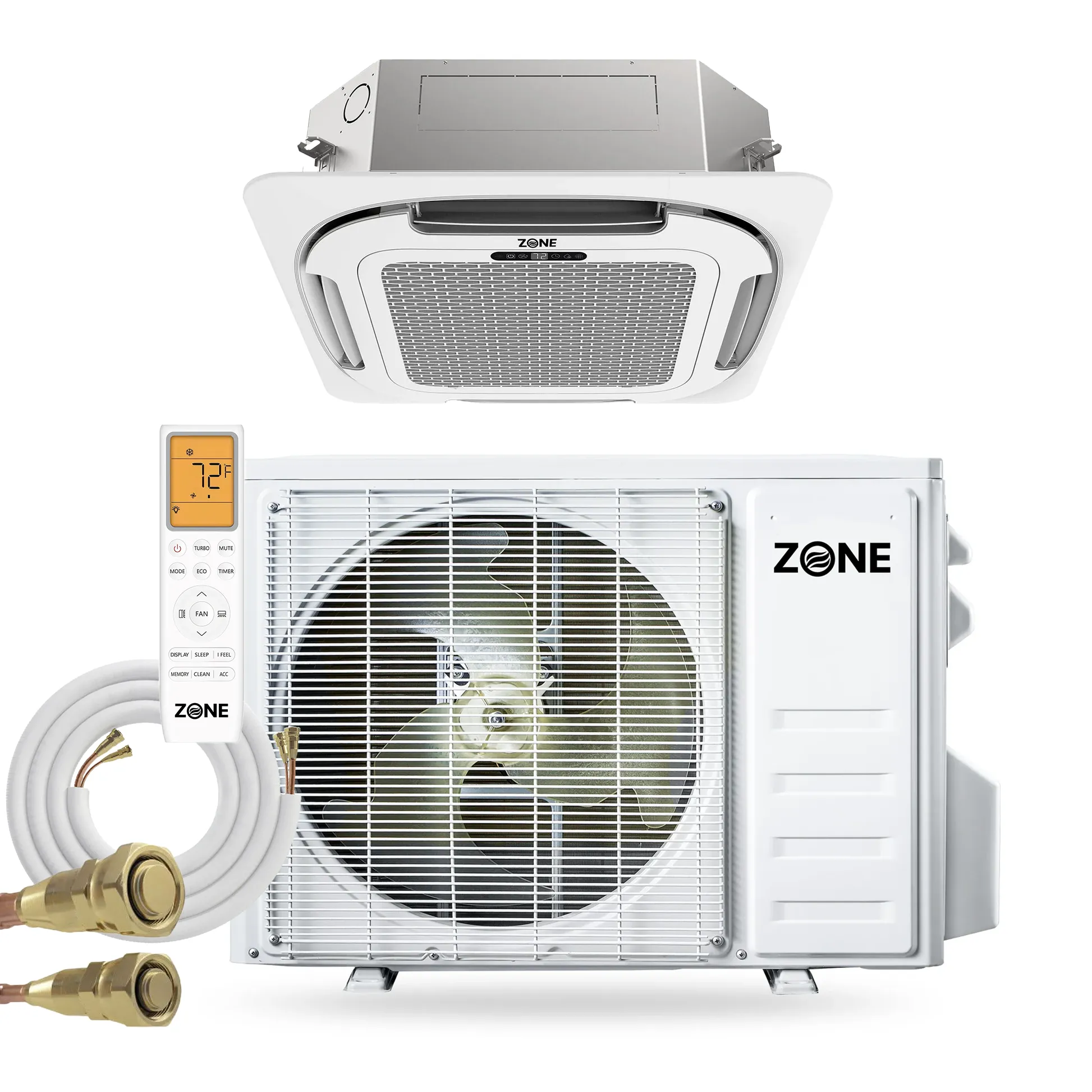
Zone Air® Airframe 9,500 BTU 21 SEER2 230V Ceiling Cassette Mini-Split Heat Pump AC with Pre-Charged Lineset - Up to 475 Sq Ft
Zone Air® Airframe 12,000 BTU 21 SEER2 230V Ceiling Cassette Mini-Split Heat Pump AC with Pre-Charged Lineset - Up to 600 Sq Ft
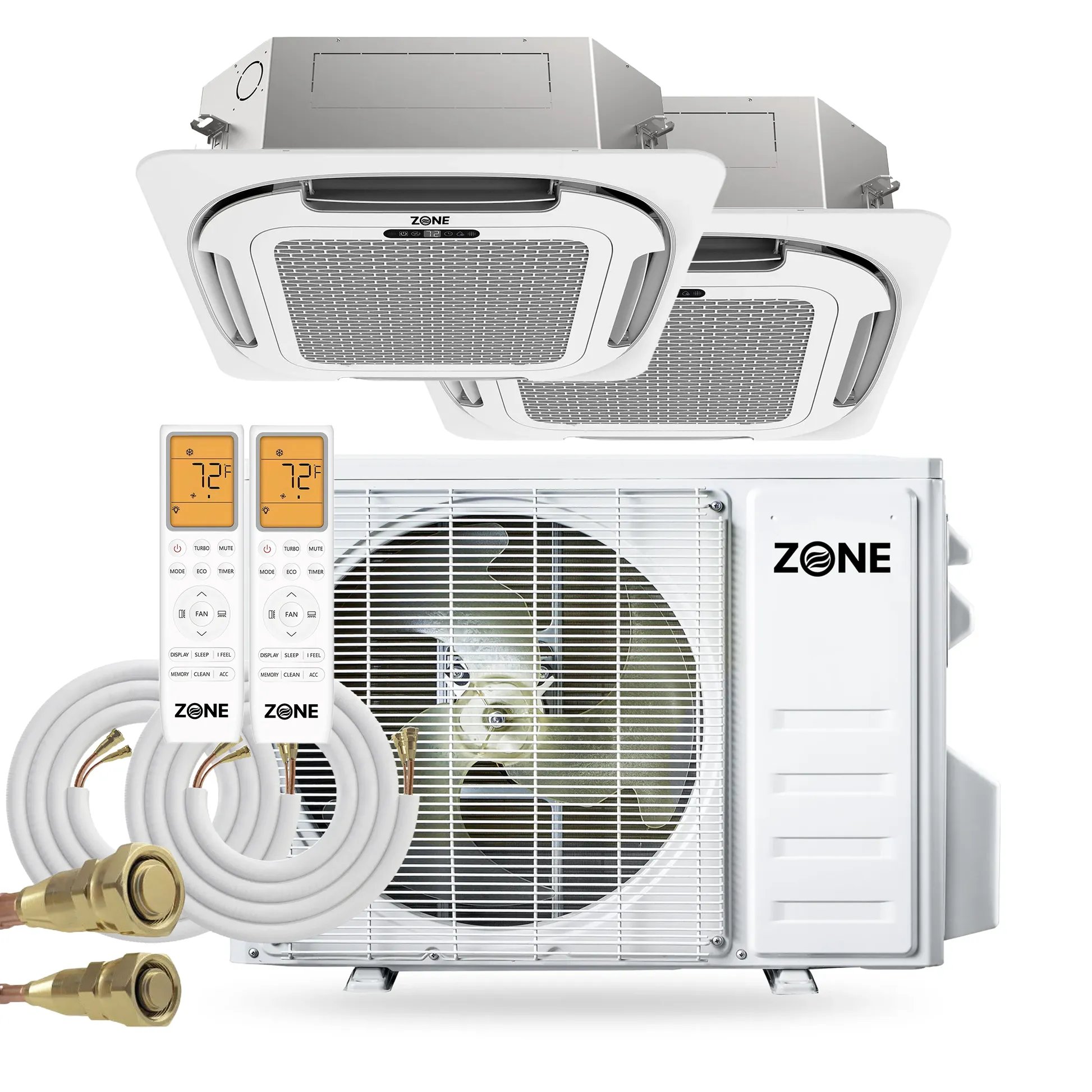
Zone Air® Airframe DUAL ZONE 19,000 BTU (9.5K+9.5K) 21 SEER2 230V Ceiling Cassette Mini-Split Heat Pump System with 2x Pre-Charged Linesets - Up to 950 Sq Ft
Zone Air® Airframe DUAL ZONE 21,500 BTU (12K+9.5K) 21 SEER2 230V Ceiling Cassette Mini-Split Heat Pump System with 2x Pre-Charged Linesets - Up to 1,075 Sq Ft
Zone Air® Airframe DUAL ZONE 24,000 BTU (12K+12K) 21 SEER2 230V Ceiling Cassette Mini-Split Heat Pump System with 2x Pre-Charged Linesets - Up to 1,200 Sq Ft
Ceiling Cassette Mini Split Systems
Shop ceiling cassette mini splits — recessed ceiling mounted units with four-way airflow for even heating and cooling. Designed for residential rooms and commercial spaces where wall space is limited or a discreet, sleek design is preferred.
- ✓21 SEER2 energy efficiency with 4-way 360° airflow
- ✓Flush ceiling mount for a clean, professional appearance
- ✓9K–12K BTU for rooms up to 500 sq ft
- ✓Ultra-quiet 30 dB operation in quiet mode
- ✓Pre-charged linesets — DIY-friendly installation
Ceiling Cassette vs Wall Mount vs Concealed — Which One Belongs in Your Room
The three indoor form factors solve the same problem (cool/heat one room or zone) but they fit different rooms differently. The choice is about the room — ceiling height, wall space, how visible you want the unit to be — not about which is best.
| Form factor | Best room shape | Install time | Visibility | Starting price |
|---|---|---|---|---|
| Wall mount | Any room with one free wall ≥36" wide | 4–6 hours | Visible 32"×11" unit on wall | $1,899 |
| Ceiling cassette | Open rooms 250–500 sq ft, offices, great rooms | 2–3 hrs drop ceiling / 4–6 hrs drywall | Only 24"×24" decorative grille visible | $2,699 |
| Concealed duct | Whole-home (2–4 rooms from one head) | 6–8 hours | Only small supply/return grilles | $3,299 |
Pick a wall mount when one wall has clear real estate and you don't care about the visible unit. Pick a cassette when wall space is contested (kitchens with cabinetry to the ceiling, offices with whiteboards or windows on every wall) or when you want the cleanest look in a public-facing room. Pick concealed when you want zero visible equipment and you have attic access for a slim-duct air handler.
Sizing a Ceiling Cassette to Your Room
Cassette sizing is the same Manual J math as any other mini split — 20–30 BTU per sq ft for cooling, adjusted up for high ceilings, west-facing glass, occupant load, and equipment heat. The two cassette sizes we carry land like this:
| Room example | Floor area | Ceiling | Load profile | Recommended |
|---|---|---|---|---|
| 12×14 home office, one west window | 168 sq ft | 8 ft | 1 occupant + laptop | 9K cassette |
| 14×18 conference room, glass wall north | 252 sq ft | 9 ft | 6 occupants + screen | 12K cassette |
| 20×24 open kitchen-living | 480 sq ft | 9 ft | Range + 4 occupants | 12K cassette (tight) |
| 22×26 great room, cathedral 14 ft | 572 sq ft | 14 ft | West glass, 2-story heat | Two 9K cassettes (dual) |
| 30×30 commercial showroom | 900 sq ft | 11 ft | Front glass, equipment | Two 12K cassettes (dual) |
A 12K cassette tops out around 550 sq ft in good envelopes and 400 sq ft when there's significant solar gain. If you're past that, two 9K cassettes on a <a href="/products/bundles/">dual-zone outdoor unit</a> outperform a single 18K because the throw is split — air reaches all four corners instead of stalling halfway across.
Use the <a href="/mini-split-sizing-calculator">free sizing calculator</a> for a Manual-J-style number if your room has unusual loads.
What the Install Actually Looks Like
In a drop ceiling (T-bar grid): Pop two adjacent 24×24 tiles, slide the cassette body into the opening, hang it from the supplied threaded rods, route the refrigerant lineset and condensate drain through the cavity to the outdoor unit, set the decorative panel, and torque the Quick Connect fittings. Two people, 2–3 hours. No cutting, no patching.
In a drywall ceiling: Mark a 22.6×22.6 inch rough opening, locate joists, cut the drywall, frame a support cradle from 2x4 cleats between joists, hoist the cassette into place, fasten with the supplied brackets, run lineset and drain, drywall-patch the seams around the decorative flange. Two people, 4–6 hours plus drywall mud cure time. Budget an extra $150–300 in drywall materials and a finisher's time if you don't do that yourself.
Either way, the cassette uses the same 16 ft pre-charged R454B lineset our wall and concealed units use — no vacuum pump, no EPA 608 license, no recovery machine. Quick Connect fittings torque to spec with a standard wrench and the system is sealed and charged from the factory.
When a Ceiling Cassette Is the Wrong Pick
We'll talk you out of a cassette if any of these apply:
- Cathedral or vaulted ceilings — there's no flat plane to mount the cassette flush. Wall mounts are correct here.
- Small bedrooms under 200 sq ft — the 9K cassette is more throw than the room can absorb and you'll short-cycle. A right-sized 9K wall mount handles the load and costs $800 less.
- No cavity access from above — if the ceiling is the underside of the roof deck (no attic) and you can't open it up, the cassette body has nowhere to live.
- Unconditioned attic with poor insulation around the unit — the cassette body in a 130°F attic loses efficiency. Either condition the attic or pick concealed-duct with the air handler in conditioned space.
When any of those apply, a <a href="/products/wall-mounted/">wall mount</a> or <a href="/products/concealed-ducted/">concealed-duct unit</a> is the honest answer.
What's in the Box
Every Zone Air ceiling cassette ships with the cassette body, outdoor condenser, decorative grille panel, built-in condensate pump (no auxiliary pump needed), 16 ft pre-charged R454B refrigerant lineset, mounting hardware for the cassette and outdoor unit, wireless remote with 7-day schedule, and a 5-year parts / 7-year compressor warranty. Free shipping on every order, 45-day returns, live tech support 9–5 MST during your install.
Ceiling Cassette Mini Split — Real Questions, Honest Answers
How much ceiling cavity do I need for a cassette mini split?
Is a ceiling cassette overkill for a single bedroom?
What does the install actually take — drop ceiling vs drywall?
Can a single 12K cassette heat and cool a 600 sq ft great room?
How does a ceiling cassette compare to a wall mount and concealed duct?
How much does a ceiling cassette mini split cost?
Explore More Mini Split Systems
Browse our full range of mini split systems, bundles, and accessories.
9,000 BTU Systems
For rooms 200–350 sq ft. The 9K cassette is rated 9,500 BTU, recessed in a drop ceiling.
Learn More →12,000 BTU Systems
The most-installed size — master bedrooms, living rooms 350–550 sq ft. 12K cassette available.
Learn More →Single Zone Systems
One indoor unit, one outdoor unit. Wall, cassette, and concealed options 9K–18K BTU.
Learn More →Wall Mount Systems
Wall-mounted mini splits for individual rooms. 9K–18K BTU, 115V and 230V options from $1,899.
Learn More →Dual Zone Bundles
Two indoor units, one outdoor unit. Independent temperature control in two rooms from $4,299.
Learn More →Concealed
Hidden mini splits — the indoor unit installs above the ceiling for invisible climate control.
Learn More →Line Set Extensions
Pre-charged refrigerant line extensions for longer runs. No vacuum pump needed.
Learn More →Accessories
Professional mounting brackets, wall caps, and installation accessories.
Learn More →Sizing Calculator
Find the right BTU capacity for your room size, insulation, and climate.
Learn More →Installation Guide
Step-by-step DIY mini split installation walkthrough with tips and tools.
Learn More →SEER Rating Guide
Learn how SEER2 ratings affect energy efficiency and your utility bills.
Learn More →Professional Comfort, Discreet Design
Ceiling cassette mini splits deliver 360-degree airflow with a clean, flush-mounted appearance. Perfect for offices, commercial spaces, and modern homes. Free shipping on every order.
Shop All Products