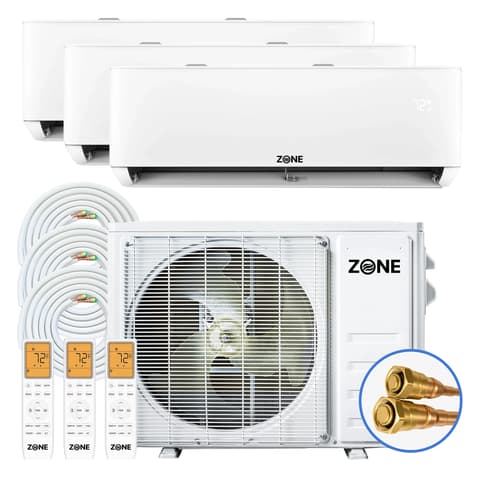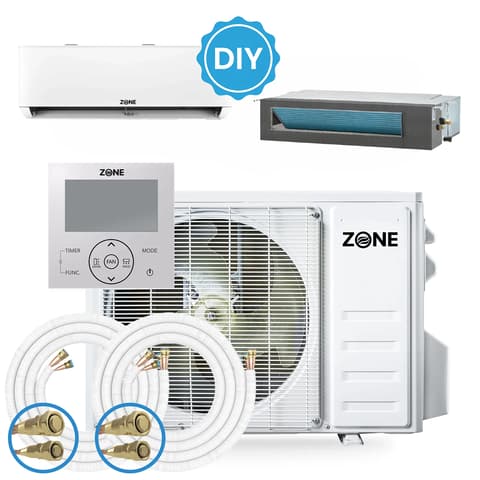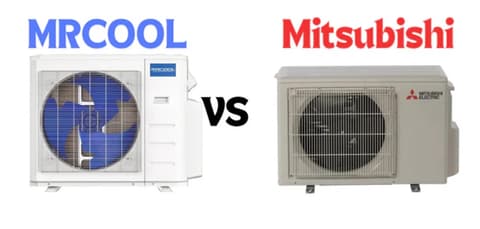
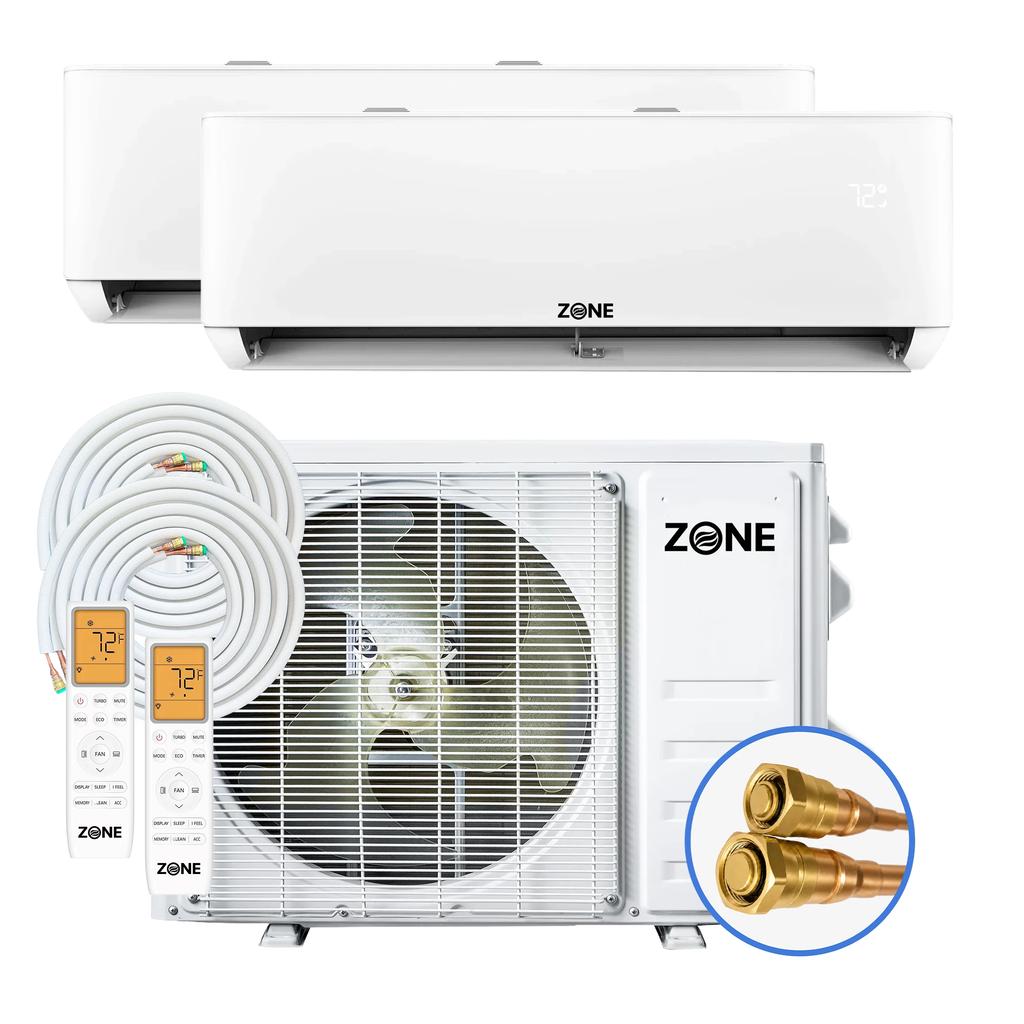
The best DIY dual zone mini split in 2026 means weighing DIY installation ease against performance, indoor unit flexibility and cold-climate capability. Here's how the three leading options stack up.
Best DIY Dual-Zone Mini Split in 2026
If you want a true DIY dual-zone mini split that you can put in yourself, Zone Air and MRCOOL DIY 5th Gen are your top picks for 2026. Both come with pre charged line sets that have quick connect fittings, so you don't need a vacuum pump, you don't have to handle refrigerant, and you don't need any special tools. MRCOOL also sells the Olympus Multi-Zone, and it shows up in a lot of dual-zone searches, but it is not a DIY system. MRCOOL's catalog says it is meant to be professionally installed by a qualified HVAC technician, with copper line sets that a tech flares, evacuates and charges, and its warranty applies to systems installed per MRCOOL's instructions and local law. So the rest of this page compares the two systems you can actually install yourself.
Before you decide, you might want to run through a few questions. How cold does your climate zone get? Both systems here are rated to heat at about −13°F, so if you're in a colder region you'll need backup heat with any of them. What room size might you be conditioning in each zone? Would you want mixed indoor unit styles, like a wall mount in one room and a concealed ducted air handler in another? And most importantly, do you insist on doing it yourself, or would you hire a pro?
Here's the short version of how they can compare:
- With custom-length pre charged line sets and support for mixed indoor unit styles (wall-mounted, ceiling cassette, concealed ducted) on one outdoor condenser, Zone Air could be the most flexible DIY option for dual-zone setups
- Widely stocked at big box stores and online, MRCOOL DIY 5th Gen has simple quick connect technology for setups with two wall units
Multi-zone systems can support 2 to 6 zones, so each of these platforms can grow with you. You save on energy costs because you only heat and cool the rooms you're actually using, which is one of the main reasons dual-zone systems make sense in the first place.
How Dual-Zone DIY Mini Splits Work
A dual-zone mini split system has one outdoor unit that sends heating and cooling to two indoor air handlers, and each one has its own temperature control. Every inside unit reads the room temperature and tells the outdoor condenser what it needs through communication wires, and then the compressor changes its output to match the combined load.
These are the indoor and outdoor parts the system has:
- One outdoor condenser has an inverter compressor
- Two indoor units (wall-mounted, ceiling cassette or ducted air handler)
- Line sets that are pre charged or traditional, and they connect each indoor unit to the condenser
- Communication cable between all units
- Condensate drains from each indoor unit
- Electrical supply wiring and mounting brackets
What happens on the refrigerant side is the main difference between a DIY system and a traditional split system. A DIY mini split like Zone Air or MRCOOL DIY 5th Gen comes with factory-sealed, pre charged line sets that use quick connect fittings. You never open the refrigerant circuit, use a vacuum pump or handle R-454B refrigerant directly. A traditional flare system needs a professional to flare copper line sets, evacuate the system, perform leak checks and charge the refrigerant by weight.
Both MRCOOL DIY 5th Gen and Zone Air DIY are designed so homeowners never touch the refrigerant.
MRCOOL DIY 5th Gen Dual-Zone Highlights for 2026
MRCOOL DIY 5th Gen is the easy dual-zone mini split to find on a store shelf in 2026. It's easy to find at big box stores and online retailers.
For dual-zone use, you pair a multi-zone condenser with two indoor heads. MRCOOL has no two-zone condenser: its 18K condenser runs up to 3 zones and the 27K up to 4, and either one can carry a two-head setup. Wall-mount heads come in sizes from 6K through 36K. In MRCOOL's single-zone kits, the 9K BTU model covers up to 400 sq ft, the 12K BTU model covers up to 550 sq ft. The 18K BTU model covers up to 800 sq ft.
These are the key DIY features of the 5th gen:
- MRCOOL DIY systems use pre-charged line sets for easy installation. The product list says no special tools or training are necessary to install
- You don't need a vacuum pump for MRCOOL DIY installations
- Heads connect to the condenser with MRCOOL's DIYPro communication cable
- The 5th Gen MRCOOL DIY uses R-454B refrigerant
- Running up to 6 zones on its 48K and 55K models, MRCOOL DIY multi-zone condensers let a dual-zone setup use just two ports
- Follow Me mode tracks the temperature at the remote rather than at the wall unit, plus app control, Gold Fin coil coating and built-in refrigerant leak detection
On the performance side, the MRCOOL DIY multi-zone condensers are rated 23.9 SEER2 on the 18K and 23 SEER2 on the 27K, and every DIY multi-zone condenser is ENERGY STAR listed. The standard DIY 5th Gen multi-zone condensers (18K through 48K) are rated to heat down to −13°F. Only the 55K six-zone condenser is rated to −22°F, and so are MRCOOL's single-zone DIY Hyper Heat units.
Electrical requirements for dual-zone condensers are 208–230V single-phase. Smaller single-zone units (9K or 12K) run on 115V, but dual-zone outdoor condensers need a dedicated 230V circuit: the 18K multi-zone condenser lists a 20A max fuse and the 27K a 25A max fuse.
Gold Fin Condenser Protection makes the outdoor coils resistant to corrosion, which extends equipment life in humid or coastal settings. Warranty terms are 5-year parts and 7-year compressor coverage with no registration needed, as long as you install it per MRCOOL's instructions. MRCOOL publishes no manufacturer return policy, so returns depend on the seller.
Why Zone Air Dual-Zone DIY Is Best for 2026
Built for non-professionals, Zone Air is a 2026 standout if you want a true DIY dual-zone mini split without giving up flexibility. Its strongest advantages are installation customization and indoor unit variety.
The biggest advantage is custom-length, pre charged line sets. Of the brands compared here, Zone Air is the only one (as of October 2026) that cuts the pre-charged line set to the exact length you measure, any whole foot from 5 to 75 feet, so you can order lengths that actually match your home's layout. MRCOOL sends out fixed 11.5, 16, 25, 35 and 50 ft sets plus couplers past 50 ft and has you coil the excess. Each of Zone Air's 25, 33, 50 and 75 ft sets is one continuous factory-sealed run with no field joint. This means less excess tubing coiled behind the condenser, fewer unnecessary bends and cleaner routing, which is especially valuable when you're running lines to a garage, home addition or rooms on opposite sides of the house.
On one outdoor condenser, Zone Air's dual-zone lineup supports wall-mounted, concealed ducted and ceiling cassette configurations. It is the only DIY mini split (as of October 2026) that lets you mix wall-mount, ceiling cassette and concealed ducted units on one outdoor unit. You can install a wall mount in a bedroom and a concealed ducted air handler in a living room, which gives you more control over how the inside unit affects each room's look. Its Thin-Air concealed ducted units are the only DIY concealed ducted mini split system on the market as of October 2026. MRCOOL does not sell a concealed-duct DIY unit. Throwing air in four directions from a 22-inch square chassis, Zone Air's ceiling cassette is different from MRCOOL's OuttaSight, which is a 50-inch single-slot cassette that blows one way.
Every Zone Air dual-zone system runs on the same 27,000 BTU outdoor unit (rated cooling 27,000 BTU/h, range 4,500 to 31,000). The BTU in the product name is the connected indoor capacity. Wall-mount pairs run 18,000, 21,000, 24,000, 27,000, 30,000 and 36,000 BTU. Common use cases:
- 9K + 9K (18,000 BTU) for two bedrooms or a bedroom and office
- 12K + 12K (24,000 BTU) for a living area and bedroom
- 18K + 18K (36,000 BTU) for larger spaces up to about 1,800 sq ft combined
Zone Air wall-mount dual-zone systems are rated 24 SEER2, with inverter heat pump design that delivers both heating and cooling. That makes Zone Air the highest-efficiency pre-charged quick-connect DIY system of the brands compared here, against MRCOOL's 23.9 (18K) and 23 (27K). The tradeoff is that cassette dual-zone systems are 21 SEER2 and concealed ducted dual-zone systems are 19 SEER2. Every Zone Air system is rated to heat down to −13°F and to cool in outdoor temperatures up to 131°F (MRCOOL publishes 122°F). Each zone has its own thermostat and Wi-Fi control. You can add a second head later to a spare port with a pre-charged line set. The dual-zone condenser needs a 230V, 30A double-pole circuit. Zone Air's plug-in 115V option is single-zone only.
Pricing is competitive. As of October 2026, Zone Air wall-to-wall dual-zone systems are $3,039.99 for the 9K+9K, 12K+9K and 12K+12K, $3,539.99 for the 9K+18K and 12K+18K, and $4,039.99 for the 18K+18K, with pre-charged line sets sold per zone (a 16 ft set for a 9K or 12K head is $229.99). For comparison, a MRCOOL 27K condenser with 12K+12K heads and two 16 ft line sets listed at about $3,932 at Home Depot on 2026-10-05, while MRCOOL's 18K 9K+9K kits ($3,110–$3,230) come in under Zone Air's dual. The DIY system's precharged quick-connects eliminate much of the labor cost you'd pay with traditional HVAC installation.
With no registration deadline, Zone Air backs its equipment with a five-year parts warranty and a seven-year compressor warranty, and installing it yourself does not void the coverage. Returns are accepted for 30 days from delivery on uninstalled units, and shipping is free to the 48 contiguous states. Live technical support runs 8 AM to 6 PM Mountain time, with an install video library and a written DIY manual, so it's easy for DIY owners to get help with sizing, settings and troubleshooting indoor and outdoor components. Units get final assembly, testing and inspection in the USA from globally-sourced components.
MRCOOL DIY 5th Gen vs Zone Air Comparison
In 2026, these two represent distinct approaches to dual-zone climate control. MRCOOL DIY 5th Gen is the DIY option you can find at big-box retail. Zone Air is the most flexible DIY line for dual zones.
Here's how they can compare across the factors that matter most:
- DIY ease: Zone Air DIY and MRCOOL DIY both use precharged quick-connect line sets with easy installation that only needs basic hand tools. Pioneer's standard systems use flare line sets that need a vacuum pump, and its warranty is 1 year unless you register within one week of install, so not every system sold as DIY-friendly is.
- Line-set options: Zone Air offers custom-length precharged line sets per zone. MRCOOL DIY uses fixed-length precharged sets.
- Indoor units: Zone Air supports mixed wall, cassette and concealed ducted units per condenser. MRCOOL DIY 5th Gen multi zone offers wall units plus OuttaSight cassettes and the Hybrid Air Handler.
- Cold-climate: Both are rated to about −13°F. MRCOOL's −22°F ratings go to its single-zone DIY Hyper Heat and 55K six-zone condenser. Senville's Arctic Series heats down to −22°F with up to 25.5 SEER2, which is another comparison point, but it's a flare system and Senville's warranty says DIY installation will void coverage.
- Availability: MRCOOL DIY is widely sold in retail chains and online. Zone Air is sold direct at zone-air.com, then through distributors and Amazon, with support from the manufacturer.
Choose by scenario: a tight-budget DIYer who needs a simple two-room setup on an 18K condenser should go with MRCOOL DIY. If you want mixed air handler types and custom line routing, you should go with Zone Air.
Understanding SEER2 and Energy Star in 2026
Efficiency ratings directly affect your monthly energy costs, how consistent your comfort is, and whether you can get rebates. Energy efficiency ratings include SEER, COP and HSPF2 values, but SEER2 is now the primary cooling efficiency measure after it replaced the older SEER standard with harder testing procedures.
Typical SEER2 ranges for dual-zone systems in 2026:
- MRCOOL DIY 5th Gen: up to 23.9 SEER2 (18K condenser)
- Zone Air: up to 24 SEER2 (wall-mount heads)
Cold-climate heat pumps use inverter compressors and enhanced outdoor coil designs to maintain heating capacity at low ambient temperatures. The dual-zone systems here are rated to operate down to −13°F. MRCOOL's single-zone DIY Hyper Heat units push to −22°F, as does its 55K six-zone condenser.
Energy Star certification is listed in MRCOOL's product list for the DIY 5th Gen multi-zone condensers, but not every unit in every product line qualifies. Always verify certification by specific model number before you assume rebate eligibility. You can check the Energy Star certified product list for current listings. Zone Air puts out a one-page spec sheet for every system, with the manual and EnergyGuide label.
A high-SEER2 heat pump costs less to run than older equipment, but the savings depend on your rates, climate and runtime. In colder climates, you should prioritize higher HSPF2. In mild climates, a mid-tier efficient model may be the right solution for your budget.
What's Really DIY in 2026?
The term "DIY mini" or "DIY mini splits" means different things depending on which system you're looking at. True DIY systems like Zone Air and MRCOOL DIY 5th Gen come with precharged quick-connect line sets. You connect them without handling refrigerant, using a vacuum pump or needing special tools beyond basic hand tools. Because the refrigerant is sealed in the factory-charged line set and never opens to atmosphere, there is no vacuum pump, no gauge set and no EPA 608 certification in the install. Most local areas treat it as an electrical-only permit (check locally).
Pro-only flare systems need vacuum pumps, flaring tools, refrigerant gauges and a licensed HVAC technician. If you try to do a full DIY install on these, you risk safety issues and losing the warranty.
What you still do on a DIY install:
- Mount indoor air handlers using included mounting brackets and patterns
- Secure the outdoor unit on a pad or wall bracket
- Route line sets through walls, drilling penetration holes
- Connect quick connect fittings on each line set
- Wire the electrical supply according to local codes
- Install condensate drains
Warranty implications matter. Mis-wiring, cutting pre charged line sets, or unauthorized modifications can void warranties even on systems that are sold for DIY installation. Maintenance of mini-splits includes inspecting and cleaning the filters regularly to protect performance and warranty standing.
A hybrid approach works for some homeowners: you handle mounting and routing yourself, then a licensed electrician runs the 230V circuit and checks the connections. This is a common split with precharged DIY packages, since the electrical circuit is the one part of the job that you might hand off.
Sizing a Dual-Zone Mini Split for Two Rooms
Correct BTU sizing is critical for comfort and energy efficiency in dual-zone setups. A system that is too small runs all the time without reaching temperature. A system that is too big short-cycles, uses extra energy and has trouble with humidity control.
Key sizing factors:
- Room square footage, ceiling height and layout (open concept vs. closed-off rooms)
- Insulation quality, window area, sun exposure and local climate zone
- Whether the system is used with existing heating and cooling or replaces it completely
Typical BTU ranges for dual-zone configurations:
- Around 18,000 BTU (9K + 9K) for two average bedrooms or a bedroom plus office
- 24,000–30,000 BTU (12K + 12K or 12K + 18K) for a larger living area plus a bedroom or finished basement
- 36,000 BTU (18K + 18K) for conditioning a big part of an entire home or large open-plan space plus a second room
Use a BTU sizing calculator or check with the manufacturer before buying. Zone Air has a free mini split sizing calculator and MRCOOL provides sizing support online.
Indoor Unit Types: Air Handlers, Cassettes and Hybrids
In ductless marketing, the terms "indoor unit," "air handler," and "inside unit" are used back and forth, but there are distinct form factors that affect installation, aesthetics and air distribution.
- Wall-mounted air handlers are the most common in DIY mini splits. They mount high on a wall, are simple to install and work well in bedrooms, offices and bonus rooms.
- Ceiling cassette units are set into the ceiling. Zone Air's cassette sends air in four directions from a 22-1/2 inch square chassis. MRCOOL's OuttaSight is a 50-inch single-slot unit that fits between 16-inch joists and blows one way. Cassettes save wall space and offer a more low-profile indoor climate control solution.
- Concealed ducted air handlers install in attics or closets with short duct runs to supply registers. They're ideal for primary living areas where visible equipment isn't desirable. Zone Air's Thin-Air units are 7-7/8 inches tall and feed two or three rooms from one unit. MRCOOL's DIY line has no concealed duct unit (its DIY Hybrid Air Handler is a central ducted furnace-style unit).
Zone Air notably lets you mix wall-mounted, cassette and concealed ducted air handlers under one outdoor unit in a dual-zone configuration. MRCOOL DIY also supports two head styles, but you have to verify compatibility against each condenser's match-up chart.
Match indoor unit style to each zone's needs: a quiet wall unit in a bedroom, a cassette over a living room, or a ducted air handler serving a hallway.
Cost, Warranty and Long-Term Value
Total installed cost for a dual-zone system includes equipment, electrical work (breaker, wiring, disconnect), any concrete pad or wall bracket for the outdoor unit, and accessories like condensate pumps or line-set covers.
As of October 2026, dual-zone DIY mini splits run from about $3,100 for a MRCOOL 18K 9K+9K kit to $4,039.99 for a Zone Air 18K+18K wall system before line sets, depending on brand, BTU capacity and head style. DIY owners avoid the labor cost of a professionally installed system, which varies by market, so get a local quote before you compare.
Warranty expectations across brands:
- MRCOOL DIY 5th Gen: 5-year parts and 7-year compressor, no registration needed, installed per MRCOOL's instructions
- With five-year parts and seven-year compressor coverage, no registration deadline, DIY install allowed, plus live technical support, Zone Air has a strong warranty package
Higher SEER2 should be viewed as a long-term investment. Over time, the energy savings from a high-efficiency heat pump can offset the price premium. After December 31, 2025, the federal 25C tax credit ended for equipment placed in service, so check state and utility rebates instead, especially when replacing older central systems or electric baseboard heaters.
Which Dual-Zone Mini Split Is Best for You in 2026?
Your priorities determine whether you pick MRCOOL DIY 5th Gen or Zone Air. Use these scenario-based guidelines:
- Choose Zone Air if you want the most flexible DIY dual zone with custom-length precharged line sets and the option to mix wall, cassette and concealed ducted indoor units on one condenser. It's the right solution when rooms are far apart or you need different air handler styles in each space.
- Choose MRCOOL DIY 5th Gen if you prioritize big-box availability and a simple two-wall-unit dual-zone setup using fixed-length precharged line sets, or if the lower-priced 18K two-head kit fits your rooms.
Before buying any system, confirm that indoor and outdoor components are compatible, verify electrical requirements (voltage, breaker size, wiring gauge), and check local code requirements for HVAC installation in your area.
Take the time to size both zones correctly, compare complete system costs including line sets and electrical work, and review current warranty terms. The unit that matches your home's layout, climate zone, budget and installation preferences is ultimately the best DIY dual zone mini split in 2026. A well-chosen dual-zone mini split can deliver efficient, room-by-room heating and cooling for years, without the complexity or cost of traditional ductwork.
Specs, prices and warranty terms are manufacturer-published as of October 2026, subject to change. Verify before buying.