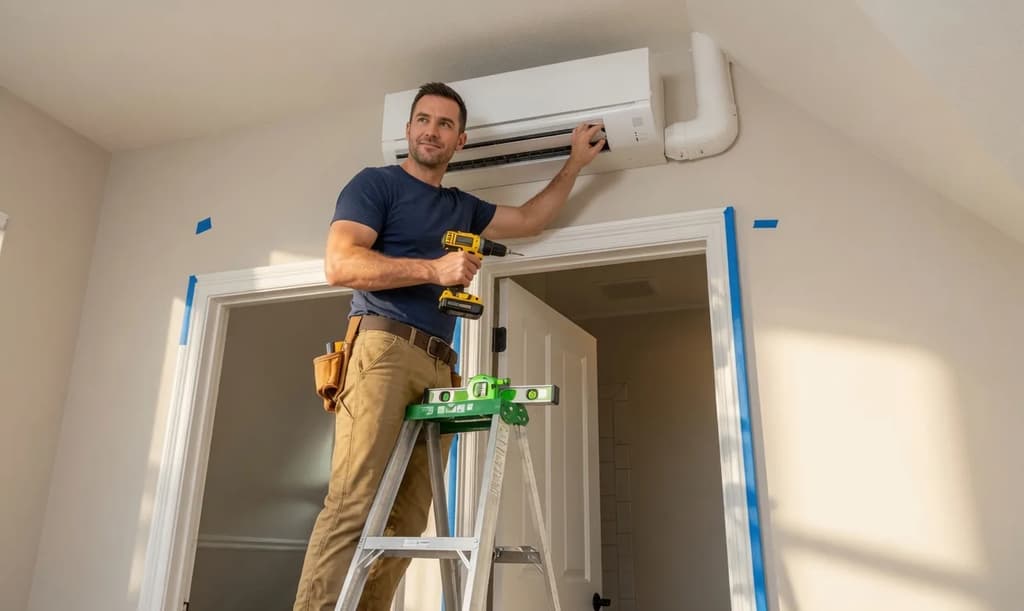
Choosing between a MRCOOL vs Senville DIY mini split can come down to more than just the price on the tag. This guide breaks down the specs, the steps to install it, the total cost, the warranty terms and how it does in cold weather so you can make a confident decision.
MRCOOL vs Senville: Quick Answer for DIYers
If you're buying a DIY mini split and want to put it in yourself, MRCOOL DIY is the one of these two brands that is built for a homeowner install. The 5th Generation line comes with pre-charged, factory-sealed QuickConnect line sets and MRCOOL's catalog says "no special tools or training are necessary to install". You do not need a vacuum pump or manifold gauges to hook up the refrigerant circuit. The DIY 5th Gen warranty gives you 5 years on parts and 7 years on the compressor, with no registration required, which is a real difference from brands that only cover you after a pro puts it in.
Senville, especially its LETO and AURA lines, does things differently. The upfront cost of Senville systems is generally lower than MRCOOL systems, and Senville has budget-friendly options for DIYers who bring in an installer. But these are traditional mini split systems that expect a professional installation path. The line sets ship empty, so you need a licensed tech for the refrigerant work, evacuation and commissioning. The electrical side needs a pro too.
The real comparison is not just equipment price. It's total project cost, whether you're legal and up to code, what the warranty actually covers, and how it'll heat when it's cold out. MRCOOL usually makes more sense for a genuine DIY install, and Senville when a homeowner is already planning to hire a pro. MRCOOL also isn't the only pre-charged option: Zone Air sells a pre-charged DIY system direct, and we cover where that fits further down.
How We Compare MRCOOL and Senville
This is a focused comparison of 2025–2026 era mini split systems, not older R-410A units that are being phased out. We're looking at:
- Total project cost is equipment plus install labor
- DIY install difficulty and required tools
- Energy efficient performance (SEER2 and HSPF2)
- Cold weather heating capacity and minimum operating temps
- Warranty terms, including rules about DIY vs professional install
- You have support, documentation and replacement parts available to you
Our examples focus on popular single zone 12,000 BTU systems - the MRCOOL DIY 5th Gen vs the Senville LETO 12K and Senville AURA 12K - because these sizes cover the most common situations: a garage, basement, room addition or small open area. We are including what the real-world electrical requirements are, what the local permit rules are, and whether you can get incentives, not just what's in the brochure specs. Long-term comfort and a safe install matter more here than getting the lowest upfront price.
MRCOOL DIY vs Senville LETO and AURA Specs
Both brands have mini splits you can use for heating and cooling. But the spec sheets are telling different stories depending on what matters most to you. The efficiency ratings for mini split systems are measured in SEER2 and HSPF2, and higher SEER2 ratings generally show lower electricity consumption for cooling. The energy efficiency varies a lot by model and tonnage for both brands.
MRCOOL figures come from the MRCOOL catalog and the DIY 5th Gen warranty.
Both brands switched to R-454B refrigerant for 2025-2026 models, because U.S. regulations require new outdoor unit models to move away from higher-GWP R-410A by January 2026. On paper, the cooling efficiency can look similar between the MRCOOL system and Senville AURA, but minimum outdoor temperature performance, included accessories like pre charged line sets, and installation quality requirements change the real-world experience. It's always worth cross-checking matched sets in the AHRI directory instead of relying only on marketing numbers.
Installation Path for True DIY vs Pro Install
The phrase "DIY mini split" gets used loosely online, but the installation path is where MRCOOL vs Senville diverge the most.
A MRCOOL DIY system is engineered for actual DIY installation. The QuickConnect line sets arrive factory-sealed and pre charged with R-454B. There is no vacuum pump required, no gauges to read and the refrigerant never opens to the air during the install. You connect the lines with basic hand tools and a torque wrench, open the service valves and the system is charged. MRCOOL DIY systems do not require a vacuum pump for installation.
Senville LETO and AURA ship more like traditional HVAC systems. The copper lines must be cut, connected using standard flare fittings, then the refrigerant circuit needs a nitrogen test, evacuation below roughly 500 microns using a micron gauge, and final charging by a licensed installer. Senville requires a licensed technician for refrigerant work.
Both brands still demand careful planning of wall penetration, condensate drainage and structural mounting of the outdoor unit. Homeowners often underestimate the drilling, routing and electrical work even for MRCOOL, and overestimate how "plug and play" a DIY mini really is.
MRCOOL DIY: What a Homeowner-Focused Mini Split Really Looks Like
The MRCOOL DIY 5th Gen is the big DIY system for 2025–2026 homeowners who want to skip the traditional HVAC industry path. MRCOOL DIY units ship with pre-charged QuickConnect line sets in 11.5, 16, 25, 35 and 50 ft lengths, with couplers to join two sets on longer runs, designed to connect with a torque wrench and basic hand tools. There's no refrigerant handling, no pressure test on site, and no nitrogen tank in your garage.
Typical DIY install steps: mount the indoor head on the wall, bore a 3–3.5 inch wall sleeve, route the line set through, set the outdoor unit on a pad or wall bracket, connect the quick-connects, open service valves and power up. Plan on most of a day for a first single zone install, and longer if the line route is difficult or the exterior wall is tall.
With a standard MRCOOL DIY 5th Gen, you're looking at heat down to about −13°F (catalog), and higher-tier DIY models are rated lower, for climates where the heating load is the main thing. MRCOOL systems also have a Wi-Fi module so you can use your phone to set schedules and change temperatures. With the DIY-friendly documentation and tech support, you can spend a weekend with tools instead of waiting weeks for an HVAC tech. Get help with sizing, layout and code questions before you start drilling.
Senville Mini Splits: Budget Equipment, Professional Start-Up
Senville LETO and AURA are strong value mini splits, but they are not designed as a full DIY mini split solution. Senville sells units where the outdoor unit usually arrives pre-charged in the condenser, but the line sets ship empty and must be evacuated and connected by someone with proper tools and certification.
The required pro tools include a vacuum pump rated for A2L refrigerants, a set of manifold gauges, a nitrogen tank and regulator for a pressure test, a flaring block, a torque wrench and a micron gauge. This is standard in the HVAC industry but far beyond what most homeowners keep in the house.
Senville LETO costs around $750 for the unit alone, making it attractive on sticker price. Senville's AURA series offers exceptional efficiency ratings, with Senville AURA hitting a peak efficiency of 25.5 SEER2. Senville AURA also provides heat down to -22°F, and the Senville AURA and ELITE series models are designed for high efficiency and performance. Senville LETO ranges from 20.5 to 20.8 SEER2 and is rated for heating down to 5°F.
Senville warranties generally require professional installation by a licensed HVAC technician for full warranty validity. If you're already budgeting for a pro install - say, as part of a renovation - a Senville mini split is a solid, energy efficient ductless system at a lower equipment cost.
Sticker Price vs Actual Project Cost
A fair MRCOOL vs Senville comparison has to look at the full cost of the project, not just what the online cart adds up to.
With the MRCOOL DIY 12K 115V, it listed at about $2,359 at Home Depot in September 2026. The line set length and accessories can move that number. You will need to add an electrician to put in the dedicated circuit, plus permits and extra supplies on top.
A similar Senville LETO may list near $750, while AURA cold weather models run closer to $1,000–$1,300. But Senville's installation costs can range from $500 to $1,500 depending on region and complexity. The total project cost for Senville is closer to MRCOOL after installation - it often lands in the same $2,000–$2,800 range once you add a licensed installer, electrical work, a disconnect box and permits.
There are hidden and shared costs that apply to both: a dedicated circuit and breaker, an outdoor disconnect, a wall bracket or concrete pad, covers to hide the line, and potential drywall repair if the path through the wall is tricky. Build a realistic budget that compares "MRCOOL DIY install plus electrician" to "Senville plus full pro install" instead of staring only at the equipment price tags.
Performance, Energy Efficiency and Cold Weather Operation
Both brands make energy efficient mini split systems that easily beat a gas furnace or older traditional HVAC setup when it comes to shoulder-season efficiency, but the differences show up once temperatures drop into the single numbers.
With a SEER2 rating of 23.5 and an HSPF2 of 10.2, the MRCOOL DIY 5th Gen 12K is one option to look at (catalog). Even at lower temperatures, the higher-tier DIY models from MRCOOL still have heating capacity you can use. When it comes to cooling, Senville AURA models reach rated efficiency up to 25.5 SEER2, but the LETO sits in the mid-range. For heating in cold weather, the Senville LETO loses capacity fast below 5°F, while the standard MRCOOL DIY 5th Gen is rated to about −13°F and the Senville AURA pushes down to about -22°F.
Improper installation can raise energy use by 30% no matter which brand you pick. Any brand of system that is too small or poorly installed will struggle when it gets really cold. It will short-cycle, ice up the outdoor unit, or fail to hit your thermostat setpoint. The 12K wall head from MRCOOL runs at 18 dB(A), so it is quiet enough for most rooms (catalog). In colder climates, DIYers do best with a cold-rated unit that's sized carefully to the room and insulation, or you can go with a pro install if it's going to be your primary winter heating.
Warranty, Support and DIY Install Risks
A lot of homeowners miss how the installation method affects warranty and long-term support.
MRCOOL has a 5-year parts and 7-year compressor warranty on the DIY 5th Gen, and it starts on the proof-of-purchase date with no registration required. On some retailer blogs you'll see a "register within 60 days" line. That refers to MRCOOL's Care Program, which is a paid monthly subscription that adds extended lifetime compressor replacement, not to the standard warranty.
Senville units need professional installation for warranty coverage. LETO usually has 5 years on parts and compressor coverage, while AURA has 10 years on the compressor. Senville's warranty does not cover labor costs. It starts from the installation date, so documentation matters. If you do not have a receipt from a licensed installer, they can deny your warranty claims.
When things go wrong, that can be a refrigerant leak from a bad flare, a kinked line set or a contaminated system. Those are labor-only issues that neither brand covers. Local contractors may not want to fix online DIY installs they did not commission. MRCOOL's sealed refrigerant path and DIY-oriented support cut down on the number of things you can get badly wrong, which is why it's the better fit of the two for pure DIY projects. You'll want to keep all receipts, serial numbers and photos of your install for any future warranty claim, whatever brand you choose.
Legal, Electrical and Code Rules for DIY
Even if the refrigerant circuit is DIY-friendly, the electrical side is serious work that you can't ignore.
Both MRCOOL and Senville outdoor unit installations typically require a dedicated circuit, a properly sized breaker (15A–30A depending on system), and an outdoor disconnect box within sight of the unit. Many jurisdictions require electrical permits and sometimes inspections for new mini splits, and unpermitted work can cause insurance issues later if there is a claim.
EPA Section 608 regulations affect Senville installs directly because traditional evacuations and refrigerant work require certified personnel. Pre-charged quick-connect systems keep the refrigerant circuit sealed from factory to install, so there's no evacuation or charging on site. Even die-hard DIYers should hire a licensed electrician for the circuit, while the homeowner handles the mechanical side of the install.
Federal Tax Credit, Rebates and Long-Term Value
Many homeowners still ask whether their mini split qualifies for the 30% federal tax credit (up to $2,000) or local utility rebates for energy efficient upgrades.
The federal 25C credit ended for equipment placed in service after December 31, 2025, so a mini split installed now won't qualify for it. Utility and state rebates are still out there. They usually need an ENERGY STAR rated mini split with specific SEER2 and HSPF2 levels. Both MRCOOL and Senville can hit these levels on select models. The MRCOOL DIY 5th Gen line has ENERGY STAR, and Senville AURA models are good options too. For self-installed DIY systems, the gray area comes from some incentive programs that strongly suggest or need professional installation.
Check with the rebate program contact before you assume a DIY system qualifies. Keep your AHRI certificate, bills and model numbers in order. Even without credits, the energy savings from a properly sized, well-installed multi zone or single zone system can cut cooling and shoulder-season heating costs over 10–15 years compared to older HVAC systems or electric resistance heat. Zone Air's free rebate search can help you find what your area offers, and whether the extra cost of a pro install may be offset by incentives.
Where Zone Air Fits as a Third Pre-Charged Option
If the reason you're looking at MRCOOL is the pre-charged install with no vacuum pump require, it's worth knowing Zone Air works the same way and sells direct at zone-air.com. A few points where it differs:
- Line sets cut to your length. Of the brands compared here, Zone Air is the only one that cuts your pre-charged line set to the exact length you measure, any whole foot from 5 to 75 (as of November 2026). A run of up to 75 ft is one continuous factory-sealed set with no field joint, while MRCOOL sends fixed lengths and uses couplers past 50 ft.
- Efficiency at 230V. The 12K 230V model is rated 24 SEER2, the highest of the pre-charged quick-connect DIY systems compared here (MRCOOL's best single-zone is 23.6). With Zone Air's 115V units, you get 23 SEER2, which is a bit below MRCOOL's 115V 23.5–23.6.
- Plug-in option at 115V. Zone Air's 115V models can plug into a dedicated 15A outlet with the optional cord kit, where local electrical code allows a plug-in install (never an extension cord). MRCOOL's 115V units are hardwired.
- You can mix room styles on one outdoor unit. It's the only DIY mini split that lets you mix wall-mount, ceiling cassette and concealed ducted units on one outdoor unit (as of November 2026).
- Cold weather. It is rated to heat down to −13°F, which is the same floor as MRCOOL's standard DIY 5th Gen. MRCOOL's higher-tier DIY models are rated lower. It is also rated to cool in outdoor temperatures up to 131°F (MRCOOL publishes 122°F).
- Warranty and returns. 5-year parts and 7-year compressor coverage with no registration deadline, and installing it yourself does not void it. Uninstalled units can be returned within 30 days of delivery.
- Price. In November 2026, the cost of the Zone Air 12K 115V direct was $1,999.99. In September 2026, MRCOOL's 12K 115V at Home Depot was running about $2,359.
For the other common matchup, see MRCOOL vs Pioneer, or the full MRCOOL alternatives roundup.
How to Decide Between MRCOOL DIY and Senville for Your Home
How ready you are to DIY, your climate and how critical heating is in deep winter all play into which brand is "right" for you.
When you're comfortable with moderate DIY projects, want to avoid refrigerant handling completely, are okay hiring an electrician for the electrical work, and prefer a warranty that doesn't hinge on a pro install, MRCOOL DIY is ideal. From purchase to power-up, the MRCOOL DIY is a true DIY system.
A Senville mini split makes sense when you're already planning a pro install setup, can secure a fair labor quote, want a lower-cost outdoor unit or a higher SEER2 model like the AURA with traditional commissioning, and have zero interest in doing any refrigerant work yourself.
Zone Air makes sense when you want the same no-vacuum-pump install as MRCOOL but need a line set cut to an odd length, 24 SEER2 on a 230V circuit, or a mix of wall, ceiling cassette and concealed ducted units on one outdoor unit.
If you live in a very cold weather region, prioritize cold-rated models - MRCOOL's higher-tier DIY models or Senville AURA - and strongly consider professional design help to avoid a system that's too small or too big. Ask yourself: What's my climate zone? How handy am I really? Do you have a local licensed installer or electrician you trust? Do local rebates need a pro install?
Before you buy, run your rooms through a mini split sizing calculator so you don't turn a DIY mini split that looks good into an expensive system that doesn't do its job. You'll want to get the install right, keep your warranty in good shape, and enjoy energy savings for years to come.
MRCOOL vs Senville FAQ
Can I install a Senville mini split myself? You can mount it, but the line set ships empty, so a licensed technician has to pressure test, evacuate and charge the refrigerant circuit. Senville also requires professional installation for warranty coverage.
Does MRCOOL's DIY warranty require registration? No. The DIY 5th Gen carries 5 years on parts and 7 years on the compressor with no registration required. The 60-day registration you may read about belongs to MRCOOL's paid Care Program.
Which handles cold weather better, MRCOOL or Senville? The standard MRCOOL DIY 5th Gen is rated to about −13°F and higher-tier DIY models are rated lower. Senville LETO is rated to 5°F, and Senville AURA to about -22°F.
Is there another pre-charged option besides MRCOOL? Yes. Zone Air ships pre-charged quick-connect line sets cut to any whole foot from 5 to 75, heats down to −13°F, and its warranty is not voided by a DIY install.
Specs and warranty terms are manufacturer-published as of November 2026, subject to change; verify before purchase. MRCOOL® and Senville are trademarks of their respective owners; Zone Air is not affiliated with or endorsed by either.