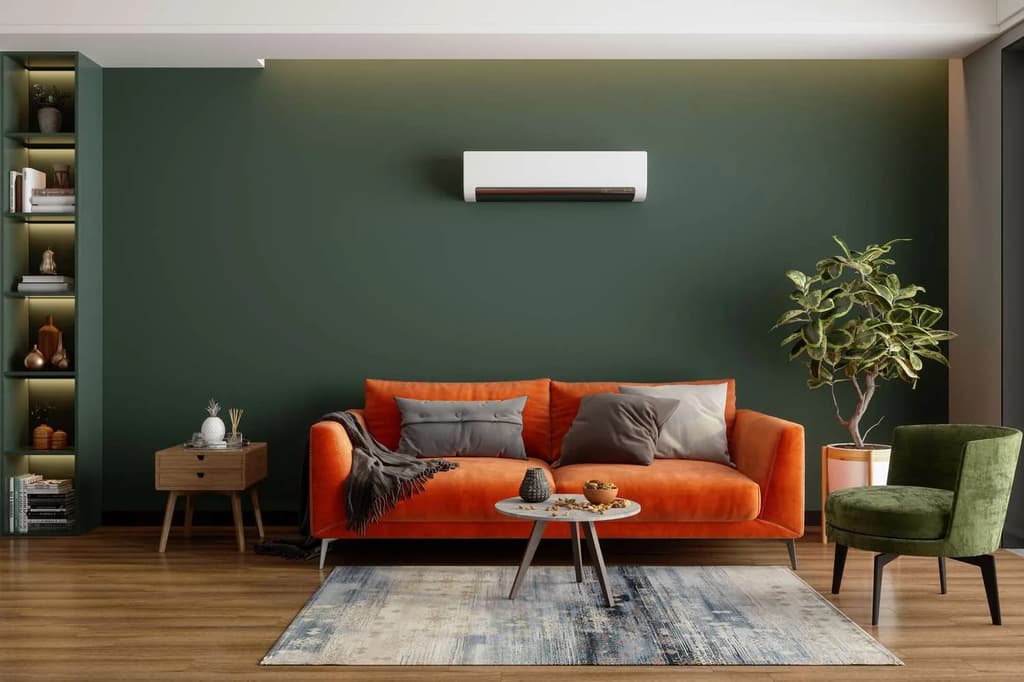
If your home loses heat fast and you don't have ductwork, the best diy mini split for cold climate heating can cut your winter heating bills while keeping every room at a steady temperature. This guide has the specs, brands and installation details that matter for cold weather heating in 2026.
Quick Answer: Best DIY Mini Split for Cold Climate Heating in 2026
For most homeowners in cold climates, the best diy mini split in 2026 is one that combines reliable heating capacity below 0°F, high seasonal efficiency and a genuine homeowner-friendly install process. Zone Air checks all three boxes.
Here's why Zone Air is the top overall pick:
- Cold weather heating to −13°F. Every Zone Air system is rated to heat down to −13°F, and you can check that on the spec sheets. The 230V single-zone models have a 24 SEER2 rating, and the 115V models have a 23 SEER2 rating, so you get high seasonal efficiency either way.
- 24 SEER2 on 230V. At 24 SEER2 on 230V, Zone Air is the highest-efficiency system that comes pre-charged and has quick-connect fittings, compared to the other brands here (MRCOOL's best single-zone is 23.6). Because it has inverter compressor technology, the unit can keep your electricity use low in both the heating season and the cooling season.
- True DIY installation. The refrigerant is factory pre-charged with R-454B and the line sets use quick-connect fittings, so you do not need a vacuum pump, a gauge set or EPA 608 certification to do the install.
- 115V plug-in models available. The 9,000 and 12,000 BTU 115V units can run on a dedicated 15A circuit. The optional cord kit makes them a plug-in install where local code lets you.
- There are custom-cut line sets that range from 5 feet all the way up to 75 feet. Of the brands compared here, Zone Air is the only one that cuts your pre-charged line set to the exact length you measure, any whole foot from 5 to 75 (as of October 2026). MRCOOL sends out fixed 11.5, 16, 25, 35 and 50 ft sets plus couplers and you have to coil the extra length yourself.
Other well-known brands can serve cold climates too. MRCOOL's standard DIY 5th Gen is rated to about −13°F, which is the same floor as Zone Air, and its higher-tier DIY models are rated lower, to −22°F. Brands like Pioneer and Friedrich also have models that can work in this space. But Zone Air puts together cold weather performance, DIY usability and warranty coverage in a way that's hard to match in 2026.
How Cold-Climate Mini Splits Work
A ductless mini split heat pump doesn't generate heat the way a furnace or baseboard heater does. It can move heat from the air outside into your home using a refrigerant cycle and a compressor. Because it transfers energy instead of converting electricity directly into warmth, a heat pump can deliver two or more units of heat per unit of electricity consumed.
Standard heat pumps can start to lose capacity when the temperature drops below 32°F. That's where cold climate models are different. Cold-climate units are designed to extract heat in freezing conditions. They can keep up useful output at temperatures from about 5°F down to −22°F depending on the model.
Making this work can involve:
- Enhanced vapor injection, which can keep the compressor producing heat when the outside temperature is low
- Outdoor coils that are larger, so you can get better heat exchange when the difference in temperature is small
- Inverter-driven compressors that can ramp up and down continuously. Inverter technology lets you keep a steady indoor temperature when outdoor conditions change, instead of the unit turning on and off the way older units do
Every ductless mini split system has two parts: the outdoor unit (condenser) and the indoor unit (air handler). Because there are no ducts, you avoid the 20 to 30% energy losses that leaky ductwork causes in many older homes. You're going to want good heating performance in cold weather, and ductless mini splits can give it to you without having to open up walls to put in duct.
Cold Weather DIY Mini Split Specs
Heating capacity is measured in British thermal units, or BTUs for short. But the BTU ratings on the nameplate can throw you off in a cold climate. Here's what to look at instead:
- Heating capacity at multiple temperatures. A system's minimum operating temperature does not indicate its heating capacity at that temperature. Output tapers as the outdoor air gets colder. Zone Air, for example, publishes a COP2 of 3.81 at 47°F and 2.1 at 5°F for its 12,000 BTU 230V unit. Check the heating capacity at 5°F and below to ensure adequate performance for your region.
- Minimum operating temperature. You should look for systems rated to heat down to −13°F or lower. Zone Air has a rating down to −13°F, so it hits the same floor as MRCOOL's standard DIY 5th Gen. MRCOOL's higher-tier DIY models are rated lower.
- SEER2 and HSPF2 ratings. SEER2 measures cooling efficiency. HSPF2 is the measure of heating efficiency over a season. If you're buying for a cold climate, the HSPF2 rating is what you want to pay more attention to than SEER2. An HSPF2 around 10 for a 12,000 BTU unit is strong for 2026.
- Voltage. 115V plug-in models (like Zone Air's 9K and 12K units) make electrical work simpler. 230V models need a dedicated double-pole breaker and potentially new wiring.
- Line set length. Zone Air has pre-charged line sets that go up to 75 feet in a single continuous run. MRCOOL's a-la-carte lengths stop at 50 feet and you can only get to 75 by joining two sets with a coupler, which limits how flexible your installation can be.
Cold weather performance curves are what matter more than the nameplate BTU. Always look at the manufacturer spec sheets to find the capacity at your local winter design temperature.
Zone Air: Best Overall DIY Mini Split for Cold Climates in 2026
For you, Zone Air built its latest generation of mini splits so you can get pro-level cold climate performance without having to hire an HVAC professional. Here are the core specs for the 12,000 BTU 230V wall mount model:
- Heating operation down to −13°F
- 24 SEER2 cooling efficiency
- HSPF2 of 10.0 (Region IV) / 8.6 (Region V)
- Heating rated capacity of 12,600 BTU/h, with a heating capacity range of 2,500 to 15,000 BTU/h
- COP2 of 3.81 at 47°F and 2.1 at 5°F
What makes Zone Air stand out among DIY models:
- Pre-charged quick-connect line sets. You don't need a vacuum pump, refrigerant gauges or nitrogen purging. The system is factory pre-charged with R-454B.
- Custom line set lengths from 5 to 75 feet. The set that comes with it is 16 feet, but you can order a longer or custom-cut run if you need to reach remote rooms, a second floor or a cabin installation without splicing. Each 25, 33, 50 or 75 ft set is one continuous factory-sealed run, not an extension.
- 115V plug-in options. You can get both the 9,000 BTU and the 12,000 BTU single-zone units in 115V, and they will run on a dedicated 15A circuit. This helps when 230V wiring isn't available. The downside is that the 115V units are 23 SEER2, not 24.
- DIY-valid warranty. Every system carries a 5-year parts and 7-year compressor warranty with no registration deadline, and it stays valid under homeowner installation.
- You can mix indoor units on one outdoor unit. As of October 2026, Zone Air is the only DIY mini split that lets you put wall-mount, ceiling cassette and concealed ducted units together on one outdoor unit. You get one outdoor unit, the right indoor unit for every room, and you can install it yourself.
- Direct from the manufacturer. Sold direct at zone-air.com, with final assembly, testing, and inspection in the USA, live technical support 8 AM to 6 PM MT, an install video library and a written DIY manual. Zone Air offers 30-day returns on uninstalled units (RMA required) and free shipping to the lower 48.
What to Expect From Zone Air at −13°F
A −13°F rating means the system keeps running and producing heat at that temperature, but it does not mean the unit delivers its full 12,000 or 18,000 BTU at −13°F. As the outdoor temperature drops, the available heating capacity is going to fall. It depends on the indoor-outdoor temperature differential and the unit size.
Here's what this means in practice:
- When the outdoor temperature is 47°F, the 12,000 BTU Zone Air unit runs near full capacity and has a published COP2 of 3.81.
- At 5°F, the published COP2 is 2.1, so you still get more than two units of heat per unit of electricity.
- At −13°F, the unit still heats, but the output is going to fall further. If your room's heat loss exceeds what the unit can deliver at that temperature, indoor temps will slip below your setpoint.
Defrost behavior matters too. When frost builds up on the outdoor coil, the unit reverses its cycle briefly to melt the ice. Automatic defrost systems should have demand-based controls to avoid unnecessary cycles, which keeps the time your indoor air handler blows cool air during heating to a minimum.
For comparison, MRCOOL's higher-tier DIY Hyper Heat line is rated to −22°F, giving it an edge in the coldest pockets of the northern US and Canada. But those units are 208/230V only and come in 12K and 18K sizes. Zone Air's −13°F floor covers the vast majority of cold climate scenarios in the mainland US.
If your region's winter lows routinely hit −15°F or colder, size your Zone Air unit above your calculated load or plan a backup heat source.
What Makes a Mini Split "DIY-Friendly"?
The term "diy mini split" gets used in a loose way. True DIY mini splits use pre-charged quick-connect line sets so you don't have to handle refrigerant at all. Here's what separates a real DIY installation from a "sort-of DIY" one:
- No refrigerant work. With Zone Air's quick-connect fittings, you tighten them to seal the fitting and release the pre-charged R-454B that is already inside. The refrigerant never opens to atmosphere, so there is no vacuum pump, no gauge set and no EPA 608 certification in the install. In most local areas, the permit is only for electrical work (check locally).
- Included mounting hardware and templates. The box has the indoor unit mount, the wall penetration sleeve and the step-by-step instructions.
- Line set flexibility. With options up to 75 feet, you're less likely to end up coiling excess tubing behind the outdoor unit or need a technician to extend a run that is too short.
Electrical requirements still apply. DIY mini-splits need a dedicated electrical line for installation. Even Zone Air's 115V models should be on their own 15A circuit. The 9K and 12K 230V models require a 15A double-pole breaker; the 18K needs a 30A double-pole breaker. Verify installation instructions and requirements for electrical work in cold-climate systems before you start; if local code requires a licensed electrician for new circuits, budget for that.
A typical install follows this sequence:
- You'll mount the bracket for the indoor air handler on the wall
- Drill a hole that is 3 inches through the exterior wall
- You'll run the line set, which is already pre-charged, from the indoor unit to the outdoor unit
- Mount the outdoor unit on a wall bracket or on a stand that is on the ground
- Connect the quick-connect fittings and tighten
- You'll wire the circuit, which is dedicated, to the disconnect.
- You'll power on and test heating and cooling modes
You can plan on most of a day for two people on a first install. Zone Air's FAQ puts the manual's step times at about 6 to 9 hours, plus any electrician work, and it goes faster once you've done one.
Zone Air vs Other DIY Mini Split Brands
In 2026, the cold climate mini split market has three types: hyper heat systems that need a pro to install them, DIY units that don't cost much, and extreme-cold models for special cases. Zone Air is right in the middle, with DIY installation and strong specs for cold weather.
Pro-installed cold-climate systems like the Daikin Atmosphera Series (SEER ratings from 22 to 27.5) and the Cooper & Hunter Hyper Heat Series (SEER ratings from 20.5 to 25) are built to deliver heating in extreme cold weather. The Cooper & Hunter Hyper Heat Series is built for extreme cold weather. It can work efficiently down to −22°F. For refrigerant work, the Daikin Atmosphera has to have professional installation and a licensed HVAC tech.
Budget and mid-range DIY systems include brands like MRCOOL DIY and Pioneer. There are other brands too. MRCOOL's DIY 5th Gen kits have a 25-foot pre-charged line set, and per MRCOOL's catalog, no special tools or training are necessary to install. MRCOOL's standard DIY 5th Gen is rated to about −13°F, and it runs from 18 to 23.6 SEER2 depending on the size, with the 9K and 12K sold as 115V hardwired units. The higher-tier Hyper Heat type is at 23.5 SEER2 for the 12K and 21.2 SEER2 for the 18K, and it pushes to −22°F with 230V only. MRCOOL's DIY 5th Gen warranty is 5 years on parts and 7 years on the compressor, with no registration required, which is the same main term as Zone Air. The Pioneer WYS Series can function at temperatures as low as −13°F, and the Pioneer WYS Series has SEER ratings from 17.5 to 21.5. Pioneer's standard kits have a 16-foot copper flare line set, and you need a vacuum pump when you install it.
High-performance niche units include the Senville AURA Series, which is made to operate efficiently down to −22°F and has SEER ratings up to 28.1. However, the installation of Senville Aura Series has to be done by a professional. The Friedrich Floating Air Premiere Series has SEER ratings from 18 to 28, and it operates effectively down to −13°F.
Zone Air leads on three axes for the DIY buyer: cold weather operation to −13°F, 24 SEER2 on 230V (the highest of the pre-charged quick-connect brands compared here), and genuine homeowner installation with custom-cut line set lengths that the other brands in this table do not match. One honest tradeoff is that on the 115V single-zone units, Zone Air is 23 SEER2 while MRCOOL's 115V 9K and 12K are 23.6 and 23.5, so the efficiency lead is a 230V story.
Right BTUs for Cold Climate DIY Mini Splits
In a cold climate, you'll want to size the heating system based on heating demand rather than cooling demand. Mini-split systems range from 9,000 BTUs all the way up to 36,000 BTUs. A 12,000 BTU unit is commonly rated for 400 to 600 square feet, and in a cold climate you should plan on the low end of that range. A 24,000 BTU unit can heat up to 1,300 square feet.
Here are some rules of thumb for cold climate sizing:
- With walls that are R-20 or better, a ceiling that is R-40 or better, and double or triple-pane windows, a well-insulated home will need 35 to 45 BTU per square foot
- For a home that is poorly insulated or drafty, you will need 45 to 60 BTU per square foot
- What is the right winter design temperature to use? That would be your local winter design temperature from Manual J data or building code. Zone 6 covers parts of New England and the upper Midwest, and the 99% design temp there often falls between −5°F and 0°F.
Oversizing mini-splits can lead to short cycling, where the compressor turns on and off rapidly instead of running steadily. This wastes energy and it reduces comfort, so it's better to match the unit to your calculated load and add a backup source for the coldest nights.
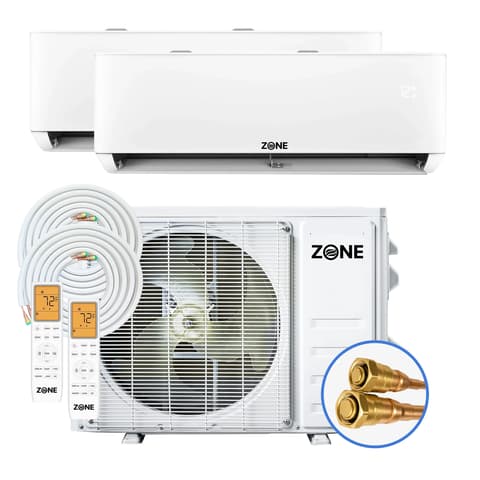
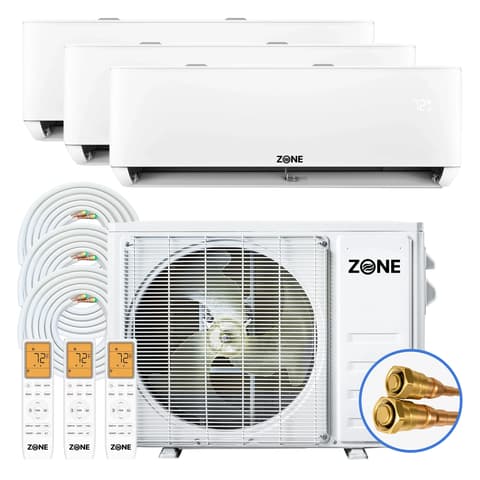
For larger spaces or multi-story homes, Zone Air offers multi-zone setups with two or three indoor heads connected to a single outdoor unit, covering up to about 1,800 square feet. Each zone can be sized to its own room's square footage and insulation profile. The heads can be wall-mount, ceiling cassette or concealed ducted in any mix. Every zone gets its own thermostat, and you can add a head later to a spare port on the outdoor unit.
If you don't want to run a full Manual J calculation, several free online calculators can estimate your heating load using your house dimensions, insulation levels, window area and local climate data. Zone Air publishes a free mini split sizing calculator.
Efficiency and Costs in Cold Climates
SEER2 measures cooling season efficiency; HSPF2 measures heating season efficiency. For a cold climate homeowner who runs heat five or six months per year, HSPF2 and low-ambient COP are what drive your electricity bill.
A heat pump with a COP of 2.0 at 32°F delivers two units of heat for every one unit of electricity. That cuts your cost per delivered BTU roughly in half compared to electric resistance heating. Look for a COP rating of at least 1.75 at 5°F for efficiency that holds up through most winter nights; Zone Air's 12K 230V unit publishes 2.1 at 5°F. At 24 SEER2 and 10.0 HSPF2 on 230V, Zone Air is the highest-efficiency pre-charged quick-connect DIY system of the brands compared here.
Variable-speed compressors play a direct role here. Instead of slamming on at full power and shutting off, an inverter compressor ramps to match the load. This avoids peak power draws and keeps room temperature stable. Smart controls such as Wi-Fi connectivity enhance comfort and energy efficiency further; you can adjust temperature by phone or set schedules from a remote location, even for a cabin you only visit on weekends.
Cost comparison example: heating a 1,200 square foot home through a New England winter (about 5,000 heating degree-days) with electric baseboard at $0.25/kWh might run $2,500 to $3,500 per season. A heat pump operating at an average seasonal COP of 2.2 could reduce that to roughly $1,100 to $1,600.
Potential incentives to offset installation costs:
- State and utility rebates vary by region. The federal 25C tax credit ended for equipment placed in service after December 31, 2025, so you'll want to check your state and utility programs instead. Zone Air systems are AHRI Certified, which is what most rebate programs ask for.
- Time-of-use electricity rates are rates that give you a better price for shifting heating to off-peak hours
- You can pair the system with solar panels to offset the electricity you use. If you size the solar array to match the load from your heat pump, you can get your net heating costs close to zero
Installing a DIY Mini Split in Harsh Winters
Installing in cold weather takes a few extra steps compared to what you need to do for a standard setup:
Outdoor unit placement:
- Mount the unit at least 12 to 18 inches above your expected maximum snow depth
- Use a wall bracket or stand that will raise it up. Do not put the condenser directly on the ground in snow country
- Angle the base pad so the water from melting snow drains away and does not freeze again under the unit
- To prevent ice from building up in a way that can damage the outdoor unit, a base pan heater helps. Some cold climate models have one included, or you can add a pan heater after you buy the unit
Airflow protection:
- Do not cover the outdoor unit with a full enclosure during the heating season. It has to pull outside air across its coils
- A simple top cover or wind guard on the side the wind hits can cut down on snow getting in without blocking airflow
Winter maintenance checklist:
- Clean the filters in the indoor air handler every month during heating season
- Check the outdoor coil for things blocking it after a heavy freeze or an ice storm.
- Check that the condensate drain line slopes down and has insulation on it so it doesn't freeze and back up
- You'll want to use covers or conduit for the line set to keep the exposed refrigerant lines safe from ice, from UV and from physical damage.
Backup Heat for DIY Mini Splits
Even a cold climate diy mini split that you picked out well has its limits. It's a good idea to have backup heating sources for when it gets extremely cold in these cases:
- Temperatures routinely below −13°F. Zone Air has a rated floor of −13°F, so it has its limits. In parts of Minnesota, Montana and northern Canada, the lows in winter can drop to −30°F or even colder.
- Poorly insulated structures. A drafty cabin with single-pane windows may lose heat faster than a unit that was sized right can put it back in at low temperatures.
- Power outages. Heat pumps run on electric. A wood stove or pellet stove gives you heat when the grid goes down.
Common backup strategies:
- Use electric baseboard or plug-in space heaters for the handful of nights per year that go past what your mini split can handle.
- For rural homes and cabins without reliable power access, a wood or pellet stove works well.
- Dual-fuel setups where an existing gas or oil furnace kicks in below a set temperature threshold. The heat pump handles everything above it
Can Zone Air carry most of the seasonal heating load in cold climates? It can handle the majority of the heating load in most cold climates. Planning for the worst night of the year is what separates a comfortable house from a cold one.
Best DIY Mini Split for Your Cold Climate Home
Follow this decision model:
- Confirm your climate. Find your local winter design temperature using ASHRAE data or your building department. This is the coldest temperature that your system needs to be able to handle.
- Calculate your heating load. Use the square footage of the space, the insulation values, the U-factors of the windows, and the height of the ceiling. For this, the gold standard is the Manual J calculation. You can use free online tools to get a rough estimate.
- Choose single-zone or multi-zone. For one room or an open-plan space, a single indoor unit will work. Multi-zone setups with two or three air handlers have room-by-room temperature control across a larger house.
- Check low-ambient ratings. Filter for units that are rated to at least −13°F. If your design temp is colder, look at −22°F options or plan backup heat.
- Look at DIY ease. Can you mount a bracket, drill a 3-inch hole and connect a dedicated breaker? If yes, a quick-connect pre-charged system like Zone Air is within reach. If not, you'll need to factor professional installation costs into your budget.
- Compare warranties. With Zone Air, you get a 5-year parts warranty and a 7-year compressor warranty, and both are good for installs that a homeowner does. There is no registration deadline. Not all brands offer this. Some will void your coverage if you don't have a licensed installer sign off on the work.
For 2026, Zone Air is a leading answer to "what is the best diy mini split for cold climate heating?" because it blends cold weather performance to −13°F, true DIY installation and 24 SEER2 efficiency on 230V in a single system. Size carefully, follow the installation instructions and expect your cold weather heat pump to deliver the comfort and cost savings that make the project worth doing.
Specs and warranty terms are manufacturer-published as of October 2026, subject to change; verify before purchase. MRCOOL® is a trademark of its owner; Zone Air is not affiliated with or endorsed by MRCOOL.