
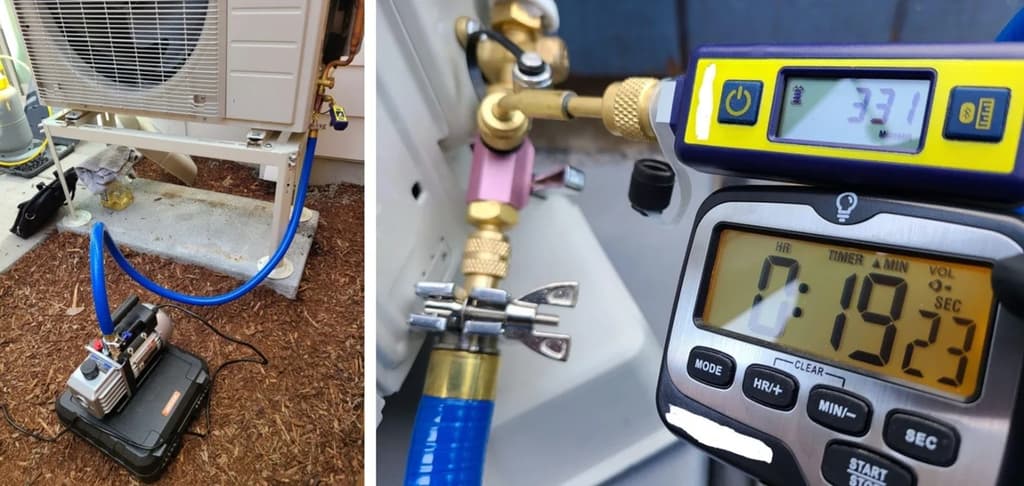
Short answer: no, you do not need to vacuum a pre charged mini split as long as it is a true pre-charged, quick-connect system and you install the line set the way it ships. The line set on a system like Zone Air DIY is evacuated and charged at the factory, then sealed at both ends. You never open the refrigerant circuit, so there's no air or moisture to pull out, and you don't need a vacuum pump, gauge set or EPA 608 certification to install it. The systems that do need a vacuum are traditional flare-fitting mini splits, which covers most of what Mitsubishi, Daikin, Fujitsu, LG and most Pioneer, Senville and Cooper & Hunter models are. There are also a few situations where even a pre-charged system ends up needing one. They are covered below.
Why a Pre-Charged Mini Split Doesn't Need a Vacuum
A vacuum pump has one job: getting air and moisture out of refrigerant lines that were open to the room while you installed them. On a traditional system you cut and flare copper on site, so the lines are full of humid air when you connect them. If that air stays in, it takes up space the refrigerant needs. The moisture can react with refrigerant and oil to form acids that eat at the compressor. So the installer pulls the lines down to a deep vacuum, usually 500 microns or lower, holds it to prove there is no leak or moisture, and only then releases the refrigerant stored in the outdoor unit.
With a pre-charged line set, you don't have to do any of that because the factory already did it. The lines are evacuated, filled with refrigerant and sealed before they leave the plant. Once the fitting is threaded fully onto its mate, the seal on the quick-connect fittings on each end opens, so the refrigerant path goes straight from the sealed line into the sealed unit without ever meeting outside air. There is nothing to evacuate.
When You Do Need to Vacuum a Pre-Charged Mini Split
"Pre-charged" only means no vacuum while the factory seal stays intact. These are the cases where a vacuum pump comes back into the job.
1. The line set gets cut, shortened or spliced. The moment you cut a pre-charged line, the refrigerant is gone and the line is open to air. Never cut a pre-charged set to length. If your run is shorter than the set, coil the extra neatly or buy the right length to begin with. Zone Air cuts pre-charged line sets to the exact length you order, any whole foot from 5 to 75 ft, so you don't have to choose between a short set and a coil of extra line.
2. The run is longer than any pre-charged set. Zone Air's longest single pre-charged run is 75 ft. MRCOOL ships fixed 11.5, 16, 25, 35 and 50 ft sets and uses line set couplers when one standard length isn't enough, with a 75 ft maximum per indoor unit. Past what the manufacturer allows, the line has to be field-built and field-charged, and that means a vacuum, gauges and a certified tech.
3. A fitting leaks, gets damaged or gets disconnected. Quick-connect fittings are made to be connected once. If a fitting is cross-threaded, a line gets kinked or punctured, or someone unscrews a connection after it is made, refrigerant can escape and air can get in. Repairing that is a refrigerant job: recover, repair, vacuum and recharge. Call the manufacturer's support before you touch it.
4. Any later refrigerant repair. Years down the road, a compressor, coil or valve repair means opening the circuit, and a tech will vacuum it before recharging. That's normal for any heat pump and has nothing to do with how it was first installed.
5. The "pre-charged" part is only the outdoor unit. This one catches a lot of people. Almost every traditional mini split ships with refrigerant already in the outdoor unit, enough for a set line length. Some sellers call that "pre-charged." The lines on those systems still arrive empty and still need flaring and a vacuum. A pre-charged line set with quick-connect fittings is the thing that removes the vacuum step.
How to Tell If Your Mini Split Is Pre-Charged
It is a good idea to check these before you buy, or before you start the install.
- Look at the line set ends. A pre-charged set has threaded quick-connect couplings with protective caps on each end. The line is sealed. With plain copper tubing with flare nuts, or open copper ends, you are looking at a traditional install.
- Read the install manual. A true pre-charged system's manual tells you to connect and tighten the couplings, and it doesn't tell you to do a vacuum or evacuation step for the standard install.
- Check what comes in the box. On Zone Air, single-zone wall systems come with a 16 ft pre-charged line set, and every other system takes pre-charged sets that you buy for each zone. Usually a traditional kit comes with empty copper, or no line set at all.
- Ask whether the warranty needs a licensed installer. Brands whose warranty needs a licensed HVAC install are almost always flare systems that need a vacuum.
What You Do Instead of Vacuuming
On a pre-charged system the refrigerant connection is a short job. The rest of the install, mounting the units, the wall penetration, the drain and the wiring, is the same as any mini split. Here's what the refrigerant part looks like:
- Unroll the line set carefully and route it so you don't make sharp turns or kinks. You'll want to keep the caps on until the moment you connect.
- Take the caps off and check that the fitting faces and screw threads are clean and not damaged.
- Line the coupling up straight and thread it on by hand so it does not cross-thread.
- Tighten with two wrenches, one holding and one turning, to the torque in the manual. Zone Air recommends an HVAC torque wrench, though it is not strictly required.
- You can power up and test, following the manual.
On Zone Air's FAQ, the list of tools is a cordless drill, a 3-inch hole saw, a 4-ft level, screwdrivers, two adjustable wrenches, a tape measure and a stud finder. You don't need a vacuum pump. You do not need manifold gauges. You don't need a refrigerant tank or a flaring tool. The cost of those tools alone is $400–600 to rent or buy, and that's a big part of why traditional mini splits are hard to do yourself. On time, the same FAQ puts a first single-zone wall install at most of a full day for two people, about 6–9 hours by the manual's step times, and faster once you've done one.
EPA 608 note
Under EPA Section 608, opening a refrigerant circuit on most systems, including flaring and charging a traditional mini split's line set, is a job for a certified technician. With a pre-charged quick-connect system the refrigerant is sealed in the factory-charged line set and never opens to atmosphere, so there is no vacuum pump, no gauge set and no EPA 608 certification in the install; most jurisdictions treat it as an electrical-only permit (check locally). If you're going the traditional route, either get 608-certified or have a tech do the final refrigerant hookup.
Pre-Charged vs Traditional Costs
The honest comparison is a pre-charged DIY system against the traditional flare route most homeowners get quoted.
Scenario 1: One 12K BTU zone
Zone Air 12K 115V (pre-charged DIY):
- Equipment: $1,999.99 with the 16 ft pre-charged line set in the box
- Tools: about $50 if you need to buy a hole saw and wrenches
- Vacuum pump / gauges / EPA cert: $0
- Total: about $2,050
Traditional flare system, DIY with rented tools:
- Equipment: about $1,500
- Vacuum pump rental: about $60
- Manifold + micron gauge: about $80
- Flaring tool: about $50
- Total: about $1,690. You need EPA 608 certification to do it legally
Traditional flare system, professionally installed:
- Equipment + labor: $3,500–5,500
The pre-charged route costs a few hundred dollars more than renting tools for a flare install, without the vacuum pump, the gauges, the flaring or the certification. With a pro install, you are saving about $1,450–3,450 in labor.
Scenario 2: Two zones
Zone Air dual-zone wall system (pre-charged DIY):
- Equipment: $3,239.99 for the 24K (12K + 12K), plus two 16 ft pre-charged line sets at $229.99 each
- Total: about $3,700, with no vacuum step on either zone
Two traditional zones, professionally installed:
- Equipment + labor: $7,000–10,000
With each zone you add, the gap gets bigger, because labor is the part of a pro install that grows fastest.
Pre-Charged Mini Splits That Skip the Vacuum
Every system in this table comes with a sealed, pre-charged line set and quick-connect fittings, so none of them need a vacuum pump. If you're wondering how the mechanics work, there's a guide on how quick connect mini split systems work, and you can see how R-32 vs R-454B stacks up in a separate piece.
Scores weight DIY-friendliness, U.S. support and overall value. For the broader shortlist, see the best DIY mini splits overall.
#1 - Zone Air DIY · Best Overall
Zone Air pairs the no-vacuum install with efficiency that used to need a flare system: 24 SEER2 on the 230V 9K and 12K, which is the highest of the pre-charged quick-connect brands compared here (MRCOOL's best single-zone is 23.6). It's rated to heat down to -13°F, the same floor as MRCOOL's standard DIY 5th Gen and 18° lower than MRCOOL's Easy Pro, since higher-tier DIY models are rated lower. And as of November 2026, it is the only one of the brands compared here that cuts your pre-charged line set to the exact length you measure, any whole foot from 5 to 75, in one continuous run with no coupler.
Best for: DIYers who want an efficient, cold-climate system without a vacuum pump. The 9K and 12K come in 115V, and with the optional 3-prong cord kit they can plug into a dedicated outlet where local code allows a plug-in install.
#2 - MRCOOL DIY 5th Gen · Widely Available
MRCOOL DIY is sold at big-box stores and it has a large library of install videos, which is why a lot of DIYers look at it first. Its quick-connect line sets skip the vacuum the same way. MRCOOL's DIY 5th Gen is rated to operate down to about -13°F, and it carries a 5-year parts and 7-year compressor warranty with no registration required.
Verdict: a solid no-vacuum system. With a price of $1,999.99 for a 12K 115V Zone Air against about $2,359 for MRCOOL's 12K 115V at Home Depot (September 2026), and both have the same 5/7 warranty terms, but Zone Air gives you custom-length line sets.
#3 - Perfect Aire QuickConnect · Best Budget Value
Genuine quick-connect at a lower upfront price than most of the field, with a 7-year compressor warranty. If budget is the hard limit and you are in a moderate climate, it is the value pick. The trade-off is efficiency in the high teens and less cold-weather range.
#4 - Klimaire DIY (E-Z Kuick Connect) · Solid Mid-Tier
A real pre-charged line set with efficiency to about 20 SEER2 and a wide range of sizes, but the support is thinner than the leaders and it has no true cold-climate performance.
When Traditional Flare Install Makes Sense
Pre-charged isn't the answer every time.
1. Your run is longer than the longest pre-charged set. Past 75 ft, the line has to be field-built and field-charged.
2. You already own the tools and you are 608 certified. Then a flare system's slightly lower equipment price can make sense.
3. The unit you want is flare-only. Mitsubishi, Daikin and Fujitsu do not sell pre-charged quick-connect lines, so their installs always include the vacuum step.
For most homeowners putting in one to three zones within a normal run, none of these apply.
Frequently Asked Questions
Do you need to vacuum a pre charged mini split?
No. A true pre-charged, quick-connect mini split ships with the line set evacuated, charged and sealed at the factory, so the refrigerant circuit never opens during the install. You connect the sealed couplings and tighten them to spec. No vacuum pump, no manifold gauges and no EPA 608 certification. You only need a vacuum if the line gets cut, damaged or disconnected, if the run is longer than the longest pre-charged set, or if the system is a traditional flare-fitting unit.
Is a "pre-charged" outdoor unit the same as a pre-charged line set?
No, and this is where a lot of buyers get caught. Most traditional mini splits ship with refrigerant in the outdoor unit and still call it pre-charged. Their line sets arrive empty, so you still flare the copper and pull a vacuum. It is the pre-charged line set with quick-connect fittings that removes the vacuum step.
Can I cut a pre-charged line set to make it shorter?
No. Cutting the line releases the refrigerant and opens the line to air, which puts you right back into vacuum-and-recharge territory. Coil the extra neatly or order the right length. Zone Air cuts pre-charged sets to any whole foot from 5 to 75 ft, so you can order the length you measured.
What happens if I skip the vacuum on a traditional (flare) mini split?
You'll shorten its life a lot. Air left in the lines cuts capacity, and moisture forms acids that attack the compressor windings. It is also a refrigerant job regulated under EPA Section 608. That risk only applies to traditional flare systems, not to a sealed pre-charged unit.
Do pre-charged line sets stay vacuum-free if I need a longer run?
Yes, as long as you use the manufacturer's pre-charged set at the length you need and stay within the rated maximum. Zone Air sells pre-charged sets up to 75 ft, each one continuous run. MRCOOL sells fixed lengths up to 50 ft and uses couplers to reach its 75 ft maximum. Past that, the line has to be field-charged.
Can I install a pre-charged mini split without an electrician?
Often, for the smaller sizes. Zone Air's 9K and 12K come in 115V and run on a dedicated 15A circuit, and with the optional cord kit they can plug into a dedicated outlet where local code allows. Power connects at the outdoor unit. The 18K needs a dedicated 230V circuit, and many people hire an electrician just for that circuit while doing the rest of the install themselves.
Conclusion
So, do you need to vacuum a pre charged mini split? No. A true quick-connect system is evacuated and charged at the factory, so it skips the vacuum step, the gauges and the EPA 608 certification. Keep the seal intact: don't cut the line, don't disconnect a fitting once it's made, and order a line set long enough for your run. The vacuum pump only comes back if one of those goes wrong, or if the system was never truly pre-charged.
Specs, prices and warranty terms are manufacturer-published as of November 2026, subject to change; verify before purchase.
Questions About Installation? Call Zone Air's technical support at (801) 882-2324 and we'll walk you through it.
Related Resources: