Watch the pre-charged Quick Connect lineset thread onto the condenser — no vacuum pump, no gauges, no refrigerant handling.
DIY Mini Splits.
Pre-Charged. No Vacuum Pump.
Zone Air ships every DIY mini split with a pre-charged R454B lineset and quick-connect fittings. No vacuum pump. No EPA Section 608 license. No flaring tools. Hand-tighten the couplings, torque to spec, and a first-time installer can have a single-zone system running in 4–8 hours.
DIY Mini Split Installation Guide: How Zone DIY Systems Work
More people than ever are skipping the contractor and installing their own ductless heating and cooling. Here is everything you need to know about diy mini splits — from sizing to startup.
Quick Answer: Can You Really Install a DIY Mini Split Yourself?
Yes. Thousands of homeowners install a DIY mini split every year without an HVAC license, and Zone systems are specifically engineered to make that process easy. Most single-zone installs (9,000–24,000 BTU) take a weekend with common tools and the included manual.
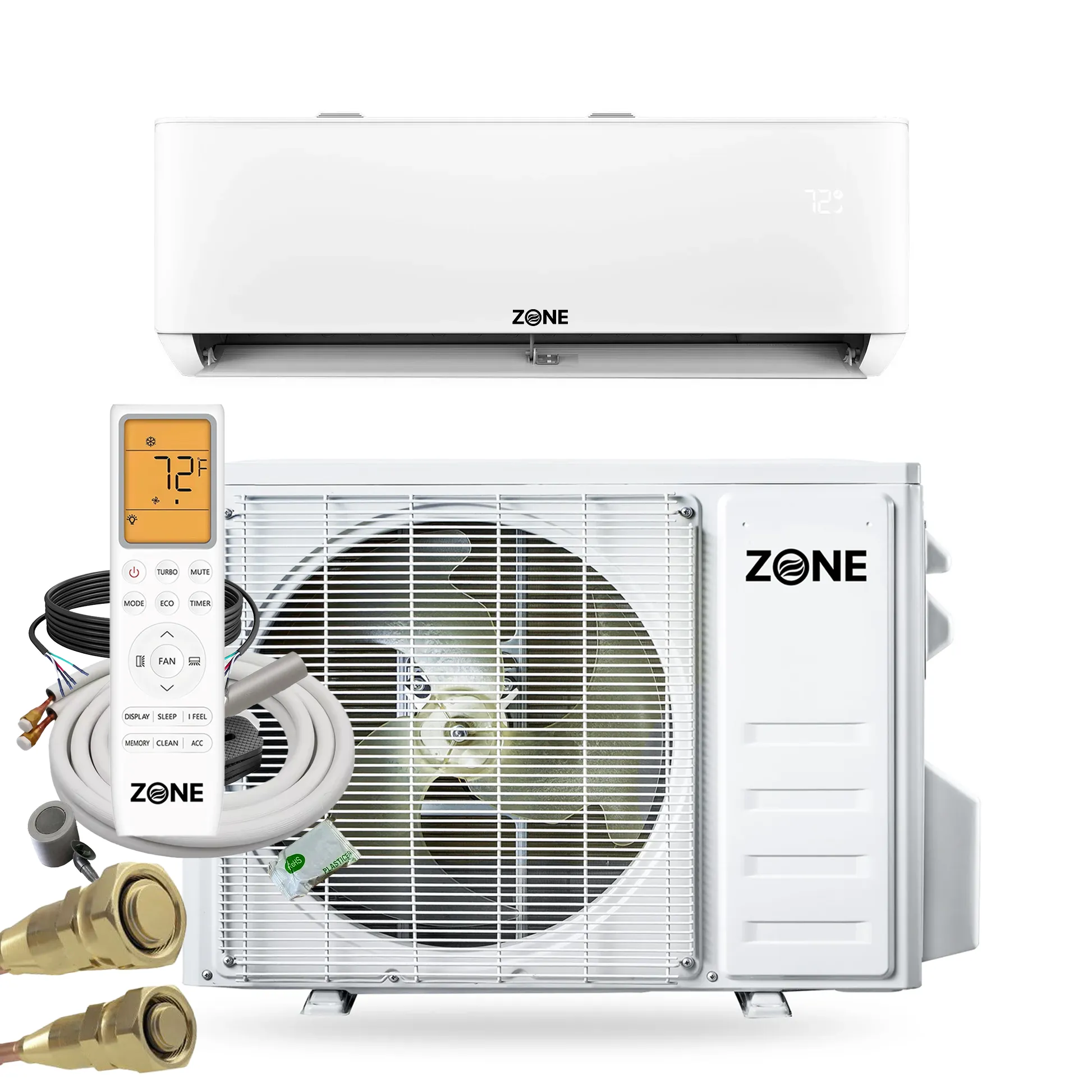
Every Zone DIY kit ships with an indoor air handler, outdoor condenser, pre-charged line set, mounting bracket, communication cable, remote control, and WiFi module. Because the line sets arrive factory-sealed with R-454B refrigerant, you never touch gauges or a vacuum pump.
The savings are real: expect to pay $3,000–$5,000 less than a comparable contractor-installed system in 2025–2026. One note — electrical work may require a licensed electrician depending on local code, even on a DIY mini split project.
What Is a DIY Mini Split Heat Pump?
A ductless mini split heat pump pairs an outdoor condenser with one or more indoor wall units, delivering both cooling and heating without ductwork. What makes it a “DIY” unit is the pre-charged, quick-connect design that eliminates refrigerant handling entirely.
Unlike a traditional mini split that would require a vacuum pump and manifold gauges, a Zone system arrives ready to connect. The unit can cool a room in summer and heat it well below freezing by moving heat rather than generating it. Zone models reach up to 24 SEER2 efficiency with cold-climate capability, and they are designed around homeowner installation from day one.
Choosing the Right DIY Mini Split Size and Type
Getting the BTU size right is the single most important decision before you buy. Undersized splits struggle; oversized ones short-cycle and waste energy.
| BTU Rating | Approx. Coverage | Common Use |
|---|---|---|
| 9,000 | Up to ~250 sq ft | Office, bedroom |
| 12,000 | Up to ~500 sq ft | Living room, master suite |
| 18,000 | Up to ~750 sq ft | Open floorplan |
| 24,000 | Up to ~1,000 sq ft | Large bonus room, garage |
Choose single-zone for one-room projects and multi-zone when conditioning an entire floor. Cold-climate buyers should check that the model maintains capacity at 5°F or lower. Zone offers sizing support to help you find the right fit before purchase.
Most-Popular DIY Mini Splits
Three lead systems cover most DIY installs. Browse the full catalog below for cassette, concealed-duct, and dual-zone configurations.
9,000 BTU 115V Wall Mount
Plug-and-play DIY install. 200–350 sq ft. The simplest mini split to install — no electrician needed.
View product →Most Popular12,000 BTU 115V Wall Mount
The most-installed DIY size. 350–550 sq ft. Master bedrooms, living rooms, finished basements.
View product →Largest Single-Zone18,000 BTU 230V Wall Mount
1.5 tons. 600–850 sq ft. Great rooms, ADUs, large basements. Dedicated 230V circuit required.
View product →Shop All DIY Mini Splits
Wall mount, ceiling cassette, concealed duct, and dual-zone bundles. 9K–30K BTU. 22–24 SEER2. Pre-charged linesets, free shipping on every order.
Single-Zone Systems
One indoor unit, one outdoor unit — for a single room.

Zone Air® DIY 9,000 BTU 23 SEER2 115V Wall Mount Ductless Mini-Split Heat Pump AC & Heater with Pre-Charged Lineset - Up to 450 Sq Ft
Zone Air® DIY 12,000 BTU 23 SEER2 115V Wall Mount Ductless Mini-Split Heat Pump AC & Heater with Pre-Charged Lineset - Up to 600 Sq Ft
Zone Air® DIY 9,000 BTU 24 SEER2 230V Wall Mount Ductless Mini-Split Heat Pump AC & Heater with Pre-Charged Lineset - Up to 450 Sq Ft
Zone Air® DIY 12,000 BTU 24 SEER2 230V Wall Mount Ductless Mini-Split Heat Pump AC & Heater with Pre-Charged Lineset - Up to 600 Sq Ft
Zone Air® DIY 18,000 BTU 23.5 SEER2 230V Wall Mount Ductless Mini-Split Heat Pump AC & Heater with Pre-Charged Lineset - Up to 900 Sq Ft
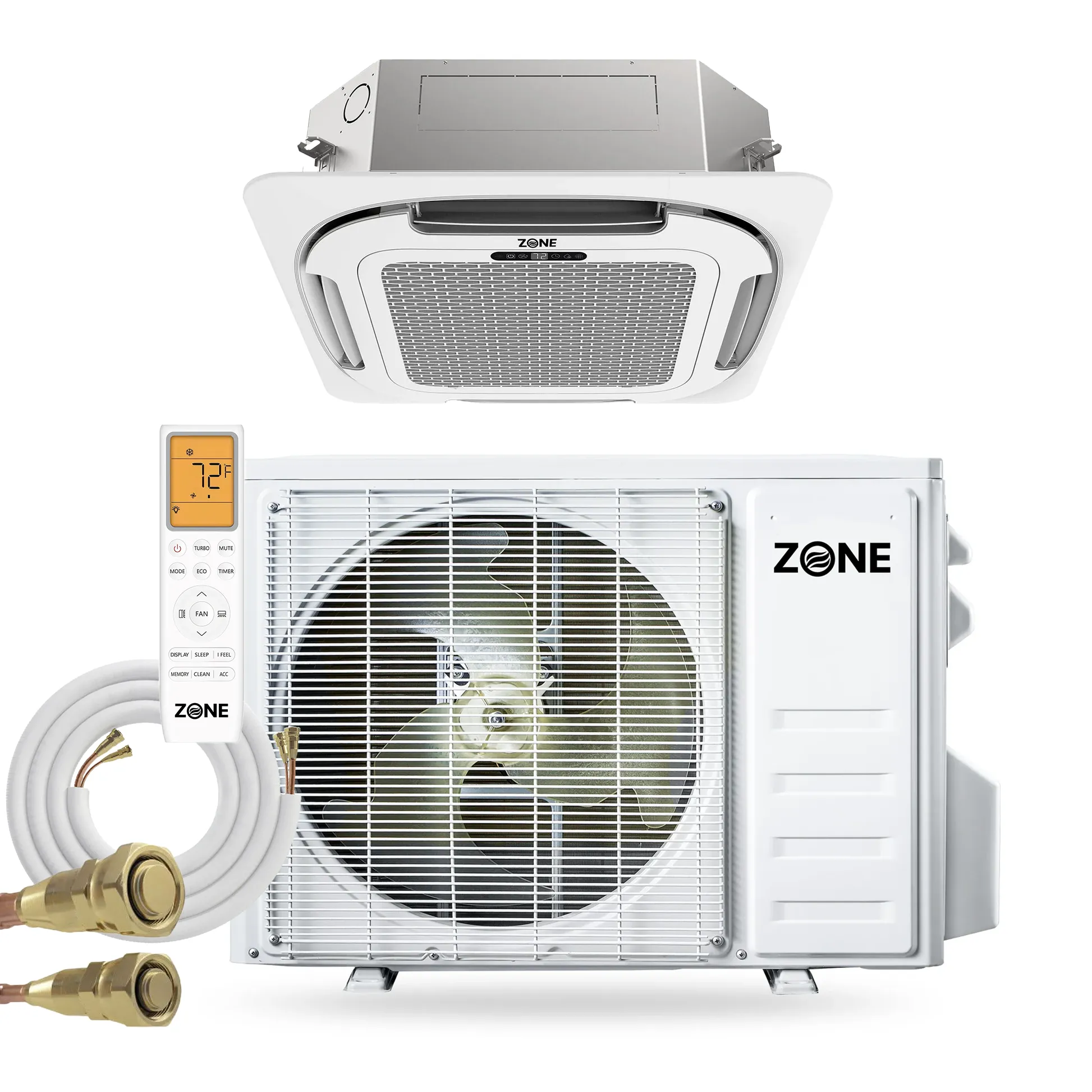
Zone Air® Airframe 9,500 BTU 21 SEER2 230V Ceiling Cassette Mini-Split Heat Pump AC with Pre-Charged Lineset - Up to 475 Sq Ft
Zone Air® Airframe 12,000 BTU 21 SEER2 230V Ceiling Cassette Mini-Split Heat Pump AC with Pre-Charged Lineset - Up to 600 Sq Ft
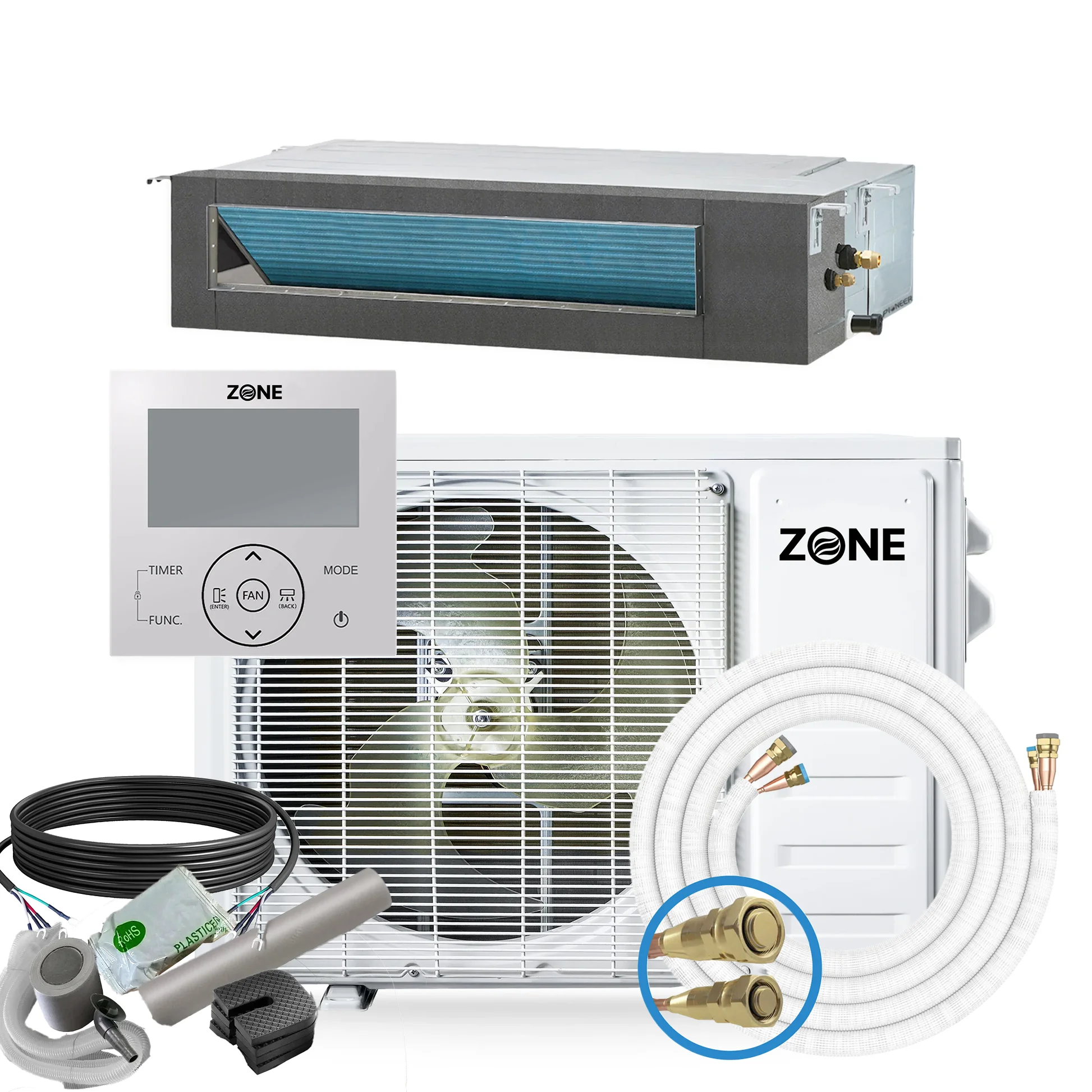
Zone Air® Thin-Air 9,500 BTU 19.6 SEER2 230V Concealed Mini-Split Heat Pump AC - Up to 475 Sq Ft
Zone Air® Thin-Air 11,000 BTU 19 SEER2 230V Concealed Mini-Split Heat Pump AC - Up to 550 Sq Ft
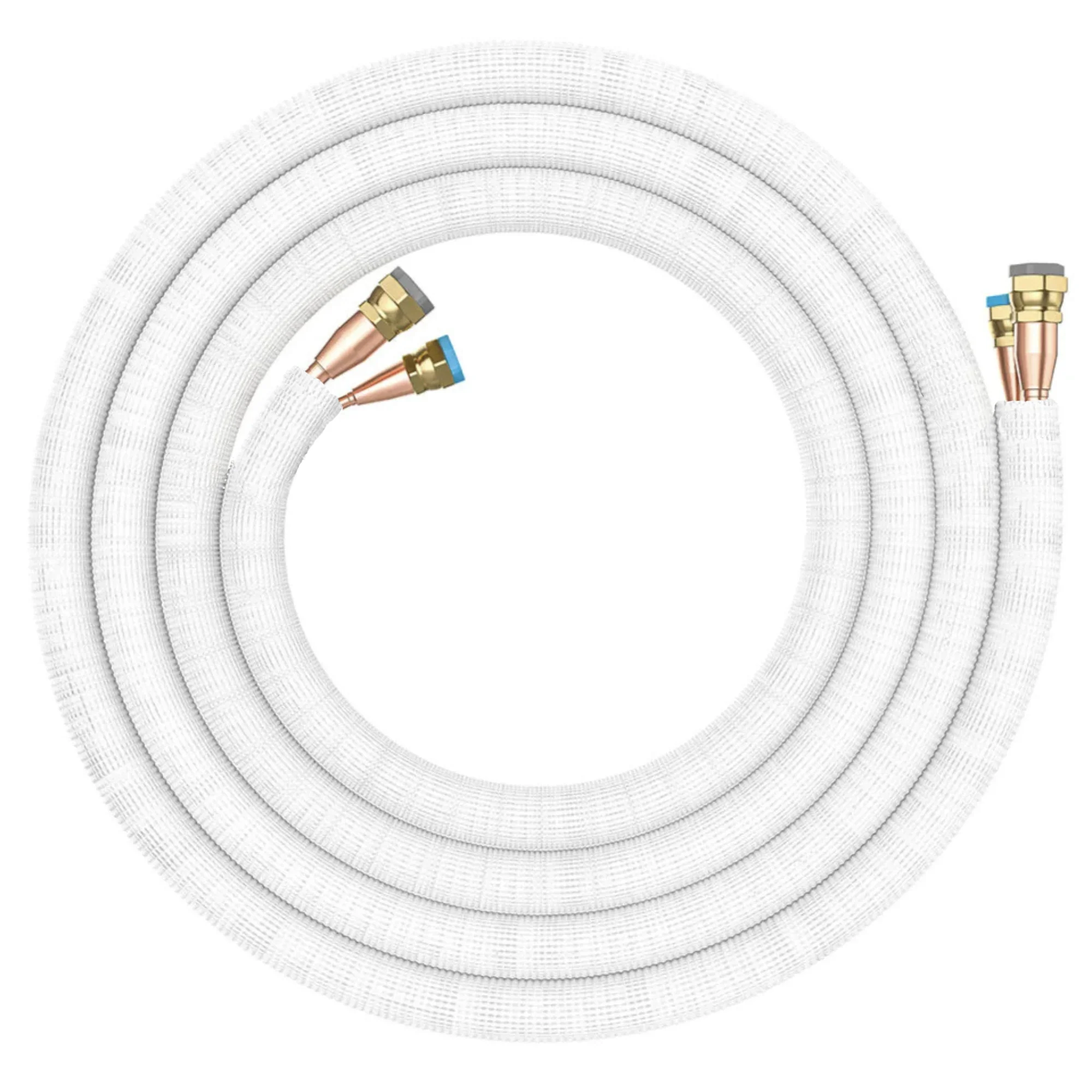
Zone Air® 9 Ft. Pre-Charged R454B Lineset Extension Kit for 9K & 12K BTU Mini-Split Systems
Zone Air® 9 Ft. Pre-Charged R454B Lineset Extension Kit for 18K BTU Mini-Split Systems
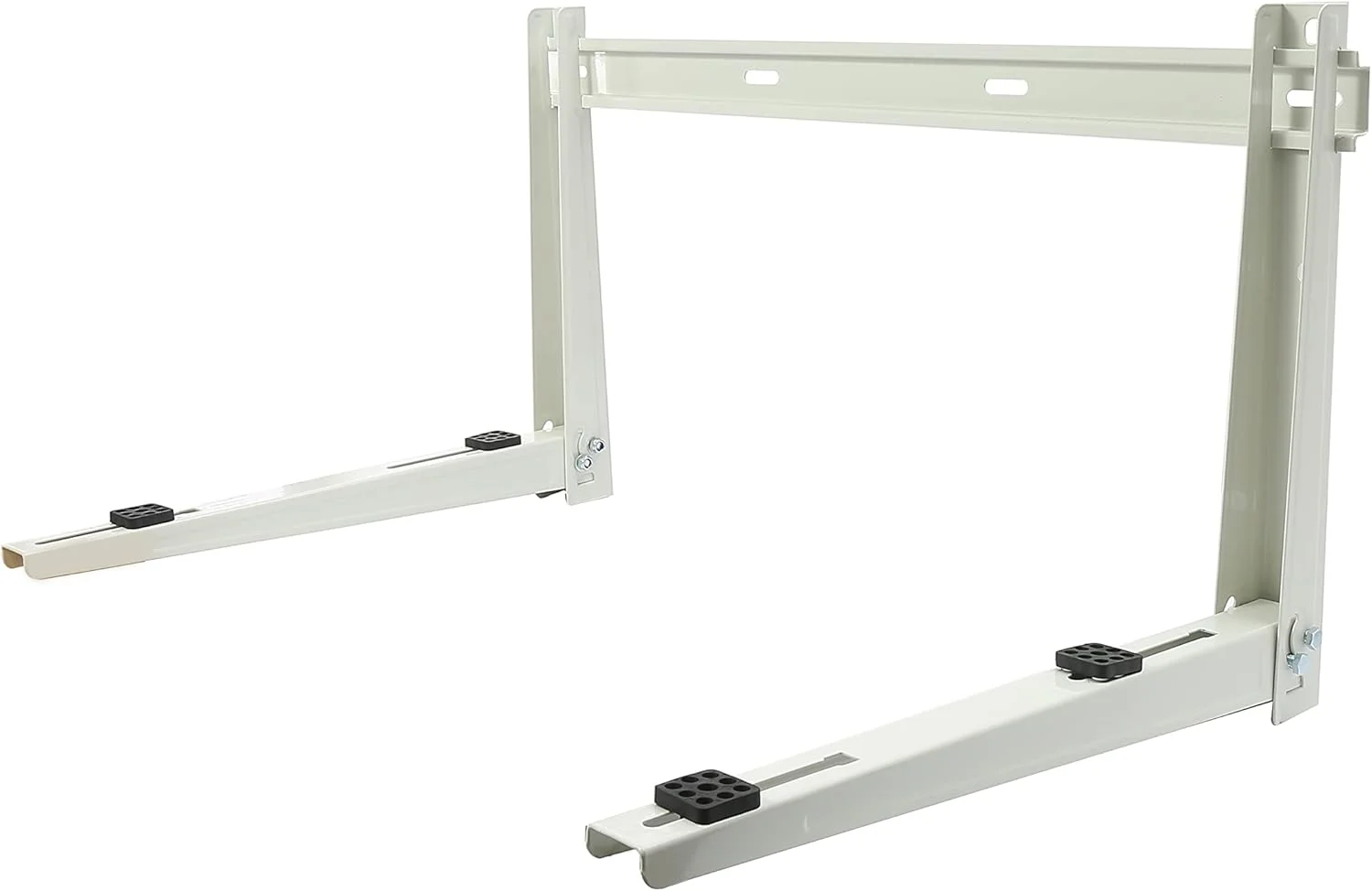
Zone Air® Heavy-Duty Foldable Wall Mount Bracket for Mini-Split Outdoor Condenser Units - Up to 550 lbs
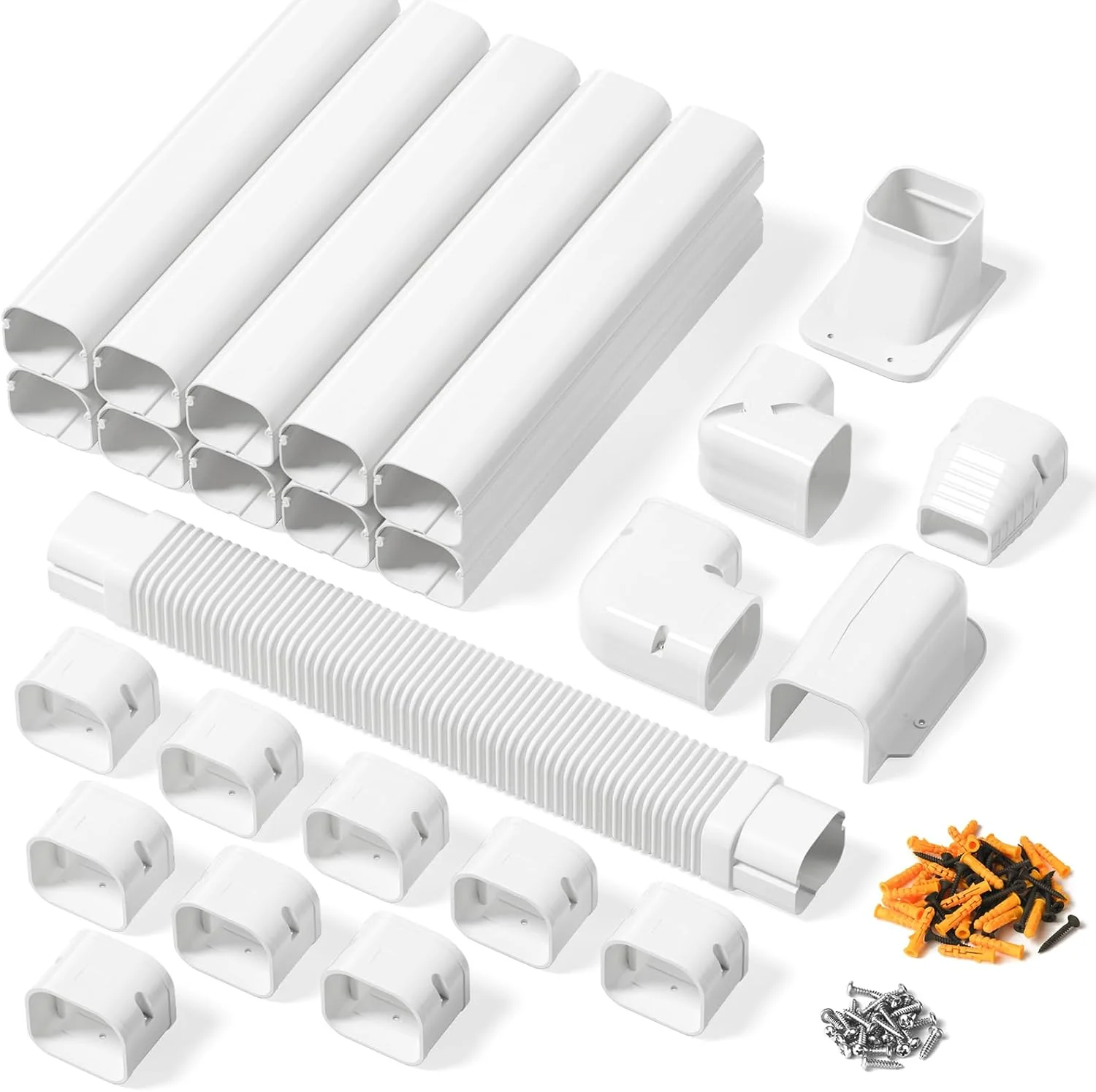
Zone Air® 16 Ft. Decorative PVC Lineset Cover Kit for Mini-Split Systems - Light Beige
Multi-Zone Bundles
Two indoor heads sharing one outdoor condenser — cool/heat two rooms with one system.
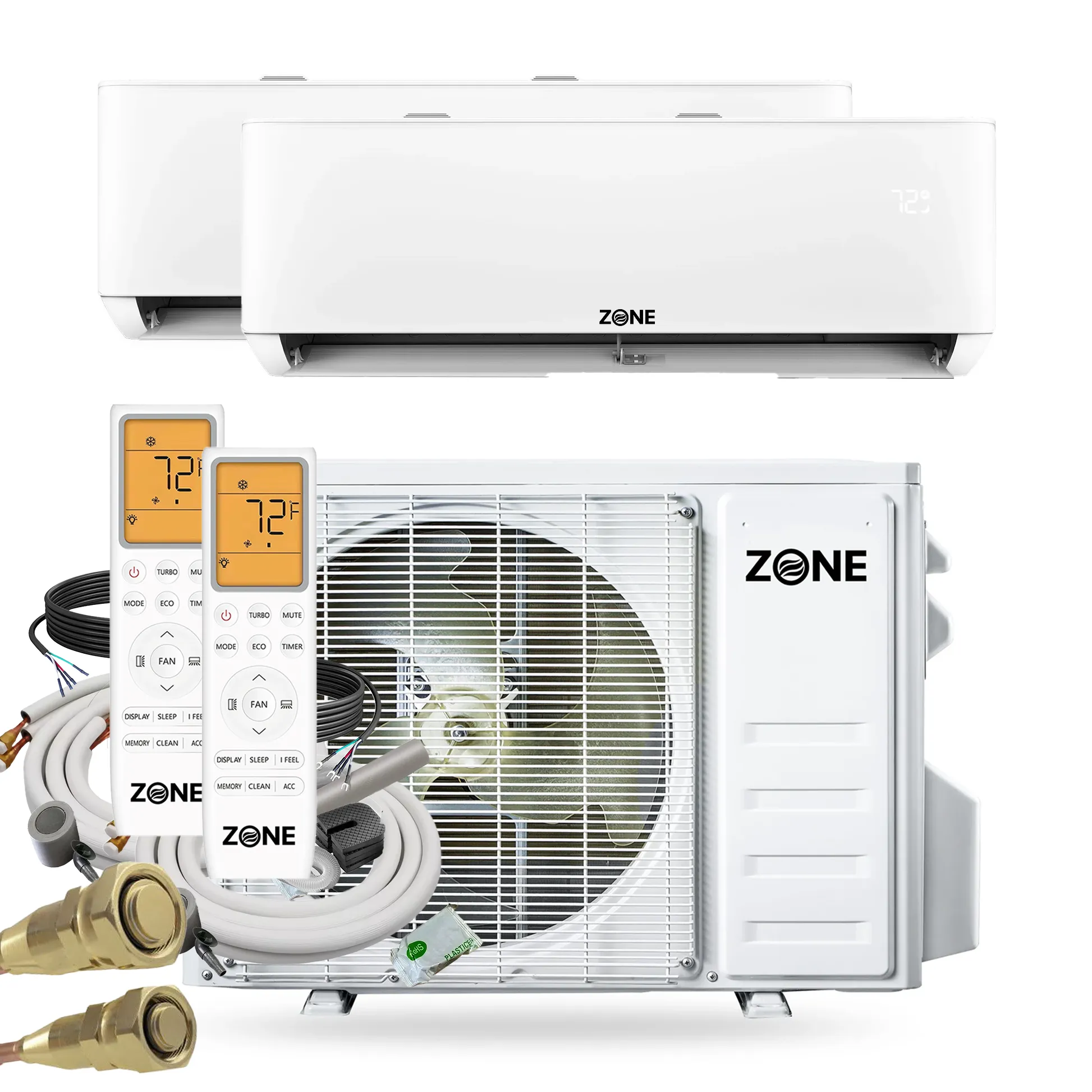
Zone Air® DIY DUAL ZONE 24,000 BTU (12K+12K) 24 SEER2 230V Wall Mount Ductless Mini-Split Heat Pump System with 2x Pre-Charged Linesets - Up to 1,200 Sq Ft
Zone Air® DIY DUAL ZONE 21,000 BTU (12K+9K) 24 SEER2 230V Wall Mount Ductless Mini-Split Heat Pump System with 2x Pre-Charged Linesets - Up to 1,050 Sq Ft
Zone Air® DIY DUAL ZONE 30,000 BTU (12K+18K) 24 SEER2 230V Wall Mount Ductless Mini-Split Heat Pump System with 2x Pre-Charged Linesets - Up to 1,500 Sq Ft
Zone Air® DIY DUAL ZONE 18,000 BTU (9K+9K) 24 SEER2 230V Wall Mount Ductless Mini-Split Heat Pump System with 2x Pre-Charged Linesets - Up to 900 Sq Ft
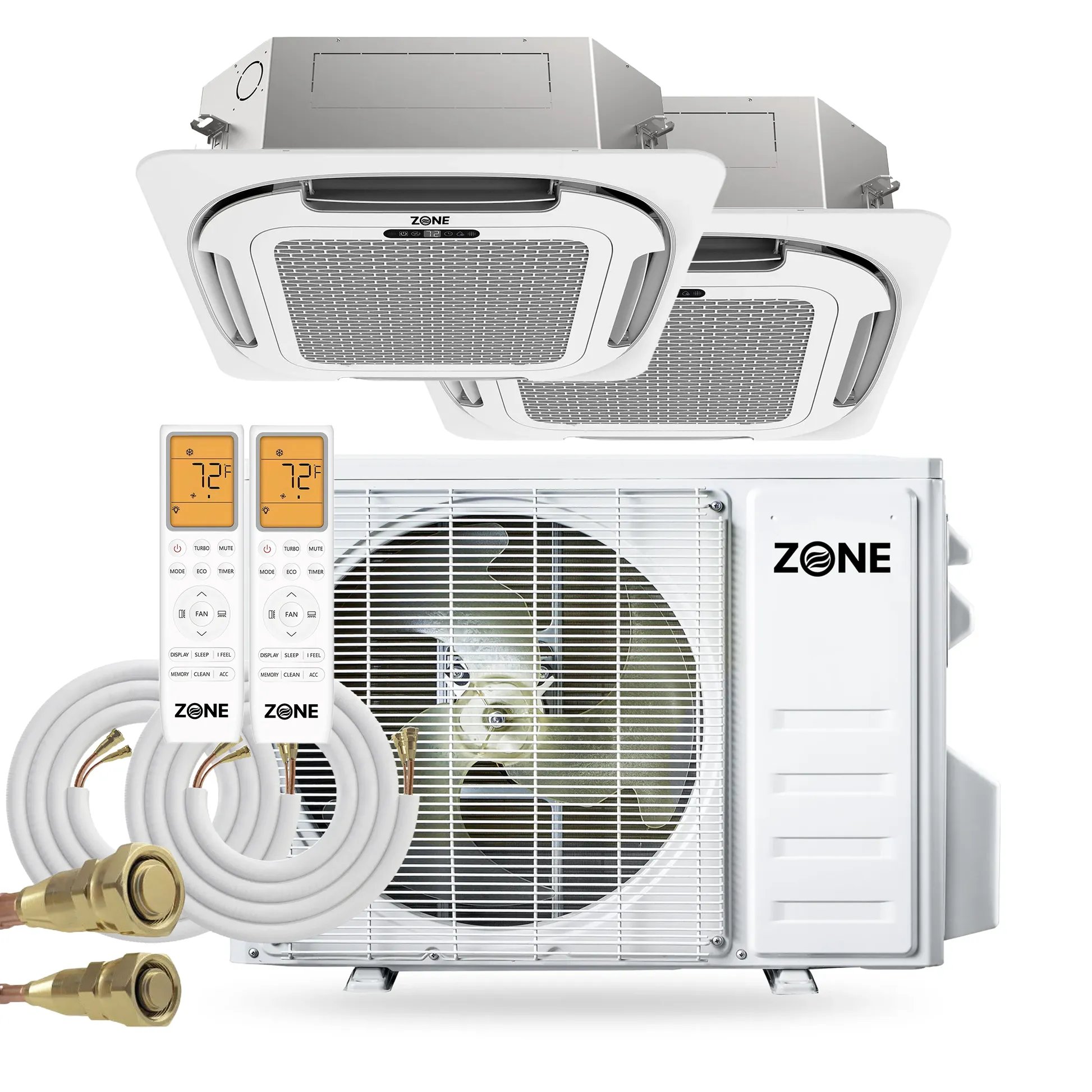
Zone Air® Airframe DUAL ZONE 24,000 BTU (12K+12K) 21 SEER2 230V Ceiling Cassette Mini-Split Heat Pump System with 2x Pre-Charged Linesets - Up to 1,200 Sq Ft
Zone Air® Airframe DUAL ZONE 19,000 BTU (9.5K+9.5K) 21 SEER2 230V Ceiling Cassette Mini-Split Heat Pump System with 2x Pre-Charged Linesets - Up to 950 Sq Ft
Zone Air® Airframe DUAL ZONE 21,500 BTU (12K+9.5K) 21 SEER2 230V Ceiling Cassette Mini-Split Heat Pump System with 2x Pre-Charged Linesets - Up to 1,075 Sq Ft
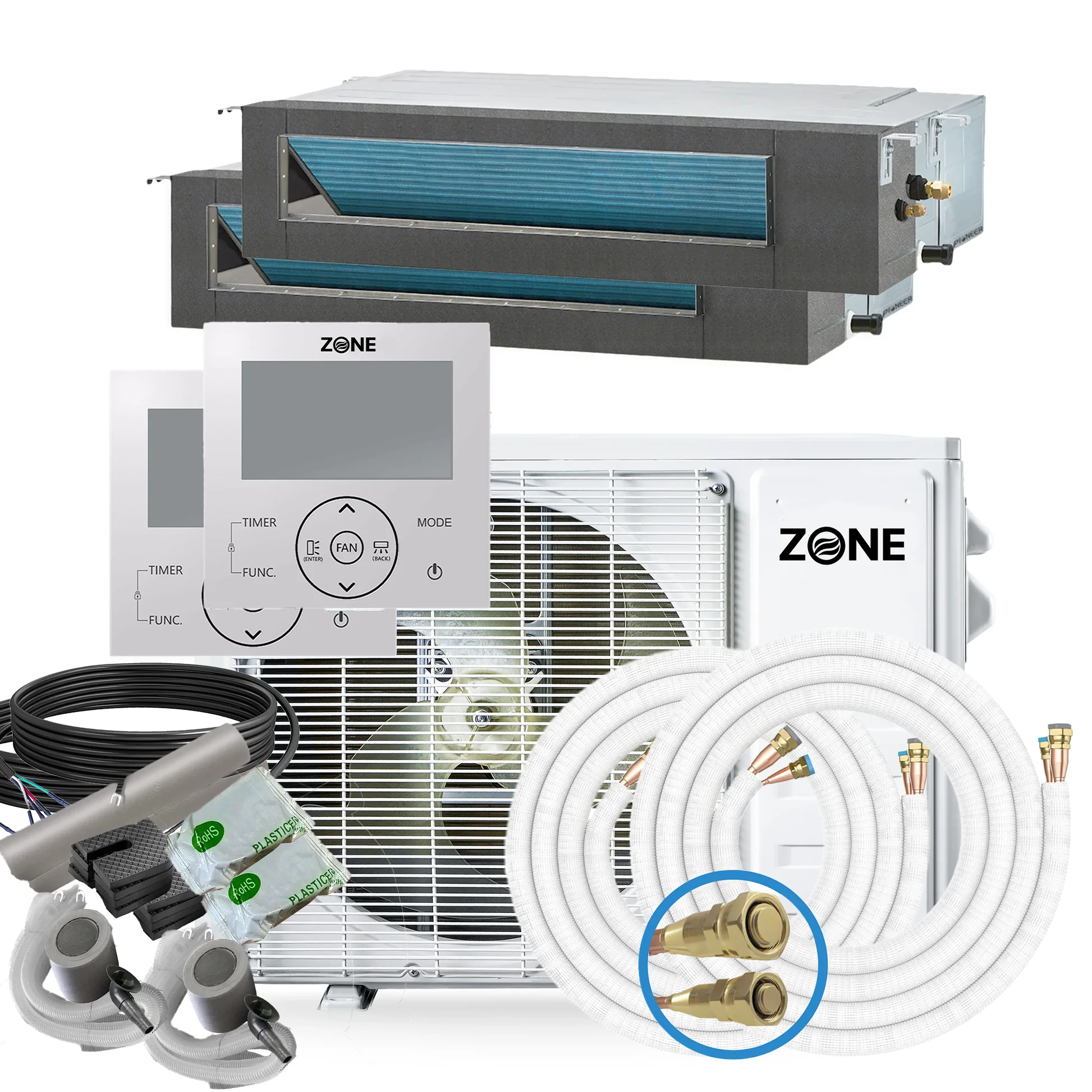
Zone Air® Thin-Air DUAL ZONE 22,000 BTU (11K+11K) 19 SEER2 230V Concealed Mini-Split Heat Pump System - Up to 1,100 Sq Ft
Zone Air® Thin-Air DUAL ZONE 19,000 BTU (9.5K+9.5K) 19 SEER2 230V Concealed Mini-Split Heat Pump System - Up to 950 Sq Ft
Zone Air® Thin-Air DUAL ZONE 20,500 BTU (11K+9.5K) 19 SEER2 230V Concealed Mini-Split Heat Pump System - Up to 1,025 Sq Ft
Planning Your DIY Mini Split Installation
Careful planning before you drill a single hole saves hours. Identify an exterior wall, choose the indoor unit height (typically seven feet or above), and pick an outdoor condenser spot with at least 12–24 inches of clearance on all sides.
Check local building and electrical codes — some jurisdictions require permits even for DIY work. Confirm you have a dedicated circuit sized for your unit (15A for 115V models, up to 30A for larger 230V units). Plan your line set route with the shortest practical run and gentle bends only.
Tools and Materials You'll Need
Because Zone kits include pre-charged line sets, you skip the expensive specialty HVAC tools entirely. Here is what you do need:
- Drill with 2.5–3.5 inch hole saw
- Level, stud finder, tape measure
- Adjustable wrench and socket set
- Safety glasses, gloves, sturdy ladder
- Non-contact voltage tester and wire stripper
Optional extras include a line set cover kit, wall sleeve, outdoor mounting pad, and condensate drain extension. Zone kits already contain the mounting template, wall bracket, and communication cable.
Step-by-Step DIY Mini Split Installation Overview
This section walks through the major steps from unboxing to startup. Always follow Zone's official install manual for detailed instructions specific to your model.
- Unpack and inspect every component for shipping damage.
- Mount the indoor wall bracket using the supplied template and drill the wall penetration at a slight downward angle.
- Hang the indoor air handler and route the pre-charged line set through the wall — gentle bends, no kinks.
- Run the condensate drain line with proper slope.
- Position and level the outdoor unit on its pad or bracket.
- Connect fittings to manufacturer torque spec and hook up the communication cable.
- Turn on power, run the startup procedure, and test both cooling and heating cycles.
Safety, Code, and Warranty Considerations
Zone systems are DIY-friendly, but safety and code compliance are non-negotiable. Always shut off power at the panel and verify with a tester before any electrical work. Local code may require a licensed electrician for the branch circuit and disconnect.
Never cut, open, or modify the sealed line set — doing so voids your warranty and may violate EPA regulations. Common mistakes include kinking the line, exceeding maximum run length, and blocking condenser airflow. Zone backs its systems with a 7-year compressor warranty and 5-year parts coverage, contingent on proper installation per the manual. Save receipts, photos, and serial numbers.
What Is a Pre-Charged Mini Split?
A pre-charged mini split ships with its refrigerant already sealed inside the lineset and outdoor unit at the factory. The line set uses brass quick-connect couplings, so the refrigerant circuit never has to be opened during installation. Because the circuit stays sealed, there is no evacuation, no vacuum pump, no manifold gauges, and no EPA Section 608 certification — the exact steps that make a traditional flare-fitting install a professional job. You connect the pre-charged line, torque the fittings to spec, and the system is ready to run.
Every Zone Air system is pre-charged with eco-friendly R454B refrigerant and includes a 16 ft pre-charged lineset (dual-zone bundles include two — one per indoor head). The table below shows exactly how far each system reaches out of the box, and how far you can extend it while staying fully pre-charged and vacuum-pump-free.
Pre-Charged Lineset Length by System
| System | Pre-Charged Lineset Included | Reach With Pre-Charged Extension | Coverage |
|---|---|---|---|
| 9K & 12K Single-Zone (115V & 230V) | 16 ft | Up to 25 ft (9 ft pre-charged extension kit) | Up to 450–600 sq ft |
| 18K Single-Zone (230V) | 16 ft | Up to 25 ft (18K 9 ft pre-charged extension kit) | Up to 900 sq ft |
| Ceiling Cassette (9.5K–12K) | 16 ft | Up to 25 ft (9 ft pre-charged extension kit) | Up to 475–600 sq ft |
| Concealed Duct | 16 ft (optional 9 ft extension) | Up to 25 ft | Per model |
| Dual-Zone Bundles | 2× 16 ft (one lineset per indoor head) | Up to 25 ft per line | Up to 900–1,500 sq ft |
Need more reach? Add a 9 ft pre-charged R454B lineset extension to take any single-zone run from 16 ft to 25 ft total — still no vacuum pump and no EPA license.
Where pre-charged ends: the no-vacuum advantage applies as long as you stay within the pre-charged lineset length (16 ft, or 25 ft with the extension kit). If your outdoor unit needs to sit farther from the indoor head than the pre-charged line reaches, that run has to be field-charged — which brings back the vacuum pump, gauges, and refrigerant handling of a traditional install. For most homes a 16–25 ft run is plenty. For the full explanation of why pre-charged systems skip the vacuum step, see do you need to vacuum a pre-charged mini split?
What Makes a Mini Split Actually DIY-Installable
Most "DIY-friendly" mini splits still require professional tools or certifications. The four things below are non-negotiable for a real homeowner install — and every Zone Air system has all four.
Pre-charged R454B lineset
16 ft of refrigerant line ships pre-loaded with R454B. No evacuation, no charging, no leak-checking with nitrogen. Quick-connect fittings hand-tighten and torque to spec.
No vacuum pump required
Traditional flare installs need a vacuum pump pulling below 500 microns. Pre-charged systems skip that step entirely — saving the $400–$1,800 tool cost and 30–60 minutes of evacuation time.
No EPA Section 608 license
EPA certification is required when the installer opens the refrigerant circuit. Pre-charged systems don't open the circuit — you connect already-pressurized couplings. No license, no test, no $150–$250 cert fee.
115V plug-and-play options
Zone Air 9K and 12K wall mounts run on a standard 15A 115V outlet — no electrician, no breaker work, no permit. Plug it in. Larger systems use a 230V circuit; most homes have spare panel capacity.
DIY Mini Split vs Traditional Pro-Installed Mini Split
The technical work for a traditional flare-fitting mini split overlaps almost entirely with what an HVAC tech does on a residential install. Pre-charged DIY mini splits remove the steps that legally require certification, leaving only the mechanical work that any homeowner with basic tools can complete.
| Step | Traditional Flare Install | Pre-Charged DIY Install |
|---|---|---|
| Refrigerant handling | EPA Section 608 license required | Not required — circuit never opens |
| Vacuum pump | Required ($400–$1,800) | Not required |
| Manifold gauges | Required ($100–$300) | Not required |
| Flaring tool | Required ($60–$150) | Not required — quick-connect couplings |
| Pressure-test with nitrogen | 15 min at 500 psi | Not required — factory pressure-tested |
| Evacuate to 500 microns | 30–60 min | Not required |
| Permit for refrigerant work | Sometimes required | Generally not required |
| Total install time | 6–10 hours (pro) | 4–8 hours (first-time DIY) |
| Labor cost | $1,500–$3,000 per zone | $0 (your time) |
For the full step-by-step with torque specs, drill angles, and electrical detail, see our DIY mini split installation guide. If you’re evaluating whether DIY makes sense for you, the installation cost breakdown shows the dollar savings line-by-line.
The #1 Mistake We See on DIY Installs
The number one thing we have seen customers get wrong during the installation process is overbending and kinking the lineset. Oftentimes a small kink isn't enough to cause an immediate leak, especially if it is carefully unkinked, but this kink will eventually lead to a leak, and we have seen many systems fail prematurely because they have been run with low refrigerant for too long.
The fix is simple: keep every bend gentle and wide, never force the line around a tight corner, and if you do put a kink in it, replace the lineset rather than straightening and hoping. A pre-charged replacement lineset costs far less than a compressor that fails two years early from running low on refrigerant. Full routing detail is in the install guide.
Shop DIY Mini Splits by Zones
One indoor head per room is one zone. Pick the configuration that matches the rooms you’re conditioning.
Single Zone (1 Zone)
One indoor unit, one outdoor condenser. The simplest and lowest-cost mini split configuration. Right for a single room or open space. From $1,899.
Shop single zone →Dual Zone (2 Zone)
One outdoor condenser powers two indoor heads with independent thermostats. Right for two rooms with different schedules. From $3,299.
Shop dual zone bundles →Multi Zone (2–5 Zone)
How multi-zone systems work, when to use them, and which Zone Air bundles fit a 3+ room project.
Read the multi-zone guide →DIY Mini Split FAQ
Answers to the most common questions about installing a mini split yourself.
What is a DIY mini split?
Do I need an HVAC license to install a DIY mini split?
Do I need a vacuum pump for a DIY mini split?
What size DIY mini split do I need?
How long does a DIY mini split install take?
Can I install a DIY mini split without an electrician?
Will DIY install void my warranty?
How much do you save with a DIY mini split?
Efficiency, Comfort, and Energy Savings with a DIY Mini Split
Long-term energy savings are honestly one of the biggest reasons homeowners choose a mini split over window units or baseboard heat. SEER2 measures seasonal cooling efficiency — higher is better. Zone models reach around 24 SEER2, roughly double what many older window ACs deliver.
Inverter-driven compressors modulate output instead of cycling on and off, keeping rooms comfortable with minimal temperature swings and lower noise. Many Zone units qualify for state and utility rebates (the federal 25C tax credit expired December 31, 2025, but state programs remain active heading into 2026) — check your zip on the rebate calculator. Replacing two 10 SEER window units with a single efficient 12,000 BTU Zone system in a 400 sq ft room can cut cooling costs by 50–60%, saving hundreds on electricity each year.
Smart Controls: WiFi and App Features
Modern Zone diy mini splits include WiFi for smartphone control right out of the box. The app lets you change modes — heat, cool, dry, fan, auto — adjust temperature setpoints, and set schedules from anywhere.
Compatible models support voice control through Amazon Alexa or Google Assistant, so you can adjust the temperature without lifting a finger. Pre-cool a workshop before you arrive, monitor a vacation cabin remotely, or email yourself screenshots of usage patterns to track savings over time.
Cost Breakdown: DIY vs Contractor Installation
The upfront price of a Zone DIY system looks similar to non-DIY brands, but the labor savings change the math dramatically.
| Cost Item | DIY (Zone 12K BTU) | Contractor Installed |
|---|---|---|
| Equipment | ~$2,189 | ~$2,200–$2,800 |
| Labor | $0 (your time) | $3,000–$5,000 |
| Electrician (if needed) | $200–$500 | Included |
| Total | ~$2,400–$2,700 | ~$5,200–$7,800 |
Long-term, a higher SEER2 rating means lower monthly bills. Skipping ductwork also eliminates the energy loss and air quality issues that come with leaky ducts. Factor in available state rebates and the gap between DIY and contractor gets even wider.
When to Call a Pro Instead of Going Full DIY
Choosing DIY does not mean doing everything alone. If your electrical panel needs an upgrade, if you are unable to safely reach a high wall mount, or if your house has questionable older wiring, bring in a licensed electrician for that piece.
Complex multi-zone designs covering an entire home may also benefit from professional layout guidance. Using a pro for specific tasks still saves a large portion of install cost and does not disqualify your system from being a DIY mini split.
Why Choose a Zone DIY Mini Split?
Zone is a DTC brand built around the DIY installer, unlike competitors that adapted professional-grade equipment into consumer packaging. Systems ship with pre-charged line sets, hit up to 24 SEER2, run as quiet as 26 dB indoors, and include WiFi control.
Zone's 45-day satisfaction guarantee lets you return or exchange if things do not work out, and U.S.-based support is available if you hit a snag mid-install. Models range from the 9,000 BTU unit for a small office to the 24,000 BTU system built for a large garage or bonus room. One homeowner replaced two expensive window units in a 500 sq ft living room with a Zone 12K, completing the install in about six hours and cutting the contractor quote in half.
Conclusion: Is a DIY Mini Split Right for Your Home?
A DIY mini split is the right move for homeowners with moderate hands-on skills who want independent climate control in specific rooms without paying contractor markup. You get heating and cooling from one system, high efficiency, zero ductwork, and thousands in labor savings with Zone's DIY-focused design.
Respect your local electrical codes, leave the sealed line set intact, and do not hesitate to call a pro for the parts that fall outside your comfort zone. Measure your room, use Zone's online sizing resources, and find the model that fits your space and budget. The tools are simple, the savings are significant, and the comfort is year-round.
Ready to Install a DIY Mini Split This Weekend?
Browse the full catalog, pick your size and form factor, and we’ll ship the system with everything you need to install it yourself.
Shop All DIY Mini Splits