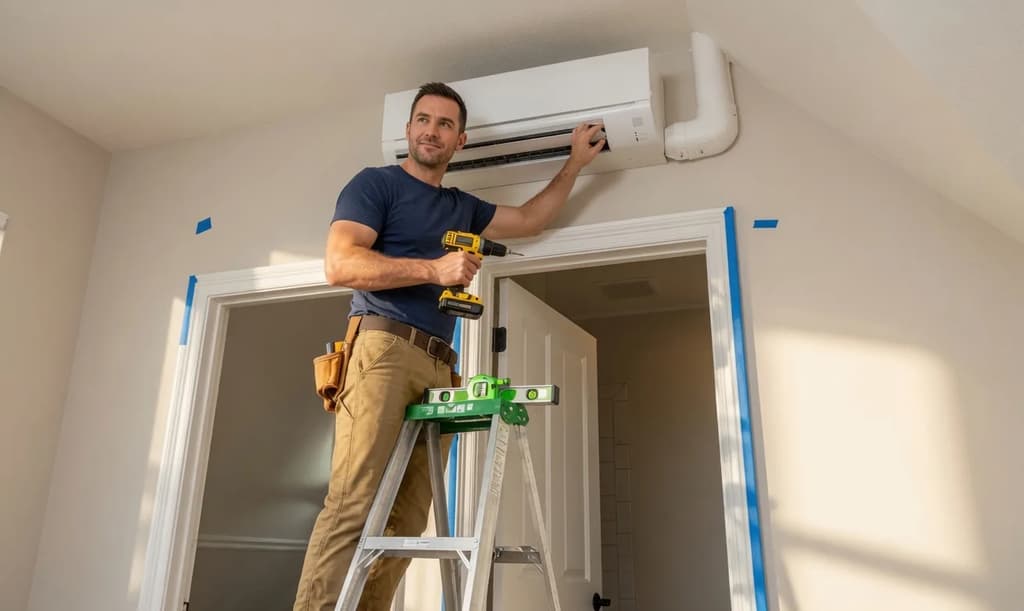
Shopping for a 115v DIY mini split 12000 BTU system? You've probably seen the official MRCOOL DIY listings at the top of every search result. This guide breaks down what a system like the MRCOOL DIY 5th Gen 12K 115V delivers, how it stacks up against Zone Air's 12K 115V system, and why the best-known name isn't always the right system for your money.
Quick Answer: What Is a 115V 12,000 BTU DIY Mini Split and Who It is For?
A 12,000 BTU 115V mini split heat pump is a single-zone ductless heating and cooling system sized for roughly 450–600 sq ft. It is built for rooms that do not have ductwork: a bedroom, home office, garage or bonus room. It cools and heats, so it's a year-round solution for a small living space. Here's what "DIY mini split" actually means:
- The system has a pre-charged quick-connect line set, so it comes ready and you don't have to handle refrigerant yourself.
- Quick-connect fittings mean you won't need a vacuum pump, a gauge set or brazing equipment.
- Everything arrives together: you get the indoor unit, the outdoor unit, the line set, the communication cable and the mounting hardware.
The MRCOOL DIY 5th Gen 115V 12K is the benchmark most homeowners search for. Zone Air's 12K 115V matches it on the cold-climate rating and warranty, costs less and adds a few things MRCOOL doesn't offer, like a plug-in option and line sets cut to your exact length. This guide covers 115V power basics, the indoor and outdoor units, pre-charged line sets, cold-climate heating, smart features, warranty and a step-by-step DIY overview.
Understanding 115V Power for DIY Mini Splits
Why 115V matters is simple: it is a standard U.S. household circuit voltage. You don't need a 240V line or a panel upgrade (see Zone Air's 110V DIY mini splits), so it saves cost and makes the electrical work easier for most homeowners. "115V" and "120V" refer to the same residential branch circuit voltage in North America. The power supply is 115V, 60Hz, single phase. A lot of people search "115V DIY mini split 12000 BTU MRCOOL DIY official" because MRCOOL uses the "115V" label on its packaging. Here are the typical electrical requirements for a 12K BTU 115V mini split:
- MRCOOL DIY 12K 115V: hardwired, with a minimum circuit ampacity of 18A and a 20A maximum fuse.
- Zone Air 12K 115V: a dedicated 15A circuit on a single-pole 15A breaker, with an optional plug-in cord kit for a dedicated GFCI outlet where local code allows (never an extension cord). Power connects at the outdoor unit, not at the indoor wall unit.
- Both of them need a dedicated circuit that runs at 60 Hz and single phase.
Even though the mini split itself is DIY-friendly, it's a good idea to check local electrical code and think about having a licensed electrician add the dedicated circuit, disconnect switch and conduit run to the outdoor unit.
Indoor Unit, Outdoor Unit and Line Set Components
Every 12K BTU 115V DIY mini split package comes with the same core components, and here is what you will get in the box.
- Indoor unit (air handler): this is the wall-mounted unit that is about 3 feet wide. Zone Air's 12K indoor unit is 36-1/2 in wide and 23.1 lbs. It comes with washable filters, an LED display, multiple fan speeds and a dry mode so you can use it for dehumidification.
- Outdoor unit (condenser): this is a compact cabinet that is resistant to weather, and it houses a variable-speed DC inverter compressor. Zone Air's 12K 115V outdoor unit has a weight of 58.4 lbs and is rated at 52 dB(A). You can set it on a concrete pad, stands or a wall bracket.
- Pre-charged line set: this is a pair of insulated copper lines (1/4 in liquid, 3/8 in suction) that come from the factory with a charge of R-454B refrigerant inside them. Both the current MRCOOL DIY 5th Gen and Zone Air's 115V models use R-454B.
- Communication cable: this is what connects the outdoor unit to the indoor unit for power and control signals. With every unit, Zone Air includes it so you do not have to figure out the right gauge and buy it separately.
MRCOOL's 12K 115V kit comes with a line set that is 25 ft long. In the box, Zone Air's 12K 115V comes with a set that is 16 ft, but you can also order any whole foot from 5 to 75 ft if you need something different.
12,000 BTU Sizing: Is a 115V Single-Zone Right for Your Room?
A 12K BTU unit is the most popular DIY size because it fits most single-room jobs. Going too big, you'll get short cycling and noise. If the unit is too small, you'll be uncomfortable.
- MRCOOL rates its 12K for up to 550 sq ft. For a well-insulated room with 8–9 ft ceilings and average window area, Zone Air rates its 12K at 350–600 sq ft.
- In a space that is poorly insulated, has high ceilings or has large south-facing windows, the effective coverage drops. A garage may need 25–30 BTU per sq ft instead of the usual 20.
- Your climate zone matters too. A 12K unit in Atlanta can handle a 550 sq ft office without any trouble. That same room in Minneapolis during a deep freeze will make the system work a lot harder.
Rough scenarios:
- 250–350 sq ft bedroom: a 9K BTU unit is probably enough.
- 400–500 sq ft home office: the 12K is the right size.
- 500–600 sq ft detached garage in a cold climate: a 12K works if it is insulated, but you should go with an 18K if it is not.
Always check the manufacturer's sizing chart, or run the numbers in Zone Air's sizing calculator before you order. Getting the right size from the start saves money and you won't have to deal with returns.
MRCOOL DIY 5th Gen 12K 115V vs Zone Air 12K 115V
As the most-searched "official" 115V DIY mini split, the MRCOOL DIY 5th Gen gets a lot of attention (our MRCOOL DIY 5th Gen vs Zone Air guide covers the whole single-zone line). When you put the two side by side, they come out close on the spec sheet, and the differences that show up are price, power connection, line set length and how they do in hot weather.
MRCOOL DIY 5th Gen 12K 115V key details (from the MRCOOL catalog):
- 23.5 SEER2 and 10.2 HSPF2, ENERGY STAR
- R-454B refrigerant, 25 ft quick-connect line set
- Gold Fin anti-corrosion condenser coating
- You get a smartphone app (Wi-Fi via a dongle), plus Alexa and Google Assistant.
- Heating rated down to about −13°F, cooling to 122°F
- It's about $2,359 for the 12K 115V kit at Home Depot (September 2026)
From the product page, here are the key things to know about the Zone Air 12K 115V DIY:
- 23 SEER2, 10.0 HSPF2, AHRI Certified, within half a point of MRCOOL on SEER2
- Heating rated down to −13°F, the same floor as MRCOOL's standard DIY 5th Gen. Cooling to 131°F
- Outdoor unit rated at 52 dB(A)
- There's an optional plug-in cord kit so you can use a dedicated GFCI outlet in places where the code allows it.
- $1,999.99 (October 2026), about $360 less
Here's how the MRCOOL DIY 12K 115V 5th Gen and the Zone Air 12K 115V DIY compare (Zone Air's full table is on its spec sheets page):
With a slightly higher SEER2 at 115V and a quieter rating on the indoor unit's lowest fan speed, MRCOOL comes out ahead. Zone Air comes out ahead on price, the plug-in option, exact-length line sets and the 131°F cooling rating. If you want the MRCOOL DIY concept without paying extra for the name, Zone Air is the smart choice.
MRCOOL 5th Gen Features That Actually Matter
"5th Gen" is just the name MRCOOL uses for its current DIY line. The core benefits are mostly the same across top-tier DIY mini splits though. Here's what actually matters:
- Higher efficiency means real energy savings, with SEER2 ratings above 22. For context, MRCOOL's own Easy Pro line is rated 19.5 to 20.2 SEER2, so the jump to the 5th Gen is real.
- Variable-speed DC inverter compressor: this is what makes efficient, quiet operation possible. It has a compressor that goes up and down instead of turning on and off. That cuts down on temperature changes and electricity use.
- Modern refrigerants: R-454B has a lower global warming potential than R-410A, which is better for the environment and it meets tightening federal regulations too.
- Cold-climate heating: low-temperature performance is the single most important spec for homeowners in colder climates.
- Certification: Zone Air's units are AHRI Certified. MRCOOL lists its DIY 5th Gen under ENERGY STAR.
What doesn't matter as much: the color of the casing, the style of the cosmetic LED panel, or the marketing names. Those shouldn't beat efficiency and warranty.
If you like MRCOOL's 5th Gen brochure, compare it with Zone Air's spec sheet: the numbers are close. The cost to get it shipped to you is lower.
Cold-Climate Performance for 115V Systems
"Hyper heat" refers to cold-climate heat pump technology that keeps usable heating output well below freezing, so you rarely need electric resistance backup.
- MRCOOL's DIY 5th Gen 12K 115V is rated for heating down to about −13°F. Higher-tier MRCOOL DIY models are rated lower.
- Zone Air's 12K 115V is also rated to −13°F, with a heating COP2 of 2.1 at 5°F (3.81 at 47°F) and a heating range of 2,500–15,000 BTU/h.
- Operating ranges: Zone Air cools in outdoor temperatures up to 131°F. MRCOOL publishes 122°F. Both heat down to −13°F.
- On its outdoor coil, MRCOOL uses a Gold Fin coating to keep it from rusting.
Real-world example: a 500 sq ft above-garage bonus room in Minnesota sees regular lows near 0°F. Either 12K system is rated to keep running at that temperature. Any heat pump will lose heat output as it gets colder, so in a room that size and climate, good insulation matters more than the brand.
What Makes DIY Possible: a Pre-Charged Line Set and a Communication Cable
With a pre-charged quick-connect line set and an included communication cable, a standard mini split becomes a true DIY installation. Without them, you would need a vacuum pump, manifold gauges and a licensed HVAC technician.
- Line set details: 1/4 in liquid and 3/8 in suction copper lines, pre-charged with R-454B. The refrigerant stays sealed in the factory-charged line set, so there is no vacuum pump, no gauge set and no EPA 608 certification in the install. Most areas treat it as an electrical-only permit (check locally).
- Available lengths: MRCOOL sends fixed 11.5, 16, 25, 35 and 50 ft sets and connects two sets with a coupler for longer runs, up to 75 ft per indoor unit. Its manual has you coil the excess behind the condenser. As of November 2026, of the brands compared here, Zone Air is the only one that cuts your pre-charged line set to the exact length you measure, any whole foot from 5 to 75, and its 25, 33, 50 and 75 ft sets are each a single factory-sealed run with no field joint.
- Communication cable: this is the multi-core cable that runs between the outdoor unit and the indoor unit to carry power and control signals.
- Critical warning: never cut, extend, join or modify a pre-charged line set yourself. If the run you need is longer than the one that comes with the unit, order the right length from the manufacturer.
Shoppers often look for the right line set length, and the setup people buy most often is the "25 ft DIY quick-connect line set." Both brands sell one.
Indoor Unit Modes, Noise and Controls
This section focuses on the wall-mounted indoor unit, because that is the part you use every day.
- Operating modes: Cool, Heat, Auto, Fan-only, Sleep and Dry (this mode takes the moisture out of the air). Both the MRCOOL DIY 5th Gen and Zone Air have them.
- Follow Me mode: a sensor in the wireless remote reads the temperature where you're sitting, so the remote acts as a portable thermostat and the indoor unit changes output to hold your target temperature there. MRCOOL talks this up a lot, and Zone Air units have it too.
- Fan speed and swing control: you get multiple fan speeds, auto-swing louvers and auto-restart after a power outage, so you don't have to set anything up again.
- Noise levels: MRCOOL rates its 12K wall unit at 18 dB(A) on the lowest fan speed. On Zone Air's 12K, mute mode is 30 dB(A) and low is 32 dB(A). Both are quiet enough for a bedroom or office.
- Maintenance: the washable filters are designed to slide out for cleaning. Optional cleaning kits are available to help maintain airflow and indoor air quality over time.
You have the included remote close at hand, so controlling the indoor unit is simple. You just point, press and adjust.
Smart Controls, App, Wi-Fi and Voice Assistants
Modern DIY mini splits come with smart features built in. When you look at official MRCOOL DIY listings, you expect to get app control and voice assistant integration, and both brands deliver that.
- MRCOOL DIY 5th Gen smart control options: on-unit display, handheld remote, the MRCOOL smartphone app (Wi-Fi through a dongle listed among the covered parts), and Alexa and Google Assistant compatibility.
- Zone Air smart features: Wi-Fi app control with geofencing and remote setpoint, Alexa and Google Home voice control, and an IR remote with a 7-day schedule that works without Wi-Fi.
- Practical benefits: pre-cool your garage before you get home, monitor a cabin's temperature remotely to prevent pipe freeze, or fold the mini split into existing smart home setups through voice commands.
- Setup notes: most DIY mini splits need a 2.4 GHz Wi-Fi network to pair. With a dual-band router, make sure you are connected to the 2.4 GHz network during setup.
Installation Overview: Mount, Connect and Start Up
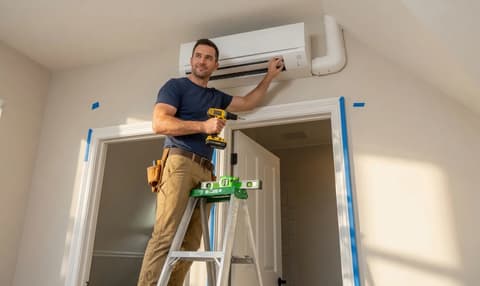
Installation does not need any special training beyond what most homeowners already know. Zone Air's FAQ says a first-time single-zone wall install takes 4–6 hours for two people, and most homeowners can finish a 12K single-zone system in a weekend.
- Choose your wall location for the indoor unit. Check how much room the manufacturer says you need from the ceiling, the corners and any obstructions. The indoor unit needs airflow that isn't blocked.
- Mount the indoor bracket using a level so the condensate has a way to drain properly.
- Drill a 3 inch hole through the wall, angled a little bit down toward the outside. Through this hole you'll run the line set, the drain hose and the communication cable.
- Run the line set, drain line and communication cable from the indoor unit through the wall to the outdoor unit location. Use line hide kits or conduit to protect exposed runs.
- Mount the outdoor unit on a level pad, blocks or a wall bracket above the expected snow line.
- Connect the quick-connect fittings at the outdoor unit to the torque spec the manufacturer gives you. Open the service valves. Connect the communication cable terminals.
- Connect power at the dedicated breaker and disconnect. You'll turn it on, run the test cycle and check that heating and cooling both work.
Tools: a drill, a 3 in hole saw, a level, wrenches and a torque wrench. No vacuum pump, gauges, tank or flaring tool.
Safety: shut off power at the breaker before any wiring. Verify voltage with a multimeter. Wear eye and hand protection. Follow local code for disconnect switch placement, line covers and condensate drainage. This simplified process is what makes homeowner installation feasible, with no professional appointment needed. Zone Air publishes step-by-step install guides, a written DIY manual and an install video library, comparable to MRCOOL's well-known install videos.
Warranty, Protection Plans and Long-Term Reliability
Warranty terms are where buyers expect brand differences, but on these two units the headline terms are the same. Read the fine print before you buy.
- MRCOOL DIY 5th Gen coverage: 5-year parts and 7-year compressor, with no registration required, starting from the proof-of-purchase date. MRCOOL also sells a paid Care Program plan that extends the coverage on the compressor.
- With Zone Air coverage, you get 5-year parts and 7-year compressor coverage with no registration deadline, and installing it yourself does not void it, as long as you follow the installation manual and local code.
- What usually voids a DIY warranty (either brand): the installation was done wrong, you modified or cut the pre-charged line set, or you moved the unit to a new location.
Before buying any 12K 115V DIY mini split, read the actual warranty document. Zone Air's full terms are on its warranty page. MRCOOL's are in its warranty PDF.
What Sets Zone Air Apart
- Line sets are cut to the exact length you measure, in any whole foot from 5 to 75, and each one is a single run with no joints in it.
- The 115V models have a plug-in option if you get the optional cord kit, while MRCOOL's 115V units have to be hardwired.
- At 24 SEER2 on 230V, Zone Air is the highest-efficiency pre-charged quick-connect DIY system of the brands compared here (MRCOOL's best single-zone is 23.6). At 115V it has 23 SEER2, which is slightly under MRCOOL.
- The only DIY mini split that lets you mix wall-mount, ceiling cassette and concealed ducted units on one outdoor unit (as of November 2026), if you later want more rooms on one system.
- It's rated to keep cooling even when outdoor temperatures go up to 131°F.
- 30-day returns on uninstalled units and free shipping to the lower 48, 1–2 days to process and 2–5 in transit.
- Final assembly, testing, and inspection in the USA, from globally-sourced components.
When to Choose Zone Air Over MRCOOL for a 115V 12K DIY Mini Split
Searching for MRCOOL DIY means you've already done your homework on the best-known name. Here's when Zone Air is the better option.
- Budget matters: Zone Air's 12K 115V is $1,999.99 (October 2026) vs about $2,359 for MRCOOL's at Home Depot (September 2026). That's real money you save upfront, and you only give up half a point of SEER2.
- If you don't want to hardwire, the optional cord kit lets you plug the Zone Air 115V into a dedicated 15A GFCI outlet where local code allows.
- Your run isn't a standard length: Zone Air cuts the line set to the measurement you give them, so you don't end up with a coil of extra line behind the condenser. You don't need a coupler on the longer runs.
- If you live somewhere hot, the Zone Air is rated to cool up to 131°F outdoors, and MRCOOL publishes 122°F.
- You want to buy from the manufacturer: Zone Air sells direct, so the line set, cord kit and accessories come in one order, with live technical support 8 AM–6 PM MT from the company that built the unit.
If cold-climate heating is your top concern, the two are evenly matched at −13°F; pick on price, power hookup and line set fit.
Before buying, use Zone Air's sizing calculator or contact their team so you don't over- or under-size your 115V 12,000 BTU DIY system. Getting the capacity and line set length right the first time saves time, money and frustration, and gets you to efficient, quiet comfort faster.
Specs and warranty terms are manufacturer-published as of November 2026, subject to change; verify before purchase. MRCOOL® is a trademark of its owner; Zone Air is not affiliated with or endorsed by MRCOOL.