
Mini Split for 3 Rooms
Three separate rooms means three indoor heads. A 3-zone system runs all of them from one outdoor condenser, so you get room-by-room temperature control without three separate systems bolted to the side of the house.
3-zone systems for three rooms
Every configuration runs three indoor heads off one outdoor unit. Match the head sizes to the three rooms, not just the total capacity to the total square footage.
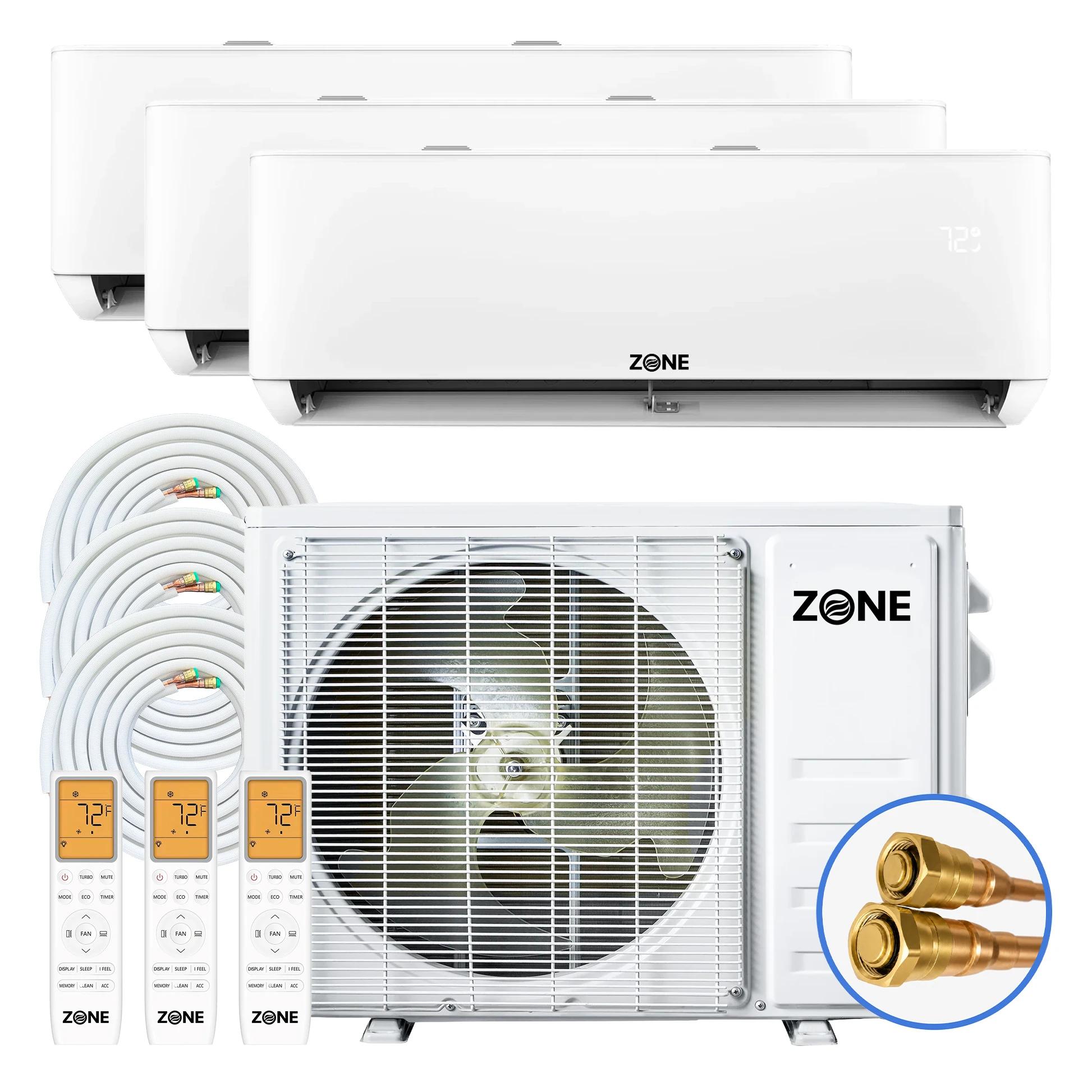
Zone Air™ DIY 3 ZONE 27,000 BTU (9K+9K+9K) 24 SEER2 230V Wall Mount Ductless Mini-Split Heat Pump System - Up to 1,350 Sq Ft
Zone Air™ DIY 3 ZONE 30,000 BTU (9K+9K+12K) 24 SEER2 230V Wall Mount Ductless Mini-Split Heat Pump System - Up to 1,500 Sq Ft
Zone Air™ DIY 3 ZONE 33,000 BTU (9K+12K+12K) 24 SEER2 230V Wall Mount Ductless Mini-Split Heat Pump System - Up to 1,650 Sq Ft
Zone Air™ DIY 3 ZONE 36,000 BTU (12K+12K+12K) 24 SEER2 230V Wall Mount Ductless Mini-Split Heat Pump System - Up to 1,800 Sq Ft
Zone Air™ DIY 3 ZONE 36,000 BTU (9K+9K+18K) 24 SEER2 230V Wall Mount Ductless Mini-Split Heat Pump System - Up to 1,800 Sq Ft
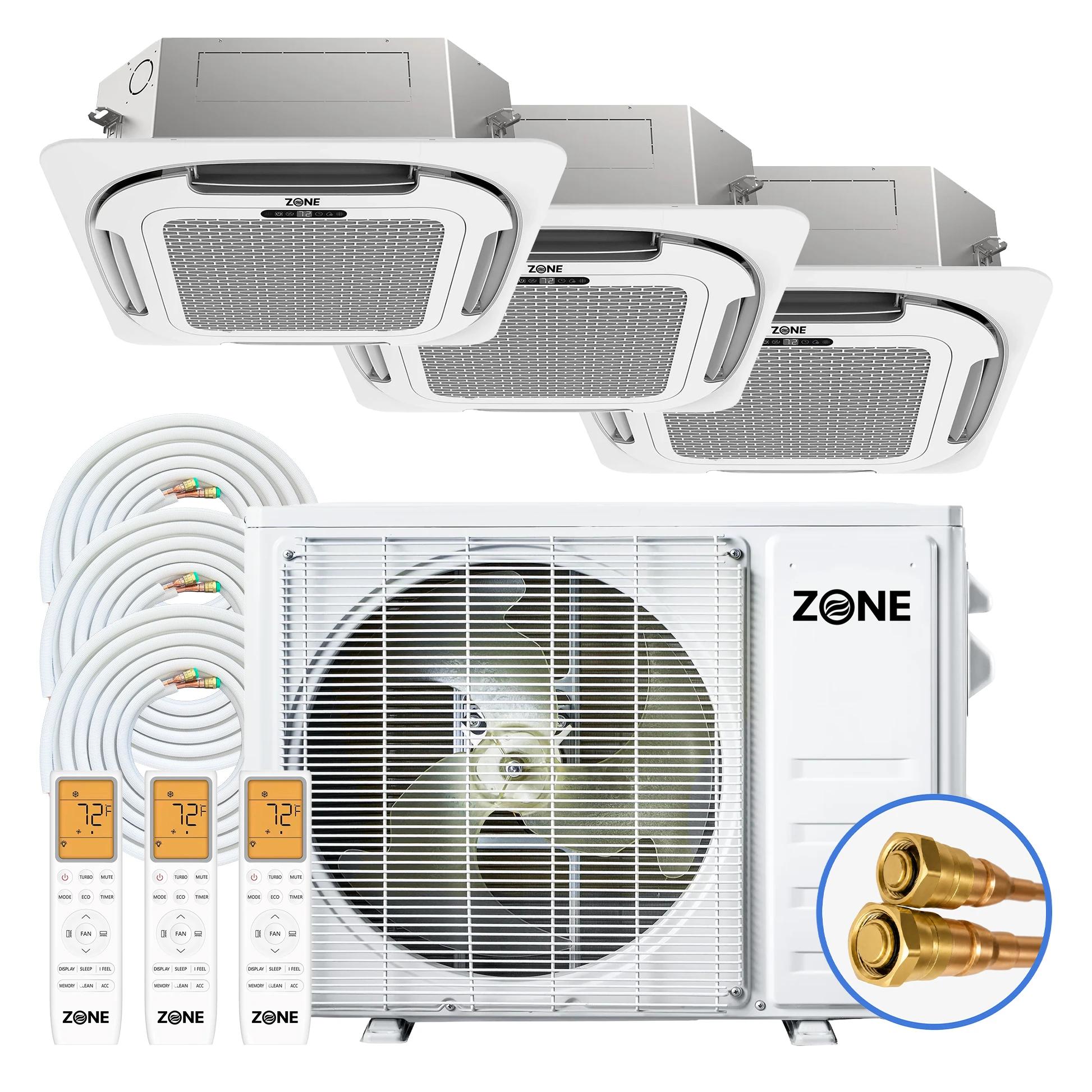
Zone Air™ Airframe 3 ZONE 36,000 BTU (12K+12K+12K) 24 SEER2 230V Ceiling Cassette Mini-Split Heat Pump System - Up to 1,800 Sq Ft
How a 3-zone system works
One outdoor condenser, three indoor heads, three line sets. Each head has its own remote and its own set point, so the primary bedroom can hold 68°F overnight while a guest room stays off and an office sits at 72°F during the workday. The compressor modulates to serve whatever combination of heads is calling at that moment.
This is the configuration that replaces central air in a house with no ductwork, or covers the three rooms a central system has never reached — the addition, the converted attic, the bonus room over the garage.
Matching heads to rooms
Total capacity is the number in the product name, but the head split is what determines whether the system actually works. A 27,000 BTU 3-zone system is three 9,000 BTU heads; a 36,000 BTU system might be three 12,000 BTU heads or a 9K+9K+18K arrangement. Those are very different systems for very different houses.
Size each of the three rooms at roughly 20 BTU per square foot, then find the configuration whose individual heads match. Three similar bedrooms take a matched set. A large living room plus two bedrooms wants an asymmetric configuration with the big head on the living space. Buying on total capacity alone is the most common way a 3-zone system ends up with one room that never gets comfortable.
Planning the install
Three zones means three line-set runs converging on one outdoor unit, so condenser placement matters more than it does on a single-zone install. Put it where the total run length across all three heads is reasonable, and where the noise and the airflow have somewhere to go.
Every zone needs its own pre-charged line set, purchased per zone in the length that run actually needs. All multi-zone systems require a dedicated 208-230V circuit — the 115V plug-in option does not extend to multi-zone. The install itself is still DIY: the refrigerant stays sealed in the line sets, so there is no vacuum pump and no EPA certification involved, just three heads instead of one.
What DIY Installers Say
As of 2026, the Zone Air 3-zone range holds an average rating of 5 out of 5 across 2 verified customer reviews spanning 6 systems.
I'm pretty handy and installed this myself (67 years old). Had no problem handling this myself. I only needed help moving the outdoor condenser around. Upstairs bedrooms were usually about five or six degrees warmer than downstairs. Now the grands can finally come stay over in the summer again.
on the Zone Air 3-zone mini split system →Three zone system in an older house. Easy enough.
on the Zone Air 3-zone mini split system →Three-room mini split FAQ
Can one mini split system cover 3 rooms?
Yes — that is exactly what a 3-zone system is. One outdoor condenser feeds three indoor heads, one per room, each with its own thermostat. What does not work is trying to serve three rooms from a single indoor head: conditioned air does not travel through doorways, so the room with the head gets cold and the other two do not.
What size 3-zone mini split do I need?
Size each of the three rooms at roughly 20 BTU per square foot, then pick the configuration whose individual head sizes match those rooms. Three 450 sq ft bedrooms suit a 27,000 BTU system (9K+9K+9K); a large living room with two bedrooms is better served by an asymmetric configuration such as 9K+9K+18K. Matching only the total capacity to the total square footage is how one room ends up permanently undersized.
Can each room be set to a different temperature?
Yes. Every indoor head on a multi-zone system has its own remote and its own set point, so one room can hold 68°F while another sits at 74°F or stays off entirely. That independence is the main reason to run a multi-zone system instead of trying to push air from one oversized head into an adjoining room.
Do all three rooms have to run at once?
No. Each head runs independently, and heads that are switched off simply do not draw from the system. The inverter compressor modulates its output to match however many zones are calling, so running one room costs meaningfully less than running all three. That ability to condition only the rooms in use is a large part of where the operating-cost savings over central air come from.
Is the line set included?
Single-zone wall mount systems ship with a 16 ft pre-charged line set in the box. Ceiling cassette systems, concealed ducted systems, and every multi-zone system are priced without the line set, which is bought per zone — from $229.99 for a 16 ft run, or $279.99 on the 18K line — so you only pay for the run lengths your layout actually needs. Longer runs are available at a length upcharge.
Can I add a fourth room later?
Not to an existing 3-zone condenser — the outdoor unit is built for a fixed number of zones, so a 3-zone system stays a 3-zone system. If a fourth space is likely within a few years, the options are to plan for it now or to add a separate single-zone system for that room later, which is often the cheaper path anyway.
Can I install this mini split myself?
Yes. Every Zone Air system ships with the refrigerant sealed inside a pre-charged quick-connect line set, so the refrigerant circuit is never opened during installation — no vacuum pump, no manifold gauges, and no EPA Section 608 certification. A single-zone install typically runs four to eight hours: mount the indoor head, set the outdoor condenser, route and hand-tighten the line set, run the condensate drain, and make the electrical connection. Check local building codes, and hire an electrician if the job needs a new circuit.
Will it still heat in the winter?
Yes. These are heat pumps, not air conditioners with a strip heater bolted on — the same system that cools in summer runs in reverse to heat in winter, and Zone Air systems are rated to keep producing heat down to -13°F. In a poorly insulated or unheated space the recovery time from cold is longer than in a finished room, so size for the heating load rather than the cooling load if winter is the harder season where you live.
What warranty comes with the system?
Zone Air systems carry a 5-year parts warranty and a 7-year compressor warranty, with live technical support if you get stuck partway through an install. Installing the system yourself does not void the warranty — the pre-charged line set is designed for exactly that.