
Mini Split for 750 Sq Ft
A 750 sq ft space needs about 15,000 BTU, which puts it on an 18,000 BTU system. The real decision is not the capacity — it is whether that capacity should arrive through one indoor head or two.
Systems for 750 sq ft
One 18,000 BTU head for open layouts, and 2-zone systems for the same square footage split across separate rooms.
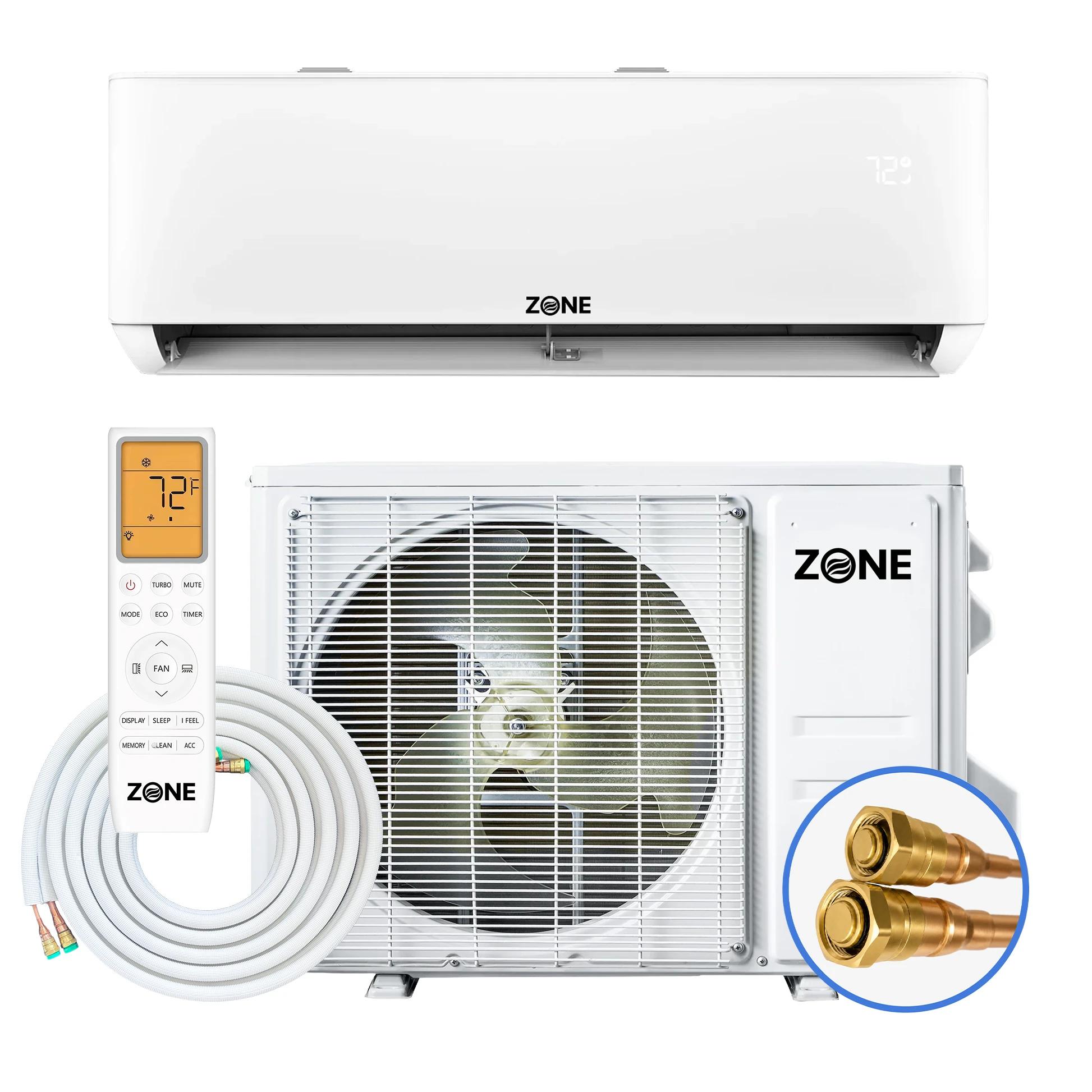
Zone Air™ DIY 18,000 BTU 23 SEER2 230V Wall Mount Ductless Mini-Split Heat Pump AC & Heater with Pre-Charged Lineset - Up to 900 Sq Ft
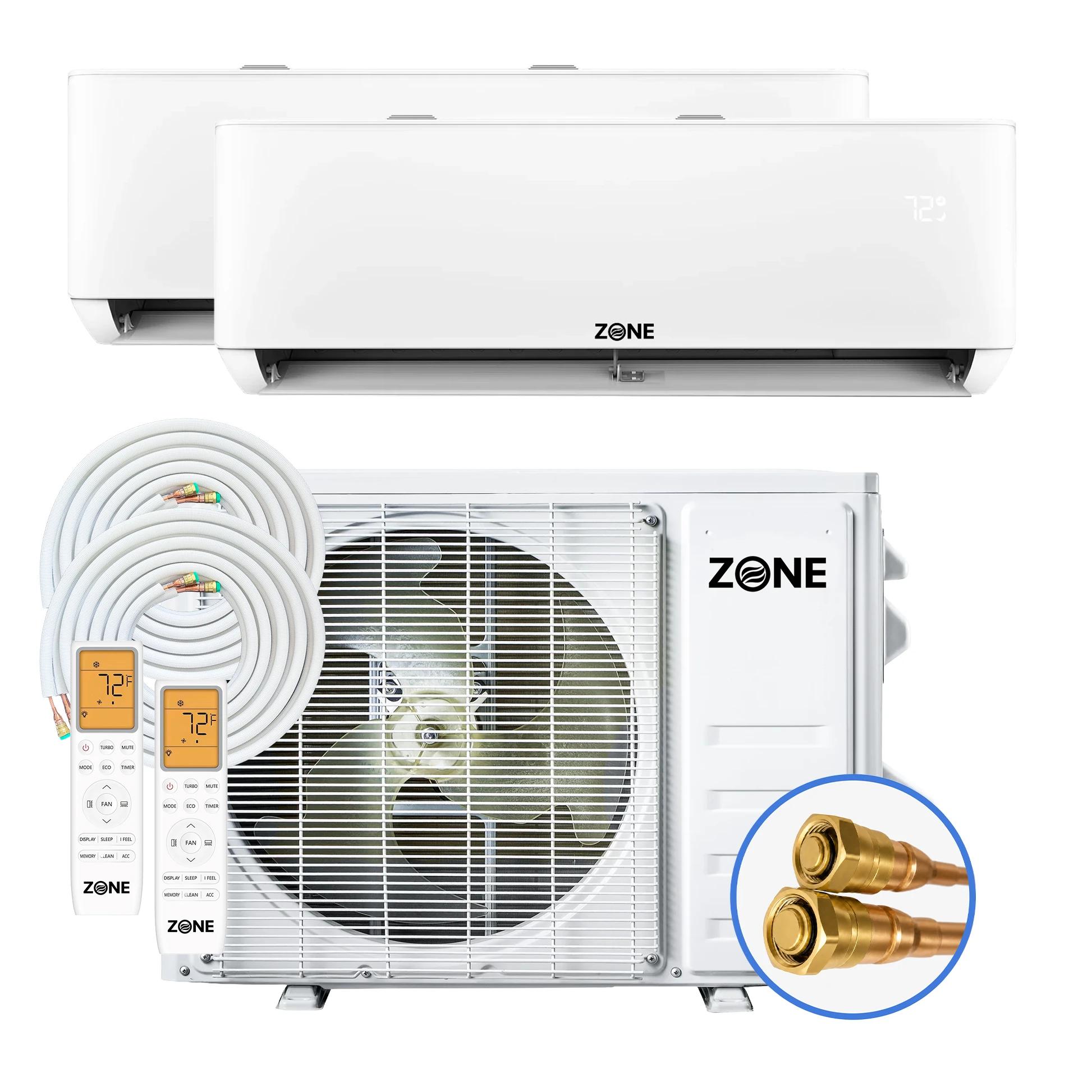
Zone Air™ DIY DUAL ZONE 18,000 BTU (9K+9K) 24 SEER2 230V Wall Mount Ductless Mini-Split Heat Pump System - Up to 900 Sq Ft
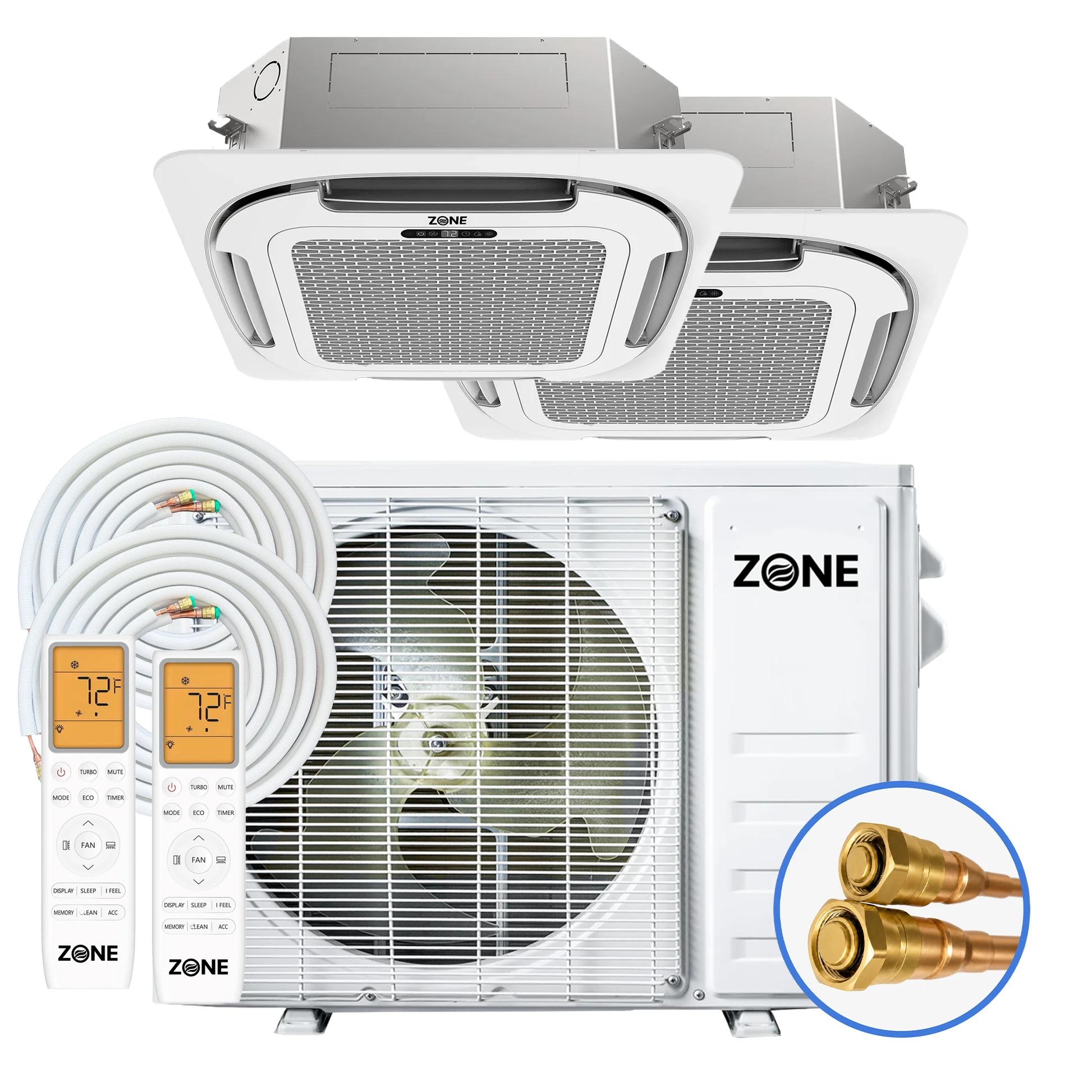
Zone Air™ Airframe DUAL ZONE 19,000 BTU (9.5K+9.5K) 21 SEER2 230V Ceiling Cassette Mini-Split Heat Pump System - Up to 950 Sq Ft
Zone Air™ DIY DUAL ZONE 21,000 BTU (12K+9K) 24 SEER2 230V Wall Mount Ductless Mini-Split Heat Pump System - Up to 1,050 Sq Ft
Zone Air™ Airframe DUAL ZONE 21,500 BTU (12K+9.5K) 21 SEER2 230V Ceiling Cassette Mini-Split Heat Pump System - Up to 1,075 Sq Ft
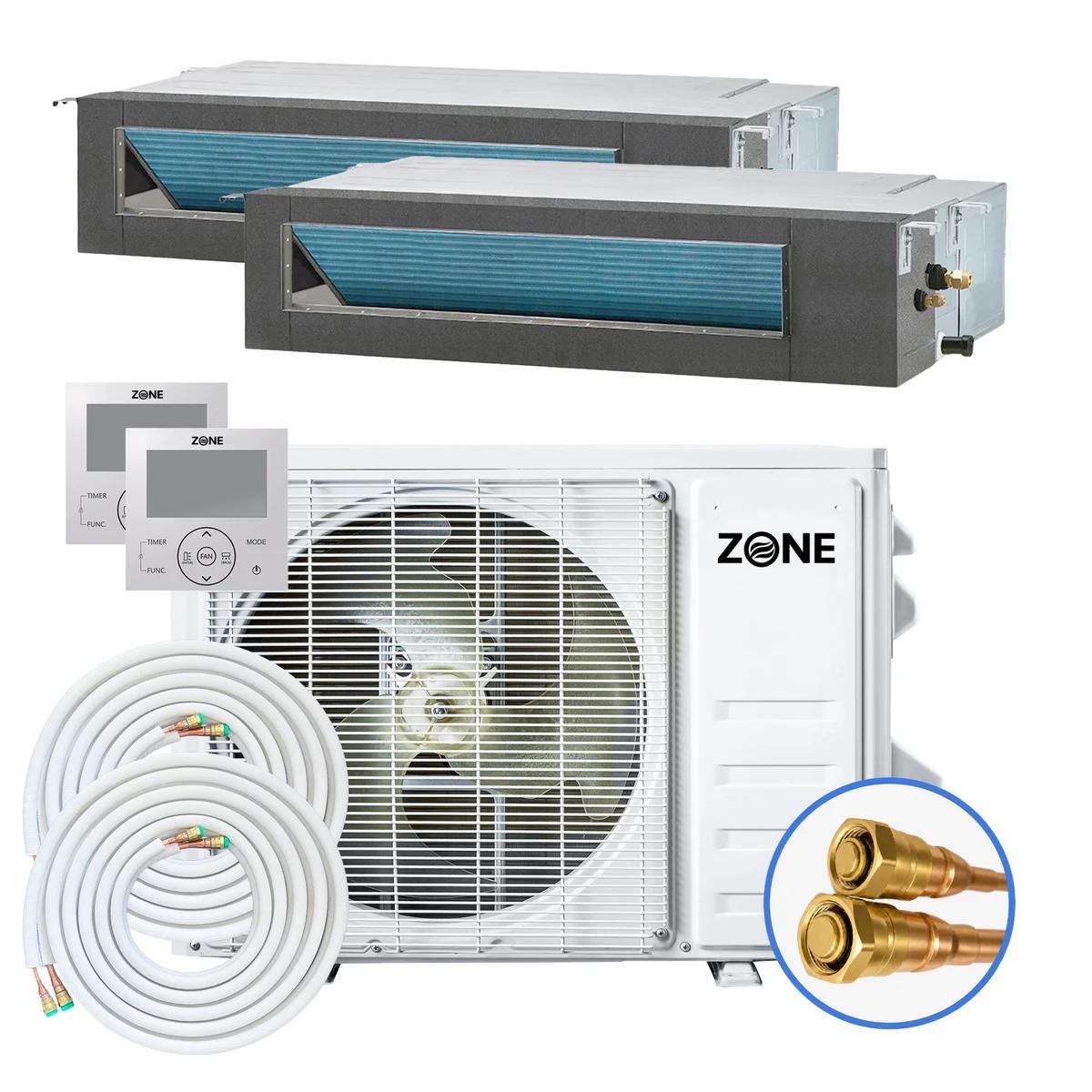
Zone Air™ Thin-Air DUAL ZONE 22,000 BTU (11K+11K) 19 SEER2 230V Concealed Mini-Split Heat Pump System - Up to 1,100 Sq Ft
What size mini split for 750 sq ft?
At 20 BTU per square foot, 750 sq ft comes to about 15,000 BTU, and the standard size at that point is 18,000 BTU — rated to roughly 900 sq ft, which gives real margin for high ceilings, west-facing glass, or thin insulation. Because these systems are inverter-driven, that margin sits idle until the room asks for it rather than costing you efficiency.
A 12,000 BTU system covers around 600 sq ft and will run at full output for hours trying to hold 750, never quite catching up on the hottest and coldest days. This is the size range where undersizing is the more common mistake, not oversizing.
One head or two? The layout decides
A single 18,000 BTU head is the right answer when the 750 sq ft is genuinely open — a great room, a finished basement, an open-plan ADU, a studio. Air moves freely, one head reaches the whole volume, and you get the simplest, cheapest install with the fewest wall penetrations.
It is the wrong answer when the 750 sq ft is two or three closed rooms. Conditioned air does not travel through doorways well, so one oversized head leaves the room it is mounted in too cold while the rooms down the hall never get comfortable. A 2-zone system puts a smaller head in each space, running off one outdoor condenser, and each head has its own set point.
The rough test: if you can stand in the middle and see the whole space, use one head. If you cannot, use two.
What 750 sq ft usually looks like
This is a small home or a large apartment, a finished basement, a two-car garage conversion, an ADU or in-law suite, a large open shop, or the upstairs floor of a modest house. In a multi-storey install, remember that heat rises: an upstairs 750 sq ft floor typically needs more cooling capacity and less heating capacity than the same footprint on the ground floor.
What DIY Installers Say
As of 2026, the Zone Air 18,000 BTU and 2-zone range holds an average rating of 4.8 out of 5 across 33 verified customer reviews spanning 6 systems, with owners most often mentioning cooling performance, quiet operation, and easy installation.
I am glad I went with a DIY option. The install was manageable, and the room is finally comfortable.
on the Zone Air 2-zone ceiling cassette mini split →I installed this in my living room, and it has handled the space well. The room feels cooler and more comfortable.
on the Zone Air 18,000 BTU mini split →The final install came out looking cleaner than I expected. It works well and does not look out of place.
on the Zone Air 18,000 BTU mini split →The installation was straightforward, and the result was exactly what I hoped for. The space is finally comfortable.
on the Zone Air 18,000 BTU mini split →Read all 30 written reviews
For a system I could install myself, the performance has been excellent. It feels like a much more expensive setup than I expected.
on the Zone Air 2-zone ceiling cassette mini split →The parts felt good out of the box, and the install was easier than I expected. After getting it running, the room cooled down fast and stayed comfortable.
on the Zone Air 18,000 BTU mini split →I put this in a room that was always either too hot or too cold, and it honestly fixed the problem right away. It has been quiet, easy to use, and way better than the window unit I had before.
on the Zone Air 2-zone mini split system →We added a 1200 sq ft family room and didn't want to take our existing HVAC out of commission. This 18K unit was the perfect solution. Heating and cooling are both excellent. The smart sleep mode is great - gradually adjusts temperature overnight so we wake up comfortable every morning. Installation with a 208V connection was straightforward for our electrician.
on the Zone Air 18,000 BTU mini split →After researching extensively, I chose this unit for the 23.5 SEER2 rating and the cold climate certifications. Three months in and it's been flawless. The variable speed operation keeps temperatures rock solid without the on/off cycling of cheaper units. We got an Energy Star rebate from our utility that covered a good chunk of the installation. Highly recommend!
on the Zone Air 18,000 BTU mini split →I installed one unit in the master suite (bedroom, bathroom, closet) and another in the main living areas (living room, dining room, kitchen). The only stuff you can see are some small linear vents - and that's it. You'd never even guess there's a mini-split system back there. Each zone stays exactly the right temperature on its own.
on the Zone Air 2-zone concealed ducted mini split →We needed some new heating and cooling for our 1890s Victorian, but we wanted to keep the place looking historic. These units got installed in the attic with little ducts going to these tiny ceiling vents - and the original plaster and trim are completely untouched. It operates super quietly and handles our crazy New England winters like a breeze.
on the Zone Air 2-zone concealed ducted mini split →The indoor head is larger than I thought, glad we measured the wall first. So far, so good.
on the Zone Air 18,000 BTU mini split →I am really happy with how quickly it cools. I can feel the room changing within a short time after turning it on.
on the Zone Air 2-zone mini split system →It keeps the room comfortable throughout the day. I do not have to keep adjusting it constantly.
on the Zone Air 18,000 BTU mini split →So far, it has been very reliable. It starts quickly, cools well, and has not given me any problems.
on the Zone Air 18,000 BTU mini split →The controls are easy, and the unit seems efficient. I do not have to mess with it much once it is set.
on the Zone Air 18,000 BTU mini split →The quality has been better than I expected. It feels solid, runs smoothly, and has been reliable.
on the Zone Air 2-zone mini split system →I like how simple it is. It does what it is supposed to do without being complicated.
on the Zone Air 18,000 BTU mini split →It has been running great since I put it in. Cooling, heating, and everyday use have all been solid.
on the Zone Air 2-zone mini split system →My office was almost unusable in the afternoon before this. Now I can work in there all day without getting overheated.
on the Zone Air 2-zone mini split system →My basement used to feel chilly and uncomfortable. This helped make it feel like a real living space.
on the Zone Air 18,000 BTU mini split →The heating side has been very useful. It warms the room quickly and makes cold mornings a lot more comfortable.
on the Zone Air 2-zone mini split system →I honestly notice how quiet it is more than anything. It cools the room well without that constant background roar.
on the Zone Air 2-zone mini split system →I had a hard time keeping this room comfortable before. After putting this in, it finally feels like the rest of the house.
on the Zone Air 2-zone mini split system →It has plenty of power without being noisy. The room cools down quickly, but it does not sound like a big appliance running.
on the Zone Air 2-zone mini split system →So far, it has been very dependable. It runs quietly, keeps the temperature steady, and does not feel like it is using a ton of power.
on the Zone Air 18,000 BTU mini split →I added this to my workspace, and it made a huge difference. I can spend hours out there now without getting uncomfortable.
on the Zone Air 18,000 BTU mini split →I waited a bit before writing this because I wanted to see how it would hold up. So far, it has been reliable and definitely worth the money.
on the Zone Air 2-zone mini split system →The cooling is strong, but what really surprised me was the noise level. Most of the time I barely notice it running.
on the Zone Air 18,000 BTU mini split →Everything about this has been simple in a good way. It looks clean, cools well, and has been one of those purchases I’m glad I didn’t overthink.
on the Zone Air 2-zone mini split system →Mini split for 750 sq ft FAQ
What size mini split do I need for 750 sq ft?
About 15,000 BTU on paper, which in practice means an 18,000 BTU system — the next size up, rated to roughly 900 sq ft. That margin covers ceiling height, sun exposure, and insulation quality, all of which the square-footage rule ignores. If the 750 sq ft is divided into separate rooms rather than open, a 2-zone system of the same total capacity is the better configuration.
Can one 18,000 BTU mini split cool a whole 750 sq ft house?
It can if the floor plan is open. A single indoor head conditions the air around it and relies on that air circulating, which works well in a great room or open studio and poorly through closed doors. In a 750 sq ft house with two bedrooms and a door on each, a single head will hold the main room comfortable while the bedrooms lag several degrees behind. That is the case for a 2-zone system.
Can each room be set to a different temperature?
Yes. Every indoor head on a multi-zone system has its own remote and its own set point, so one room can hold 68°F while another sits at 74°F or stays off entirely. That independence is the main reason to run a multi-zone system instead of trying to push air from one oversized head into an adjoining room.
Do I need a 240V circuit, or will a regular outlet work?
It depends on the size. Zone Air 9,000 and 12,000 BTU systems come in a 115V version that runs on a standard household outlet and a 15A single-pole breaker, so many installs need no new service at all. The 18,000 BTU system and every multi-zone system require 208-230V. If the space already has a 240V circuit for a dryer, welder, or shop tool, the harder half of the electrical work is done.
Can I install this mini split myself?
Yes. Every Zone Air system ships with the refrigerant sealed inside a pre-charged quick-connect line set, so the refrigerant circuit is never opened during installation — no vacuum pump, no manifold gauges, and no EPA Section 608 certification. A single-zone install typically runs four to eight hours: mount the indoor head, set the outdoor condenser, route and hand-tighten the line set, run the condensate drain, and make the electrical connection. Check local building codes, and hire an electrician if the job needs a new circuit.
Is the line set included?
Single-zone wall mount systems ship with a 16 ft pre-charged line set in the box. Ceiling cassette systems, concealed ducted systems, and every multi-zone system are priced without the line set, which is bought per zone — from $229.99 for a 16 ft run, or $279.99 on the 18K line — so you only pay for the run lengths your layout actually needs. Longer runs are available at a length upcharge.
Will it still heat in the winter?
Yes. These are heat pumps, not air conditioners with a strip heater bolted on — the same system that cools in summer runs in reverse to heat in winter, and Zone Air systems are rated to keep producing heat down to -13°F. In a poorly insulated or unheated space the recovery time from cold is longer than in a finished room, so size for the heating load rather than the cooling load if winter is the harder season where you live.
What warranty comes with the system?
Zone Air systems carry a 5-year parts warranty and a 7-year compressor warranty, with live technical support if you get stuck partway through an install. Installing the system yourself does not void the warranty — the pre-charged line set is designed for exactly that.